
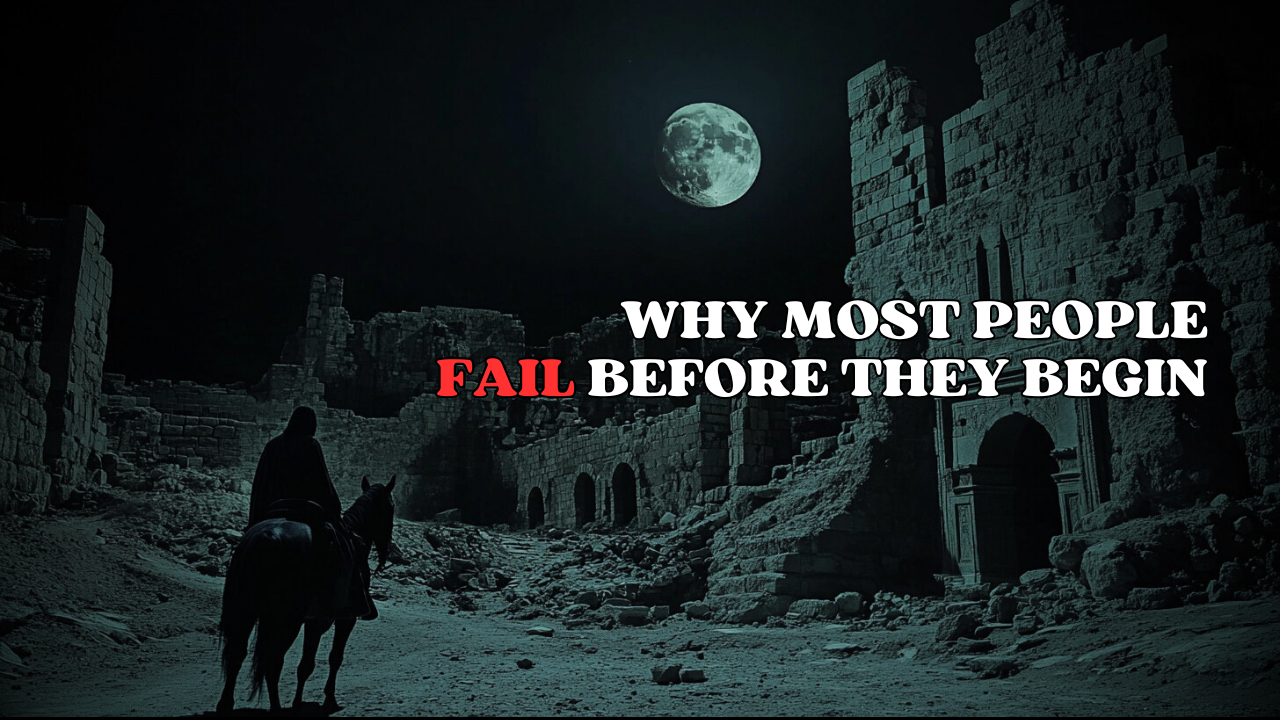
Why Most People Fail Before They Even Begin
Not because they lack talent.
Not because they don’t have resources.
Not because they aren’t trying hard enough.
They fail because they misread the moment.
Not because they lack talent.
Not because they don’t have resources.
Not because they aren’t trying hard enough.
They fail because they misread the moment.
They mistake movement for progress.
Noise for strategy.
Excitement for execution.
They charge in, ready to build, lead, and conquer—without first seeing what’s actually in front of them. And then they wonder why the walls crumble.
But Nehemiah? He played a different game.
He didn’t show up swinging hammers and barking orders. He didn’t rally the troops before he understood the battlefield.
Instead, he did something counterintuitive. He waited. He watched. He walked the ruins in silence.
“So I went to Jerusalem and was there three days. Then I arose in the night, I and a few men with me. And I told no one what my God had put into my heart to do for Jerusalem.” (Nehemiah 2:11-12)
Before you build anything—your business, your ministry, your life—there’s a crucial step most people skip.
You have to see it before you speak it.
Because the wrong words at the wrong time?
They don’t just slow you down. They sabotage the entire thing before it even begins.

The Key to Fruitfulness
Last week, the Lord spoke to me and said, "There is a faithfulness that will unlock a fruitfulness."
This word resonated with me, and I knew it was a call for the body of Christ to press in, to remain steadfast, and to trust the process He has ordained.
We live in an age where instant gratification is the norm. People want results without process, fruit without root, transformation without endurance. But in the Kingdom of God, things do not operate this way. There is a process of pressing in, of remaining faithful even when we do not yet see the fruit, and this is where breakthrough is born.

Last week, the Lord spoke to me and said, "There is a faithfulness that will unlock a fruitfulness."
This word resonated with me, and I knew it was a call for the body of Christ to press in, to remain steadfast, and to trust the process He has ordained.
We live in an age where instant gratification is the norm. People want results without process, fruit without root, transformation without endurance. But in the Kingdom of God, things do not operate this way. There is a process of pressing in, of remaining faithful even when we do not yet see the fruit, and this is where breakthrough is born.
The Nature of Grafting
The Lord gave me a picture of a branch and a vine. A branch cannot bear fruit on its own; it must be grafted into the vine, receiving life and sustenance from it. And how does a branch become grafted? It must be pressed tightly against the vine until the two become one. The fibers must intertwine, the wounds must heal together, and in time, the branch is no longer separate but fully integrated.
However, it is important to understand that this is not a word about salvation. This is not about being "grafted in" like the Gentiles were grafted into the promises of God (Romans 11:17-24). Salvation is surely a grafted-in process, but it is something Jesus has already done. We receive its benefits by grace through faith in Christ (Ephesians 2:8-9). What this word is speaking to is the process of staying firmly in place—remaining steadfast, long-lasting, patient, and immovable—until strength is released, until the nature of the situation changes, and even until your own identity and perspective are transformed.
This is not just about pressing into the Vine as Christ. It is a metaphor for being deeply rooted, for staying in one place long enough for roots to go down, for fruitfulness to emerge, and for endurance to produce maturity (James 1:3-4).
Many people move from place to place, from calling to calling, and from commitment to commitment, never remaining planted long enough to see the harvest.
The Call to Remain: Bob Jones’ Prophetic Word
Bob Jones once shared a powerful prophetic word: "There are too many tumbleweeds in the body of Christ. If you want fruits, you have to put down roots."
"There are too many tumbleweeds in the body of Christ. If you want fruits, you have to put down roots."
- Bob Jones
A tumbleweed is carried by every wind, never staying in one place, never maturing, and never producing fruit. But a tree that is planted by streams of water (Psalm 1:3) will bear fruit in its season. The Lord is calling His people to root themselves in Him, in their assignments, in their communities, and in His promises. This is the key to seeing real, lasting fruit.
Faithfulness is not passive—it is active perseverance. The Lord is calling His people to remain, to press in, and to trust that the season of fruitfulness is coming. Do not give up because you do not yet see the results. His promise is sure. His word will not return void.
The enemy would love for you to disengage, to become weary in well-doing, but the Lord says, "Stay. Keep pressing. Keep believing." What He has spoken will come to pass.
A Prophetic Invitation
This is the invitation: press into the Lord as never before. The fruit will come, but the process must be honored. Do not despise the season of grafting. Do not grow weary in the waiting. The Lord is doing a deep work, and the harvest will be abundant.
The time is now. Faithfulness will unlock fruitfulness. Stay pressed against the Vine, and watch as His life begins to flow through you in a way you have never experienced before.
Be encouraged. The Lord is faithful, and He will complete the work He has begun in you.

Delayed, Not Denied: The Purpose Behind God’s Timing
We inhabit a world obsessed with immediacy. Everything—our careers, relationships, even our spirituality—demands instant gratification. If we’re not moving, we assume we’re stagnating. But this is a false presupposition, an illusion constructed by an impatient culture. The truth is that God does not adhere to human timelines. He is not rushed. He is not pressured. And, as hard as it may be to accept, He is never late.
Nehemiah understood this. He had a vision—a burden, a calling. He saw the broken walls of Jerusalem and longed to rebuild. Yet, for months, he remained still. He waited. He prayed. He resisted the urge to act prematurely. And because of that, when the moment of opportunity came, he was ready.

We inhabit a world obsessed with immediacy. Everything—our careers, relationships, even our spirituality—demands instant gratification. If we’re not moving, we assume we’re stagnating. But this is a false presupposition, an illusion constructed by an impatient culture. The truth is that God does not adhere to human timelines. He is not rushed. He is not pressured. And, as hard as it may be to accept, He is never late.
Nehemiah understood this. He had a vision—a burden, a calling. He saw the broken walls of Jerusalem and longed to rebuild. Yet, for months, he remained still. He waited. He prayed. He resisted the urge to act prematurely. And because of that, when the moment of opportunity came, he was ready.
Modern people struggle with this idea. We are told to “seize the moment,” to “act now before it’s too late.” But Nehemiah’s story teaches us a radical counterpoint: waiting is not passivity. Waiting is preparation.
So, what happens when we trust in God’s timeline? Nehemiah 2:1-8 offers three crucial lessons.
1. While We Are Waiting, We Can Be Maturing
The passage opens with what seems to be an innocuous statement:
"In the month of Nisan, in the twentieth year of King Artaxerxes, when wine was before him, I took up the wine and gave it to the king." (Nehemiah 2:1)
At first glance, it appears trivial. But the weight of this statement is staggering. Four months had passed since Nehemiah first heard the devastating news of Jerusalem’s ruins (Nehemiah 1:1). For four long months, he carried this burden—yet he did not rush ahead. He did not abandon his post. He did not force the issue. He waited.
And herein lies the first lesson: The right thing at the wrong time can become the wrong thing.
We see this principle throughout scripture. Moses had a vision to liberate Israel, but his impatience led him to kill an Egyptian, forcing him into forty years of exile. Why? Because his character had not yet caught up with his calling.
Many of us carry a deep sense of purpose. We are pregnant with potential. But if we attempt to give birth to something before its time, the result can be catastrophic. A premature birth is always fragile—sometimes fatal. If we step into our calling too soon, we may find that the very thing meant to bless us becomes a burden we cannot bear.
So, if you find yourself waiting, do not fight it. Do not resent it. Understand that God is using this season to forge something in you that cannot be developed any other way.
2. While We Are Waiting, We Can Be Preparing
When Nehemiah’s moment finally came, he was prepared:
"And the king said to me, 'Why is your face sad, seeing you are not sick? This is nothing but sadness of the heart.' Then I was very much afraid. I said to the king, 'Let the king live forever! Why should not my face be sad, when the city, the place of my fathers' graves, lies in ruins, and its gates have been destroyed by fire?' Then the king said to me, 'What are you requesting?' So I prayed to the God of heaven." (Nehemiah 2:2-4)
Notice that Nehemiah does not hesitate. He does not fumble over his words. The king asks, “What do you want?” and Nehemiah is ready with an answer. Why? Because he had spent his waiting season preparing.
Too often, people mistake waiting for passivity. But waiting on God does not mean doing nothing—it means doing the right things in the right season.
Nehemiah prayed – He spent four months in intercession, seeking God’s wisdom.
Nehemiah planned – When the opportunity arose, he already knew what he needed: timber, travel letters, authority.
Nehemiah positioned himself well – He remained faithful in his role, gaining trust with the king.
Many people are waiting for an opportunity, but if it arrived today, they would be unprepared. They want God to open a door, but they have not prepared for what lies on the other side.
David was anointed as king but spent years tending sheep. Joseph had a dream of leadership but spent years managing a prison before stepping into power. If God has not released you yet, it may be because He is still preparing you.
3. While We Are Waiting, We Can Allow God to Work Behind the Scenes
One of the most striking aspects of Nehemiah’s story is that while he waited, God was working behind the scenes.
"And the king said to me (the queen sitting beside him), 'How long will you be gone, and when will you return?' So it pleased the king to send me when I had given him a time. And I said to the king, 'If it pleases the king, let letters be given me to the governors of the province Beyond the River, that they may let me pass through until I come to Judah, and a letter to Asaph, the keeper of the king's forest, that he may give me timber…' And the king granted me what I asked, for the good hand of my God was upon me." (Nehemiah 2:6-8)
Nehemiah received more than permission—he received provision. God had softened the king’s heart before Nehemiah even asked. Historians suggest that this took place during a Persian feast when kings were inclined to show generosity. Some believe it may have even been the king’s birthday, a time when favors were traditionally granted.
In other words, God orchestrated the perfect moment.
Had Nehemiah spoken earlier, he may have been denied. Had he waited longer, the opportunity may have passed. But because he trusted God’s timing, everything aligned as it needed to.
Some of you feel like nothing is happening. But just because you cannot see God moving does not mean He is not working. While you wait, God is aligning the right people, the right opportunities, and the right circumstances.
Trust the Timeline
So, what does it mean to trust God’s timeline?
You wait, and in the waiting, you mature. God develops your character so that you can carry the vision without collapsing under it.
You wait, and in the waiting, you prepare. You refine your skills, your plan, and your mindset so that when the opportunity arrives, you are ready.
You wait, and in the waiting, God moves. He orchestrates events in ways that you could never manufacture on your own.
If you are frustrated in your waiting season, resist the urge to force the process. Trust that His timing is perfect. Nehemiah waited, and when the moment came, he was ready. His preparation met God’s opportunity, and everything shifted.
If you feel stuck right now, stop fighting the timeline. Let God mature you. Let Him prepare you. Let Him work behind the scenes.
Because when the time is right, nothing will be able to stop what He is about to do in your life.

Prophecy Is A Weapon Needed For Battle
The prophetic is not a mystical lottery; it is a sword. When you receive a word from God, you are not merely given information—you are handed ammunition. The Word of the Lord is meant to be wielded, spoken, and acted upon with courage and discipline. It is not something to be shelved like a trophy; it is a directive for war.

“This charge I commit to you, son Timothy, according to the prophecies previously made concerning you, that by them you may wage the good warfare,”
- 1 Timothy 1:18
In an era where skepticism and deconstruction are celebrated as intellectual virtues, the church faces a crisis of authority. The prophetic voice—the divine articulation of God's truth—has been undermined by manipulation, misapplication, and sheer neglect. We have treated prophecy as a trinket, a sentimental relic, rather than what it is meant to be: a weapon. And, if we are to stand firm in the face of cultural decay, we must recover its power.
The Nature of Prophecy
Many believers treat prophecy as a fortune cookie—pleasant, disposable, and optional. They want a word from God, but only if it aligns with their preconceived desires. They chase after prophets like oracles, dispensing divine dictation to those too timid to seek God themselves. But this is an abdication of responsibility.
The prophetic is not a mystical lottery; it is a sword. When you receive a word from God, you are not merely given information—you are handed ammunition. The Word of the Lord is meant to be wielded, spoken, and acted upon with courage and discipline. It is not something to be shelved like a trophy; it is a directive for war.
Warriors vs. Spectators
Consider this: If the prophetic is merely a comforting message, why does the Apostle Paul tell Timothy to recall the prophecies spoken over him to fight the battle well? (1 Tim. 1:18). The answer is straightforward—because prophecy, when properly stewarded, grants the soldier his battle orders. Without it, he is wandering, reactionary, and vulnerable.
It is no coincidence that Christ is depicted with a sword proceeding from his mouth in Revelation. His authority is not wielded through sheer force but through the spoken Word, through truth declared with precision. If that is the model set before us, how should we approach our prophetic words? Should they not be wielded with the same intentionality, sharpness, and holy ferocity?
The Crisis of Despising Prophecy
Today, many in the church, scandalized by false prophets and charlatans, have thrown the baby out with the bathwater. The moment a prophetic word fails to materialize according to their personal timeline, they cast off the entire concept of divine speech. This is intellectual laziness disguised as discernment. It is a failure to recognize that counterfeits only exist because something authentic is worth imitating.
Paul's admonition in 1 Thessalonians 5:20—"Do not despise prophecies"—was not an abstract encouragement. It was a direct command to a church tempted to reject the prophetic because of misuse and disorder. The same danger persists today. We are on the precipice of dismissing one of the most potent weapons in our arsenal simply because it has been mishandled by those unworthy of it.
The Shield and the Sword
The previous season—whether in your life or the life of the church—may have been one of defense. A year where the objective was simply to endure, to stand firm. That was the season of the shield, the year of holding the line against the relentless onslaught of doubt, despair, and demonic resistance.
But this season is different. This is the year of the sword, the year when the church must take ground rather than merely defend it. This is the year when believers must recognize that their prophetic words are not just nice ideas but weapons—sharpened for strategic engagement in the battle for culture, truth, and righteousness.
Activating the Prophetic Sword
So, how does one wield prophecy as a weapon?
Recall the Word – A forgotten prophecy is a useless prophecy. Write it down. Memorize it. Make it a living part of your spiritual arsenal.
Declare the Word – Speak it out. The sword is in the mouth. If you refuse to declare what God has spoken, you fight unarmed.
Align Your Life to the Word – A prophetic word is not an inevitability but an invitation. It requires action, discipline, and obedience. A soldier does not merely read his battle orders—he executes them.
Test the Word – Prophecy is not above scrutiny. Test it against scripture, confirm it with wise counsel, and ensure it aligns with the nature of God. But do not let the fear of deception lead to paralysis.
War with the Word – Use your prophetic word as a counterstrike when the enemy comes with discouragement, doubt, or distraction. "It is written!" should not just be the cry of Christ in the wilderness but the rallying cry of every believer armed with divine Revelation.
Time to Take Up Arms
There is a cultural, spiritual, and existential battle raging, and the church cannot afford to be unarmed. We must cease treating prophecy as mere sentimentality and begin wielding it with the weight it deserves. The enemy has no issue using words as weapons—he has been twisting and distorting truth since the beginning. The only question is whether we will do the same, not with distortion but divine clarity and courage.
The prophetic is not an accessory to the Christian life but a weapon. So take up your sword. Speak the word. Advance.

The Church, Scandals, and Righteous Anger
Recently, I came across a video of Dana White, the CEO of UFC, addressing one of his fighters, Bryce Mitchell, who had made some ignorant and outright ridiculous comments about Adolf Hitler. Dana White didn’t mince words. He didn’t sugarcoat or excuse it. He simply said, “Yeah, this is my guy. And what he said was stupid.”
Contrast that with what we see in the church when ministers fall into scandal. Where are the pastors, the leaders, standing up and saying, This is one of ours, and what they did was wrong? Instead, we see defensiveness, silence, and sometimes even enabling. And in that vacuum of accountability, the internet—specifically, independent YouTube creators and podcasters—has stepped in.

If we haven’t met yet, my name is Darren Stott. I pastor a church called Eden in the greater Seattle area. I want to address something heavy today—not to create more harm, speculation, or stir up pessimism against the church, but to help people navigate ministry scandals honestly, deeply, and righteously. Because if we’re not careful, disillusionment can lead to disengagement, and disengagement from the body of Christ can be dangerous.
Recently, I came across a video of Dana White, the CEO of UFC, addressing one of his fighters, Bryce Mitchell, who had made some ignorant and outright ridiculous comments about Adolf Hitler. Dana White didn’t mince words. He didn’t sugarcoat or excuse it. He simply said, “Yeah, this is my guy. And what he said was stupid.”
Contrast that with what we see in the church when ministers fall into scandal. Where are the pastors, the leaders, standing up and saying, This is one of ours, and what they did was wrong?
Instead, we see defensiveness, silence, and sometimes even enabling. And in that vacuum of accountability, the internet—specifically, independent YouTube creators and podcasters—has stepped in.
The Rise of New Media and the Church's Response
We live in a new media era. The traditional gatekeepers of information—major news networks, denominational structures, and official church statements—no longer control the narrative. Instead, independent content creators, some of whom have never stepped foot inside a seminary, are exposing issues within the church with a level of depth and detail that institutional bodies have either ignored or suppressed.
And while some see this as a negative development—an untrained army of young YouTubers monetizing scandal—the truth is more complex. Many of these people have been deeply wounded by the church. Their anger is not baseless. It is a response to real pain, real betrayal, real hypocrisy. And for those of us within the church, the question isn’t, How do we shut them down? The question is, How do we respond righteously?
The IHOP Scandal and the Pain of Betrayal
The recent investigative report on IHOP (International House of Prayer) and its founder, Mike Bickle, has brought to light a staggering number of allegations—over 200 testimonies of abuse, grooming, and manipulation. If you have a heart, even a fraction of these allegations should break it. If you have any sense of righteousness, it should stir a deep, holy anger.
The church is meant to be a place of refuge, a sanctuary of safety. Yet, when institutions that claim to center on Christ instead become places of secrecy, coercion, and harm, the world takes note. And rightly so.
We saw this with the Catholic Church decades ago. Now, the microscope is on our own charismatic, apostolic, and revivalist circles. And while the enemy seeks to weaponize these exposures to discredit the faith entirely, we cannot allow that to deter us from seeking truth.
Because here’s the reality: Jesus himself got angry. He flipped tables in the temple because the sacred was being exploited. That was righteous anger. And what we see today—the exposure of deep-seated corruption—is something that should stir a similar reaction in us.
Processing the Truth Without Losing Faith
Many people right now are walking through a crisis of faith. Some are turning away from the church entirely. Others are throwing out anything supernatural, prophetic, or charismatic, as though spiritual gifts themselves are the problem rather than the individuals who abused them.
I get it. I’ve been there. I was hurt in the church, and I let my brokenness turn into bitterness. I swore I would never go back. But let me tell you what I learned: Forgiveness is not about feeling ready. It is an act of faith. It is choosing to release judgment, even when you don’t feel like it. And when you do, it breaks the power of bitterness over your life.
So if you’ve been hurt by the church, by a pastor, by a leader—say it out loud: I forgive you. Not because they deserve it, but because you deserve freedom. Say it in faith, and trust that the feelings will follow.
God is Revealing to Heal
There’s a lot of talk right now about “exposure.” But I don’t believe God is merely exposing to shame. I believe He is revealing to heal. The devil accuses to destroy. God reveals to restore. And while some leaders will fall and never return to ministry, others will repent, be refined, and be entrusted again—not because of their power, but because of their humility.
A new breed of leaders is rising. And you will know them not by their charisma, but by their character. Not by their authority, but by the way they steward it. They will be those who walk with a limp—because they have wrestled with God, and they have come out different.
The Lord showed me that these will be leaders who do not build platforms for their own names but create altars for His presence. They will not chase influence, but they will steward intimacy with God. These are not men and women who will be blinded by their own ambition, but those who have been broken in secret places and have learned what it means to be fully dependent on the Lord. They have walked through betrayal, failure, loss, and hardship—not as a badge of honor, but as a refining fire that has burned away pride and left behind only what is pure.
They will not manipulate, coerce, or deceive to gain a following. Instead, their authority will be evident in their integrity. You will know them not because they declare themselves as apostles and prophets, but because their lives bear the weight of true apostolic and prophetic responsibility. Their leadership will be marked by service, their power will be tempered by humility, and their influence will not come from the stage but from the depths of their prayer closets.
These are the ones who walk with a limp, not because they are weak, but because they have contended with God and have surrendered. They do not lean on their own strength but on the One who has carried them through the fire. They are leaders who have been crushed but not destroyed, who have been humbled but not silenced, and who have found their greatest joy in obedience rather than in recognition.
The Church is Not Finished
The enemy would love for us to believe that the church is beyond redemption. That it is not a safe place. That we cannot trust anyone. But let me tell you: The church is not done.
Yes, it is being refined. Yes, there is judgment in the house of God. But don’t let cynicism win. Don’t let bitterness steal what is holy. This is not the time to disengage. It is the time to lean in, to intercede, to be a priesthood that stands in the gap for the broken.
So guard your faith. Don’t throw out Jesus because of Judas. Don’t abandon the gospel because of grifters. Stay engaged. Process righteously. Fight for truth. And above all, walk in love—even when that love is fierce, unyielding, and unwilling to tolerate evil in the house of God.
Grace and peace be unto you, in the name of our Lord Jesus Christ.

Break Free from the Cycle: Step into the Overcomer’s Throne
There’s an invitation from heaven right now—a call to break free from the cycle of falling and repenting, falling and repenting. Too many believers are stuck, constantly confessing but never overcoming. They receive forgiveness but never step into transformation. But I hear the Lord saying: This is the year of victory. This is the year to step into the Overcomer’s Throne.

There’s an invitation from heaven right now—a call to break free from the cycle of falling and repenting, falling and repenting. Too many believers are stuck, constantly confessing but never overcoming. They receive forgiveness but never step into transformation. But I hear the Lord saying: This is the year of victory. This is the year to step into the Overcomer’s Throne.
Hebrews 4:16 declares:
"Let us then approach the throne of grace with confidence, so that we may receive mercy and find grace to help us in our time of need."
The throne we are invited to isn’t just a throne of mercy—it’s a throne of grace. And that distinction matters.
The Problem: Why So Many Believers Stay Stuck
Here’s where many in the church have been misled. They think mercy and grace are the same. But they aren’t. Mercy forgives you, but grace empowers you. Mercy meets you in your failure, but grace gives you the strength to never return to it.
Without grace, you will keep running back to the same sins, the same patterns, the same struggles. That’s why so many people live in cycles of confession but never experience transformation. They’ve received mercy but never accessed grace.
But that changes today.
The Invitation: Come to the Overcomer’s Throne
The Lord spoke this to me so clearly:
"My throne of grace is the Overcomer’s Throne."
God is not just calling you to a place of forgiveness—He is calling you to a place of power. This is not the year to keep hiding. This is not the year to shrink back in shame, like Adam in the garden. This is the year to step forward, to come boldly before the throne, and to receive the supernatural grace to overcome.
At the Throne of Grace, you will find:
✔ Mercy to cover your past.
✔ Grace to empower your future.
This is where everything shifts.
Plug This Into Your Life Today
1️⃣ Stop Hiding. This is not the year to cover your sin—it’s the year to expose it to God and let His mercy wash over you.
2️⃣ Step Boldly Before His Throne. Stop waiting to “get yourself together.” You don’t need to clean yourself up before coming—He is calling you now.
3️⃣ Receive Grace to Overcome. Grace is more than forgiveness—it’s the power to walk in righteousness, the power to break addictions, the power to live in victory.
4️⃣ Embrace Transformation. You do not have permission to stay the same this year. You must grow, mature, and rise into everything God has called you to be.
This Is Your Year to Overcome
This is not the year to remain bound by the same sins, the same struggles, the same excuses. You are not who you were last year. You do not have to stay stuck. His grace is here, available, waiting for you to step in and receive everything you need to walk in victory.
I bless you with this:
✔ Confidence to come before His throne.
✔ Mercy to wash over you.
✔ Grace to empower you.
You are not called to live in cycles of failure. You are called to overcome.
Come boldly before the Overcomer’s Throne. Mercy is waiting for you, and so is the power to change.
In Jesus’ name.
🔥 If this word spoke to you, share it. People need to hear this today. 🔥
The Prayer That Shifts Everything
Not all prayer is created equal. Some prayers are effective, mobilizing action, bringing clarity, and catalyzing transformation. Others? They’re hollow, ineffective utterances that lack alignment with reality and responsibility. So, what’s the difference? What makes a prayer move mountains instead of simply echoing into the void?
Life is full of struggles—those moments when the weight of the world feels unbearable. You feel paralyzed, trapped by circumstances too big for you to handle. Yet, in the chaos, there exists a tool—often neglected, misunderstood, or improperly wielded—that has the potential to shift everything: prayer.
Not all prayer is created equal. Some prayers are effective, mobilizing action, bringing clarity, and catalyzing transformation. Others? They’re hollow, ineffective utterances that lack alignment with reality and responsibility. So, what’s the difference? What makes a prayer move mountains instead of simply echoing into the void?
The story of Nehemiah offers us a roadmap to transformative prayer. Let’s break it down.
Prayer That Acknowledges vs. Prayer That Avoids
When Nehemiah began to pray, he didn’t start with his problem. He didn’t jump into a list of things he needed or a litany of complaints. Instead, he began by acknowledging God’s greatness.
"O Lord God of heaven, the great and awesome God who keeps covenant and steadfast love," he prayed.
This wasn’t just a formula. Nehemiah wasn’t checking a box to make sure his prayer sounded right. He was reorienting his focus. The greatness of God wasn’t just something he believed intellectually—it was the lens through which he viewed everything else. He saw the ruins of Jerusalem, yes, but he also saw the God who was more than capable of rebuilding them.
There’s a lesson here. When you pray, the first thing you need to do is lift your eyes. Shift your focus from the size of your problem to the size of your God. Why? Because your perspective shapes your prayers. If you see God as small, your prayers will be small. If you see God as distant or indifferent, you won’t ask for much. But if you have a revelation of a big God—a God who is mighty, compassionate, and faithful—then your prayers will reflect that.
This is the year where big asks will lead to big rewards. But here’s the catch: You will not have big prayers unless you have a revelation of a big God.
Think about it. When a child trusts their parent, they ask boldly. They don’t hesitate to ask for what they need because they believe their parent will come through. That’s the kind of faith Nehemiah had. That’s the kind of faith we need.
The opposite is prayer that avoids this acknowledgment. It’s a prayer that magnifies the problem instead of God. This kind of prayer leads nowhere. It’s powerless because it’s disconnected from the foundation of reality—God Himself.
"This is the year where big asks will lead to big rewards. But a small view of God leads to small prayers, and small prayers lead to small results."
Prayer That Repents vs. Prayer That Excuses
Nehemiah’s prayer didn’t stop at worship. It wasn’t just about acknowledging who God is—it was also about confronting who he was. With bold honesty, Nehemiah confessed the sins of his people, his family, and even himself. “We have acted very corruptly against you,” he prayed. “Even I and my father’s house have sinned.”
This moment of repentance is powerful. Nehemiah could have shifted blame. He could have pointed fingers at the generations before him who made mistakes, or at the leaders who failed to protect Jerusalem. But he didn’t. He owned the problem. He stood in the gap, taking responsibility for what was broken.
How often do we resist admitting our own faults? How often do we shift the blame or make excuses? Yet, the kind of prayer that shifts everything requires honesty. It requires humility. It requires repentance.
Prayer that excuses or blame-shifts is powerless. It’s an evasion of responsibility, a refusal to confront reality. And when you evade reality, you forfeit the opportunity for transformation. Repentance, by contrast, opens the door for growth because it aligns you with what is true and invites the possibility of change.
"God doesn’t bless excuses—He blesses honesty. When you own what’s broken, God redeems it."
Repentance isn’t about wallowing in guilt; it’s about realigning yourself with God’s holiness. It’s about removing the barriers that keep His power from flowing freely into your life.
Prayer That Boldly Asks vs. Prayer That Fears
Finally, Nehemiah’s prayer was bold. After worshiping God and confessing sin, he didn’t hesitate to ask for something specific: “Give success to your servant today, and grant him mercy in the sight of this man.”
This wasn’t a vague request. It wasn’t timid or hesitant. Nehemiah knew exactly what he needed—favor with the king—and he wasn’t afraid to ask for it. His boldness wasn’t arrogance; it was rooted in his faith. He knew who God was, and he trusted that God could and would intervene.
Too often, our prayers lack this kind of boldness. We hesitate to ask God for big things because we’re afraid of being disappointed. We hold back because we feel unworthy or unsure. But prayer that shifts everything dares to ask big things of a big God.
"A weak request reveals a weak belief. But a bold prayer reveals bold faith."
What are you asking God for right now? Are your prayers timid or bold? Specific or vague? Grounded in faith, or weighed down by fear?
What Kind of Prayer Shifts Everything?
Nehemiah’s prayer teaches us that the kind of prayer that mobilizes and shifts circumstances must:
Acknowledge God’s greatness. Lift your eyes and focus on His power and character.
Take responsibility for what’s broken. Confront sin and align yourself with truth.
Ask boldly, grounded in faith. Make specific, faith-filled requests that reflect trust in His promises.
This kind of prayer isn’t about passivity or wishful thinking. It’s about aligning yourself with the truth of who God is, the reality of your situation, and the bold faith required to act.
When Nehemiah prayed, he didn’t stop with “amen.” He stood up, went to the king, and took the first step toward rebuilding the walls of Jerusalem. His prayer mobilized action because it aligned him with the God who moves heaven and earth.
If you want to see things shift in your life, start with the right kind of prayer. Lift your eyes. Own what’s broken. Ask boldly. Then stand up and take the next step, trusting that God will guide you.
"This is the year where big asks will lead to big rewards. Don’t settle for small prayers. Pray the kind of prayer that shifts everything."

The Cross-Shaped Revival: A Prophetic Word
The move is upon us—a revival that embodies the shape of the cross. It is both vertical and horizontal, drawing us closer to God while knitting us together with one another. In past revivals, there was often a focus on the vertical—individual encounters with God, personal transformation, and private devotion. While those moves of the Spirit were powerful and needed, this revival will look different. It will expand beyond individual experiences and flow outward, touching relationships, communities, and the world.

This word was inspired by a fascinating conversation I had today with Pastor Bonnie Chavda about the impact of revivalism and Pentecostalism in the 1960s and 70s.
We reflected on how those movements, while powerful, tended to be more individualistic in their encounter focus.
During our conversation, I felt the Lord speaking to me—not just about my own calling and assignments, but also about the broader direction of His next move. Bonnie was incredibly encouraging, offering wisdom and excitement about how I’m walking out my roles and assignments.
Yet, even as she spoke, the Lord continued to stir my spirit about how this next move of God will contrast with previous ones.
It will move beyond individual encounters to a revival that brings deep connection, unity, and restoration within the body of Christ, expressing both the vertical and horizontal dimensions of the cross.
•••
The move is upon us—a revival that embodies the shape of the cross. It is both vertical and horizontal, drawing us closer to God while knitting us together with one another. In past revivals, there was often a focus on the vertical—individual encounters with God, personal transformation, and private devotion. While those moves of the Spirit were powerful and needed, this revival will look different. It will expand beyond individual experiences and flow outward, touching relationships, communities, and the world.
This cross-shaped revival will restore the full picture of what Jesus intended: a people who love God deeply and love one another sacrificially. The vertical beam represents our connection with God, and the horizontal beam represents the restoration of relationships between people. This revival will not just transform hearts; it will heal families, unite churches, and bring reconciliation to communities.
The evidence of this move will be seen in how we serve one another. It will not be confined to sanctuaries or conferences but will invade dining rooms, workplaces, and city streets. We will see the glory of God in the breaking of bread together, in caring for the orphan and widow, in acts of generosity and humility.
As Jesus said, “By this everyone will know that you are My disciples, if you love one another” (John 13:35). This is the revival we are stepping into—a move where love is not just declared but demonstrated.
Acts 2:44-47 gives us a glimpse of what this could look like: “All the believers were together and had everything in common. They sold property and possessions to give to anyone who had need. Every day they continued to meet together in the temple courts. They broke bread in their homes and ate together with glad and sincere hearts, praising God and enjoying the favor of all the people. And the Lord added to their number daily those who were being saved.”
This is the shape of the revival: shared lives, shared resources, and shared encounters with God. It is no longer enough to pursue personal breakthrough while neglecting the needs around us.
The Spirit is moving through the unity of the Church, through connection, service, and sacrifice.
This move will carry the full weight of the cross—love for God and love for people.
Now is the time to step into it!!!