
The Power of Almost Nothing
In this article, Pastor Darren explains that transformation doesn’t start with certainty—it starts with willingness.
Using the image of a mustard seed, he shows that even the smallest step of faith is enough to shift your life. Faith isn’t about size, but direction. When you trust God, even a little, everything begins to change.
You don’t need more—you just need to start.
Even a mustard seed feels insignificant.
That’s the point.
We’ve been conditioned to believe that change requires scale—more certainty, more proof, more clarity before we move. But transformation rarely begins with certainty. It begins with willingness.
A mustard seed of faith isn’t impressive. It’s not loud. It doesn’t demand attention. It simply shows up—small, quiet, almost dismissible.
And yet, it’s enough.
Because faith doesn’t work by size. It works by direction.
When you place even the smallest amount of trust in something greater than yourself, you interrupt the pattern of control. You loosen your grip on needing to know everything before taking the next step.
That’s where things begin to shift.
Not all at once. Not dramatically. But undeniably.
A small act of faith becomes a new lens. A new lens becomes a new decision. A new decision becomes a new life.
The seed doesn’t look like much.
But given the right soil, it changes everything.
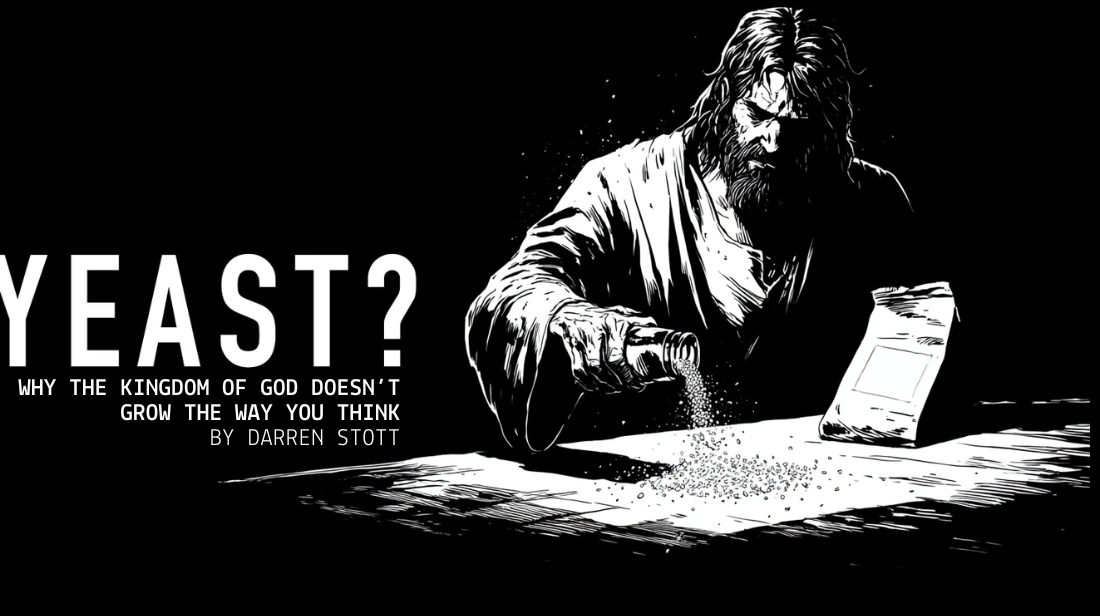
The Kingdom of Heaven Is Like Leaven?
What spreads quietly often lasts the longest.
That’s how the Kingdom works.
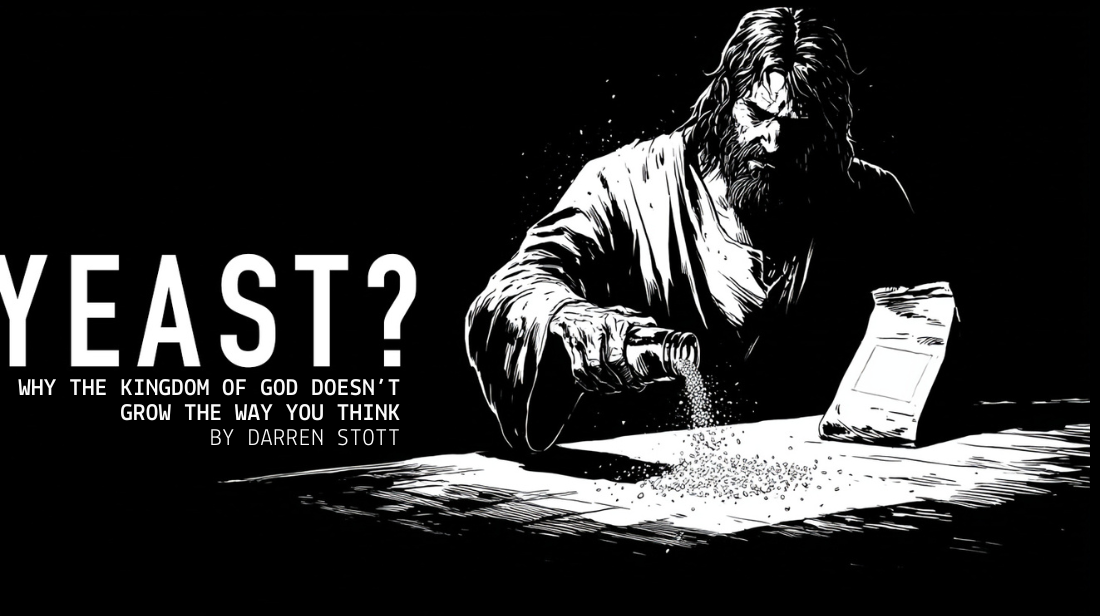
“Another parable spake he unto them; The kingdom of heaven is like unto leaven, which a woman took, and hid in three measures of meal, till it was all leavened.” - Matthew 13:33
“The Kingdom of Heaven Is Like Leaven.” - Jesus
Wait!! Isn’t Leaven Evil?
That’s the flinch.
That moment your brain hits the brakes.
Because leaven has a reputation.
It sneaks in.
It spreads.
It changes things quietly.
And most of the time in Scripture, it’s a warning label.
So why would Jesus reach for that metaphor?
Because leaven isn’t evil.
It’s effective.
Leaven doesn’t announce itself.
It doesn’t ask permission.
It doesn’t build a platform or start a movement.
It just works.
A little disappears into the dough,
and then—inevitably—
the whole loaf is different.
That’s why leaven is dangerous when sin is involved.
Not because it’s loud,
but because it’s subtle.
And that’s exactly why Jesus uses it for the Kingdom.
The Kingdom of Heaven doesn’t crash the gates.
It doesn’t dominate the skyline.
It doesn’t shout for attention.
It infiltrates.
It embeds.
It changes the system from the inside.
Leaven doesn’t replace the dough.
It transforms it.
Same mechanism.
Different master.
Which raises an uncomfortable question for the Church:
If the Kingdom really works like leaven,
why are we so obsessed with being seen instead of being felt?
Why do we keep building mountains
when Jesus described yeast?
The Kingdom doesn’t win by isolation.
It wins by influence.
Quietly.
Relentlessly.
Until everything rises.
Sometimes the Kingdom of God is big, bold, and unmistakably visible—
Jesus shows us this.
But other times, the Kingdom is nearly invisible.
Subtle.
Hidden.
And just as powerful.
Just as effective.

Understanding Soul Spirit Hurts & Demonic Oppression
We are the most trauma-aware generation in history — and somehow the most spiritually tormented.
We have language for everything now. Trauma, triggers, attachment wounds, emotional dysregulation, nervous system dysrhythmia, trauma-bonding, shadow work. We’ve created an emotional dictionary that would impress Freud and bewilder Moses.
The Church is not well.
We are the most trauma-aware generation in history — and somehow the most spiritually tormented.
Isn’t that strange?
We have language for everything now. Trauma, triggers, attachment wounds, emotional dysregulation, nervous system dysrhythmia, trauma-bonding, shadow work. We’ve created an emotional dictionary that would impress Freud and bewilder Moses.
And yet — anxiety is up. Depression is rising. Trust is collapsing. Loneliness is epidemic. Self-harm among teens is skyrocketing. Marriages are dissolving. Friendships are thinning. Faith is fading behind a fog of exhaustion.
We are not well.
And the Christians aren’t doing much better. In fact, many believers feel like they’re drowning silently.
They love God.
They worship sincerely.
They pray earnestly.
But spiritually?
Emotionally?
They’re numb.
They’re tired.
They’re stuck in cycles they can’t explain or escape.
If emotional vocabulary could save the soul, we’d be the healthiest saints who ever lived. Instead, we are medicated, exhausted, overwhelmed, and spiritually compromised.
Why?
Because trauma isn’t just overwhelming pain from the past.
Trauma — when unhealed — becomes architecture.
It builds something.
A structure.
A legal opening.
A spiritual doorway.
And the enemy loves doorways.
We Don’t Have a Mental Health Crisis. We Have a Soul Crisis.
People say:
“I’m hurting emotionally.”
But look beneath that surface and you find:
Spiritual numbness
Suspicion toward God
Prayer fatigue
Trust collapse
Hope erosion
A constant sense of threat or abandonment
This isn’t just psychology.
This is spiritual biology.
Yes, humans have emotions — but the Bible says we also have souls.
And the soul can be:
Broken (Psalm 34:18)
“The LORD is near to the brokenhearted and saves those who are crushed in spirit.”
Crushed (Psalm 51:17)
“A broken and contrite heart, O God, You will not despise.”
Wounded (Psalm 147:3)
“He heals the brokenhearted and binds up their wounds.”
Cast down (Psalm 42:5)
“Why are you cast down, O my soul, and why are you in turmoil within me?”
Fragmented (Ezekiel 34:16)
“I will seek the lost, bring back the strayed, bind up the injured, and strengthen the weak…”
(speaks of God restoring the scattered, shattered, and broken parts of His people)
Tormented (Lamentations 3:17–19)
“My soul is bereft of peace… my soul continually remembers it and is bowed down within me.”
Scripture isn’t polite about this. It stares trauma in the face and names it.
Meanwhile, culture glamorizes trauma as identity, and the church often treats trauma like a bad mood.
So believers limp along, inwardly bleeding, outwardly smiling, doing their best to worship through internal shrapnel.
But here’s the truth most people never hear:
You can't worship your way out of a lie that lives in your soul.
You can be saved and still be stuck.
Not because you don't love God — but because you're injured.
How Trauma Becomes a Door
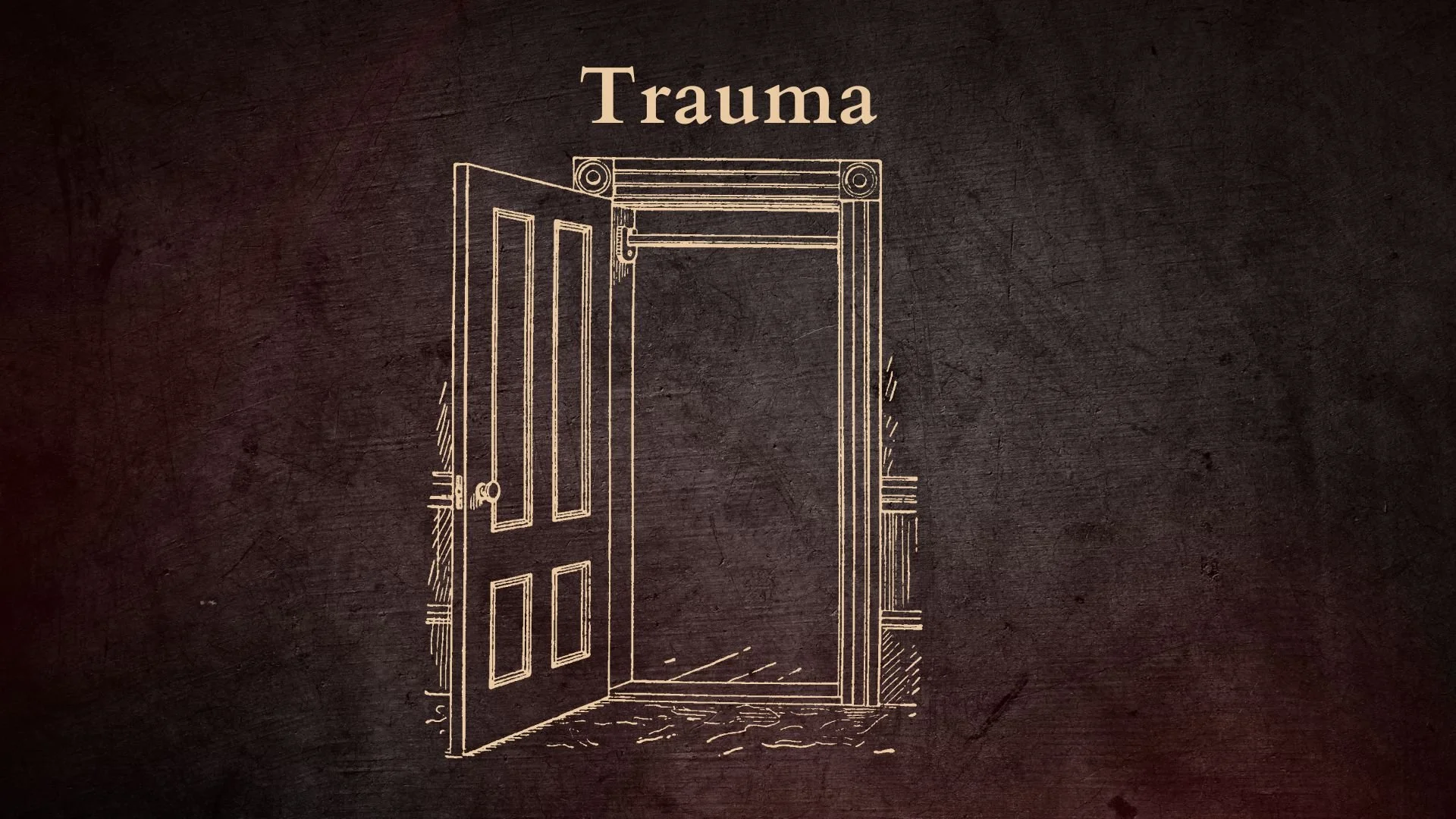
Trauma happens.
And for a moment, everything freezes.
But here’s the part no one talks about:
The doorway isn't built during the trauma.
It's built afterward. Quietly. Piece by piece.
Like a spiritual IKEA project, assembled without instructions but with devastating precision.
It starts with the trauma — the moment something broke. That becomes the top beam of the frame. Then comes the unhealed wound — the lingering ache we never really processed or resolved. That takes its place as the left post, holding the structure steady. Now comes the crucial moment: a lie enters — whispered at the point of maximum vulnerability…
“You’re alone.”
“You’re not safe.”
“You don’t matter.”
“God didn’t show up for you.”
“You’re unlovable.”
That lie becomes the right post — the supporting beam. And once you believe it, agreement forms — like a hinge. That hinge swings open the moment you emotionally nod along. Then coping mechanisms arrive — the doorknob — the habits we think are protecting us but that actually become re-entry points for bondage. And then, quietly, like a thief slipping through the night, the intruder steps in: fear, shame, despair, rejection, torment, heaviness — not invited, but legally permitted.
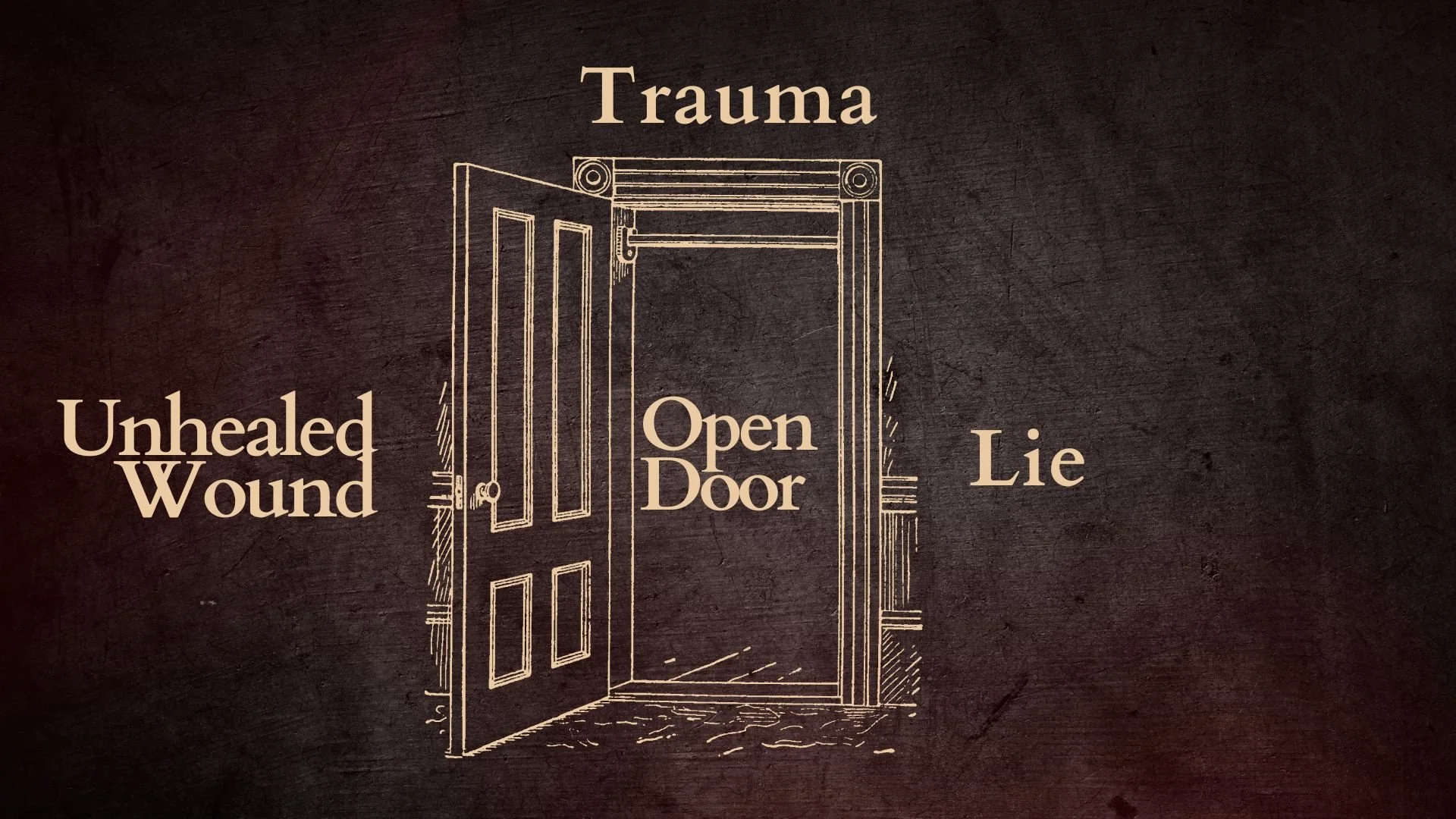
No one intends to build a spiritual doorway.
But unresolved pain, embraced lies, and survival habits become the raw materials.
Time passes. Life moves on.
And suddenly, there it is — a door you never meant to construct, opened to something God never invited in.
Why So Many Believers Feel Spiritually “Blocked”
Modern Christian advice often sounds like:
“Just pray about it.”
“Praise through it.”
“Try harder.”
“Trust God.”
And those things matter — deeply.
But here's the catch:
You can’t cast out what has legal right,
and you can’t praise away what has permission to stay.
You don’t have a faith problem.
You have a wound problem.
And wounds don’t heal through striving — they heal through truth.
How The Devil Uses Pain To Train
Satan doesn’t simply wound you.
He teaches you through the wound.
Trauma becomes his classroom.
And pain becomes a megaphone.
Right after the impact, while your soul is raw, he feeds you doctrine:
“You’re abandoned.”
“You’re unsafe.”
“You’re unseen.”
“You’re worthless.”
“Love hurts.”
“God protects everyone else.”
“You’re damaged.”
And you don’t say it out loud, but a part of your soul whispers,
“…maybe that’s true.”
That is the agreement.
That is the hinge.
That is the moment the door creaks open.
The enemy does not need rebellion —
just cooperation with a lie.
Five Real Doorway Blueprints
1. Abandonment
Trauma: A parent leaves, emotionally or physically.
Wound: Rejection.
Lie: “No one will ever stay.”
Agreement: “I must protect myself.”
Doorway: Self-isolation, mistrust.
Spirit: Rejection, fear, loneliness.
They don’t fear commitment —
they fear devastation.
2. Betrayal
Trauma: Someone you trusted violated you.
Wound: Shattered trust.
Lie: “I can only rely on myself.”
Agreement: “Never trust fully again.”
Doorway: Control, emotional shutdown.
Spirit: Suspicion, fear, jealousy.
They call it discernment —
but it’s actually fear with Bible verses.
3. Humiliation / Shame
Trauma: Mocked, belittled, bullied.
Wound: Identity rupture.
Lie: “I’m not enough.”
Agreement: “I must hide my real self.”
Doorway: People-pleasing, self-rejection.
Spirit: Shame, insecurity, self-loathing.
They don’t lack confidence —
they lack safety.
4. Sudden Loss
Trauma: Unexpected grief or abandonment by circumstance.
Wound: Despair, heartbreak.
Lie: “God didn’t show up.”
Agreement: “I can’t trust God with my heart again.”
Doorway: Withdrawing from faith.
Spirit: Heaviness, hopelessness.
They don’t doubt God exists —
they doubt His care.
5. Sexual Violation
Trauma: Abuse, betrayal of innocence, unwanted exposure.
Wound: Soul defilement.
Lie: “I am dirty.”
Agreement: “I have no worth.”
Doorway: Self-hate, secret shame, compulsion.
Spirit: Lust, torment, confusion.
They don’t struggle with purity —
they struggle with violation.
Why the Church Often Misses It
Because we preach forgiveness without inner healing.
Deliverance without soul repair.
Holiness without emotional restoration.
But Jesus didn’t come just to save you.
He came to heal your soul and then set you free.
Heal the brokenhearted → proclaim liberty
(Luke 4:18)
Not the other way around.
You don’t free captives by yelling at chains —
you heal the heart that forged them.
Healing Doesn’t Mean Pretending It Didn’t Hurt
Healing means:
You remember without bleeding
You feel without drowning
You trust without terror
You love without bracing for abandonment
You rest without fear
You worship with an open heart again
Healing isn’t forgetting.
It's removing the power, authority, and influence of the wound.
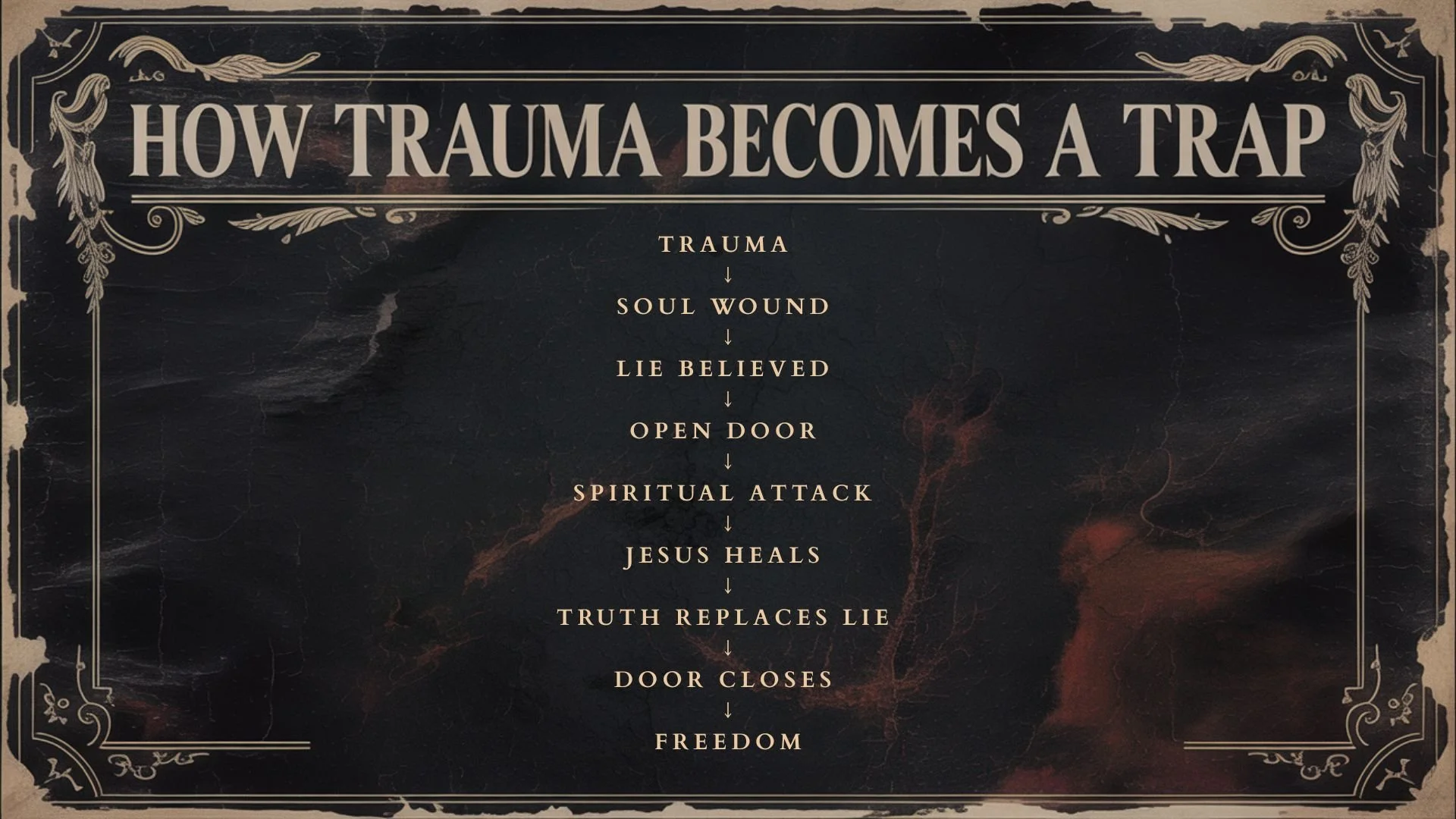
The Door-Closing Prayer
(Intentionally unchanged — this is the legal language that shuts doors.)
Lord Jesus, I come before You…
(full inner-healing prayer as provided)
Pray it slowly.
Name the wound. ___________________________
Break agreement with the lie.
Close the door.
Invite the Spirit of Truth to fill the now-vacated space.
Mercy rebuilds.
Truth seals.
Freedom enters.
This is how you heal a soul.
You're Not Weak — You're Wounded
You don’t need shame.
You don't need to “try harder.”
You don’t need to fake being fine.
You need healing — and Jesus heals deeply.
The enemy hoped your trauma would become a tomb.
Instead, it’s becoming your testimony.
You are not broken beyond repair.
You are being rebuilt by the One who restores souls.
Trauma doesn’t get the last word —
Jesus does.
And He calls you whole.

Debugging the Soul: Understanding Generational Curses
We all inherit things we didn’t choose.
A way of reacting. A fear that doesn’t make sense. A story that seems to replay itself in every generation.
You can feel it sometimes — in the way your temper mirrors your father’s, or how your mother’s anxiety hums quietly in your own chest.
We call it personality.
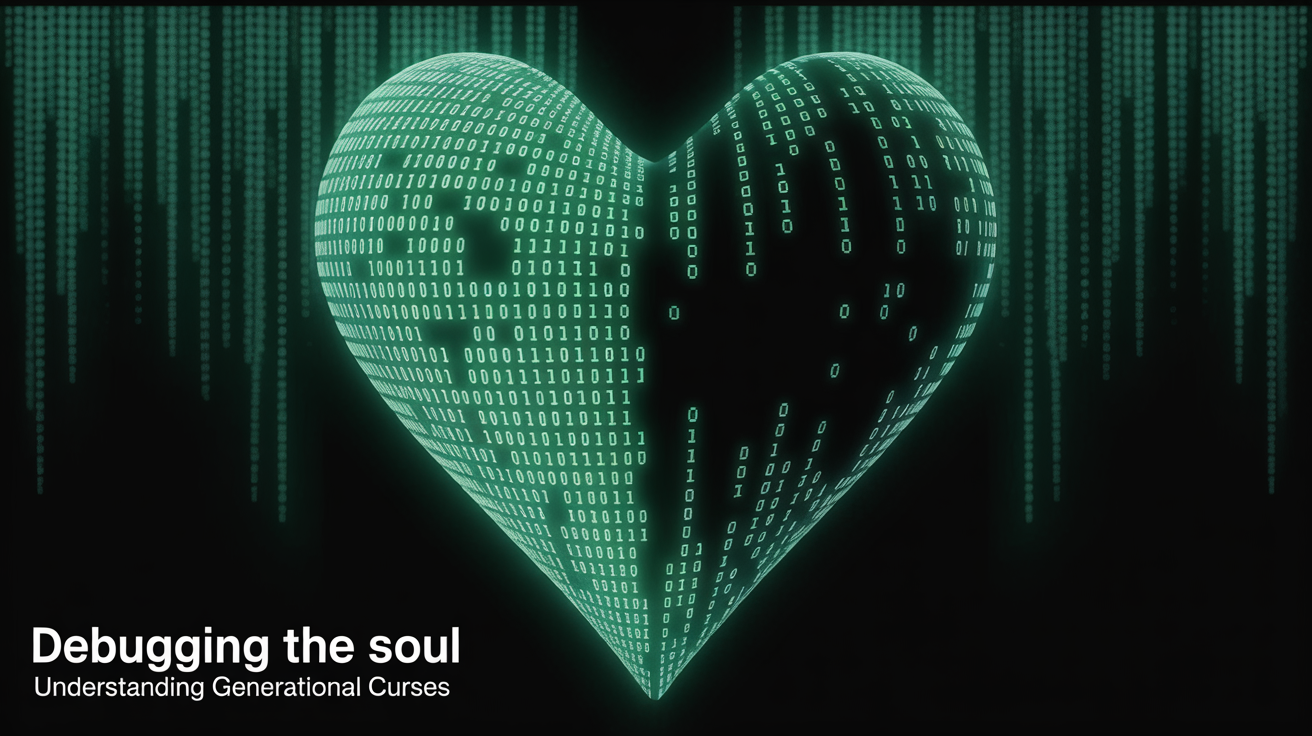
But what if it’s code?
We all inherit things we didn’t choose.
A way of reacting. A fear that doesn’t make sense. A story that seems to replay itself in every generation.
You can feel it sometimes — in the way your temper mirrors your father’s, or how your mother’s anxiety hums quietly in your own chest.
We call it personality.
But what if it’s code?
What if every human carries an operating system written by generations before us — lines of belief, fear, and desire that keep running in the background until someone decides to rewrite them?
That’s what Scripture calls a curse. Not a superstition, but a system bug — an inherited malfunction that keeps repeating itself until grace steps in to debug the soul.
You can see it in cultures too—repeating loops of greed, division, and decay. Nothing new under the sun, just old code running again on new hardware.
Creation runs on divine architecture—a spiritual operating system—then generational curses are what happen when the system gets breached. Not because of superstition or fate, but because of code that was written wrong and never corrected.
A generational curse isn’t a ghost haunting your family tree. It’s legacy software—a repeating script that keeps running because no one ever went in to comment it out.
Think of it like this: a curse is a malicious process authorized to run in a family’s operating system because someone—an ancestor, a parent, even you—clicked “agree” on the wrong terms of service. It gains access through sin, through the violation of divine law, and continues executing across generations until the original permission is revoked.
A curse is a bug in the code, and bugs never fix themselves.
To understand this, we have to start with the code itself. The Bible calls it “the law,” but that word—torah—means instruction, design, blueprint.
The law of God isn’t a rulebook; it’s the architecture of existence. It’s the source code that governs both Heaven and Earth. “Forever, O Lord, your word is settled in heaven.” Translation: the code is stable. The system works.
Creation itself runs on binary: light and darkness, life and death, blessing and curse, obedience and rebellion. The logic gates of existence. One and zero. When the code aligns with its Designer, everything hums. When it doesn’t, corruption spreads. This is what Deuteronomy 28 describes—not random punishments, but the built-in consequences of disobedience. When you honor the design, you prosper. When you don’t, the system collapses.
The first recorded system breach happened in Eden. We often describe the Fall as a relational failure—Adam and Eve disobeyed, and intimacy was lost. But beneath the heartbreak was something more technical: a legal rupture. God entrusted Adam with dominion—a kind of administrative authority over creation. He wasn’t just tending a garden; he was managing a network. He didn’t have a written law, but he had divine instruction embedded in him. Dominion was sustained through alignment.
When Adam disobeyed, he didn’t merely offend God’s heart; he triggered a breach. The firewall went down. The system was exposed. Humanity’s moral and spiritual DNA—our source code—became open to corruption.
And where there’s vulnerability, there’s exploitation. Lucifer didn’t seize creation by brute force; he logged in with Adam’s stolen credentials. He didn’t own the earth, but he gained control of its systems. He became, as Jesus called him, “the prince of this world,” not because he was enthroned, but because the true administrator abandoned his post.
From that point forward, two systems began running in parallel: the Kingdom of Light, still stable, still secure; and a counterfeit network built on stolen authority—the System of Darkness. Paul called it “the mystery of lawlessness.” Not chaos, but an elegant counterfeit, a rival legal order running corrupted code.
Lucifer The Hacker
Lucifer has always been a hacker, not a creator. He can’t write original code; he can only copy and corrupt what already exists. His strategy is accusation, not creation. He’s not just the tempter; he’s the prosecutor. The “accuser of the brethren” isn’t shouting insults—he’s submitting legal claims based on unpatched vulnerabilities in the human code.
Every unconfessed sin, every unhealed wound, every unresolved agreement with darkness becomes a data point he uses to sustain his access. The real battle isn’t fought with swords or slogans—it’s fought in the court of law and the lines of code.
Humanity’s original role was priestly—to bridge Heaven and Earth, to keep the systems synchronized. We were designed as the API between divine and created realms. But when the priesthood fell, the sync broke. Earth’s operating system desynchronized from Heaven’s. That’s why disease, decay, and death exist—they’re not part of the original design; they’re evidence of desync.
Redemption, then, isn’t escape—it’s restoration. Christ came not as a revolutionary, but as a programmer. The Second Adam logged back in sinless, authorized, and fully aligned. He fulfilled every legal requirement of the code and reestablished human access. He didn’t bypass the law; He fulfilled it from within. Because you can’t hack your way into holiness. You have to satisfy the system.
The Cross was more than a spiritual symbol—it was a system-wide update. When Jesus said, “It is finished,” it wasn’t a cry of exhaustion. It was a deployment notice. The patch was complete. The corrupted build was terminated. A new version of humanity went live.
Colossians says He “canceled the record of debt that stood against us, nailing it to the cross.” That wasn’t metaphor—it was a legal announcement. Every recursive loop of sin, shame, and death was closed. Every access point sealed. Every generational exploit patched.
Communion was never meant to just be a religious ritual. It is the symbolic installation of the new system. “This is my body, broken for you. This is my blood, shed for you.” The old covenantal code—bound by sin and death—was deprecated. A new covenant—powered by grace—was uploaded!
Grace isn’t the absence of law; it’s law fulfilled and rewritten inside us. Romans 8 calls it “the law of the Spirit of life in Christ Jesus,” meaning a higher algorithm now supersedes the corrupted one. The same code, but rewritten in love.
Generational Curses
So where does that leave the idea of generational curses? Think of them as legacy code—scripts that were written generations ago, still running quietly in the background. You didn’t write them, but you’re still executing them. The insecurity, the addiction, the self-sabotage—they’re not random; they’re echoes of inherited code.
It may or may not be your fault. But it is your responsibility to debug it.
Confession is the act of opening the console and viewing the errors. Repentance is deleting the malicious lines. Faith is installing the patch. And the blood of Jesus is the security certificate that authorizes the change.
You don’t need to throw out the whole system; you just need to rewrite the corrupted parts.
Most people try to fix their lives by adding features—new habits, new apps, new affirmations. But that’s surface-level. The real bugs hide in the kernel—in the way you process shame, fear, power, or belonging. The only way to fix a system that’s broken at the root is to reinstall it.
This is what Jesus did. He didn’t just save souls; He restored the source. He didn’t erase the law; He encoded it into the human spirit. The Holy Spirit is now the compiler—translating the code of Christ into human syntax.
Grace runs natively now.
The New Creation Operation System
When Paul said we are “a new creation,” he wasn’t speaking in metaphor. He meant it literally: a new kind of human software now exists. The old operating system has been replaced.
The difference between a person living under a curse and one living under blessing isn’t moral superiority—it’s code alignment. One runs on fear and self-reliance. The other runs on love and obedience. One constantly crashes; the other hums in harmony.
And if you’ve ever wondered why certain patterns keep showing up in your life—why you keep reliving the same conflict, falling into the same relational script, repeating the same fears—it might not be about willpower. It might be about programming.
You’re not broken. You’re running old code.
But here’s the beauty: Jesus paid for your update.
The system doesn’t need to be replaced—it’s already been redeemed. You just have to download what’s already been written for you.
Every time you forgive, you’re rewriting code.
Every time you worship, you’re syncing to the Source.
Every time you love your enemies, you’re running Heaven’s software in real time.
Faith is not superstition—it’s alignment. It’s trusting that the Architect knew what He was doing when He wrote the system. It’s agreeing that His logic still works.
And once you begin to live from that perspective, sin stops feeling like failure. It starts looking like malfunction. Repentance stops feeling like punishment. It starts looking like optimization. Holiness stops feeling like control. It starts looking like stability.
That’s what the gospel really is: not a moral code, but a system update. Not a demand for perfection, but an invitation to restoration.
When Jesus rose from the dead, He didn’t just defeat death—He deployed resurrection life. Paul called Him “the firstfruits,” the prototype of a restored human system—bug-free, death-proof, fully synchronized with Heaven. And now that same Spirit runs in us.
Every believer is a participant in the restoration project of creation. We’re not waiting for Heaven to download; we’re the servers through which it’s being streamed into the world.
Every healed heart is a patch. Every act of forgiveness, a bug fix. Every miracle, a system restore.
Adam opened the loop. Christ closed it. And now, the system is stable again.
If you find yourself repeating the same old patterns, maybe it’s time to ask: is this really me, or is it legacy code still running in the background?
Maybe what your soul needs isn’t another app, another plan, or another promise.
Maybe it just needs a reboot.
Because the patch has already been written.
You just have to install it.
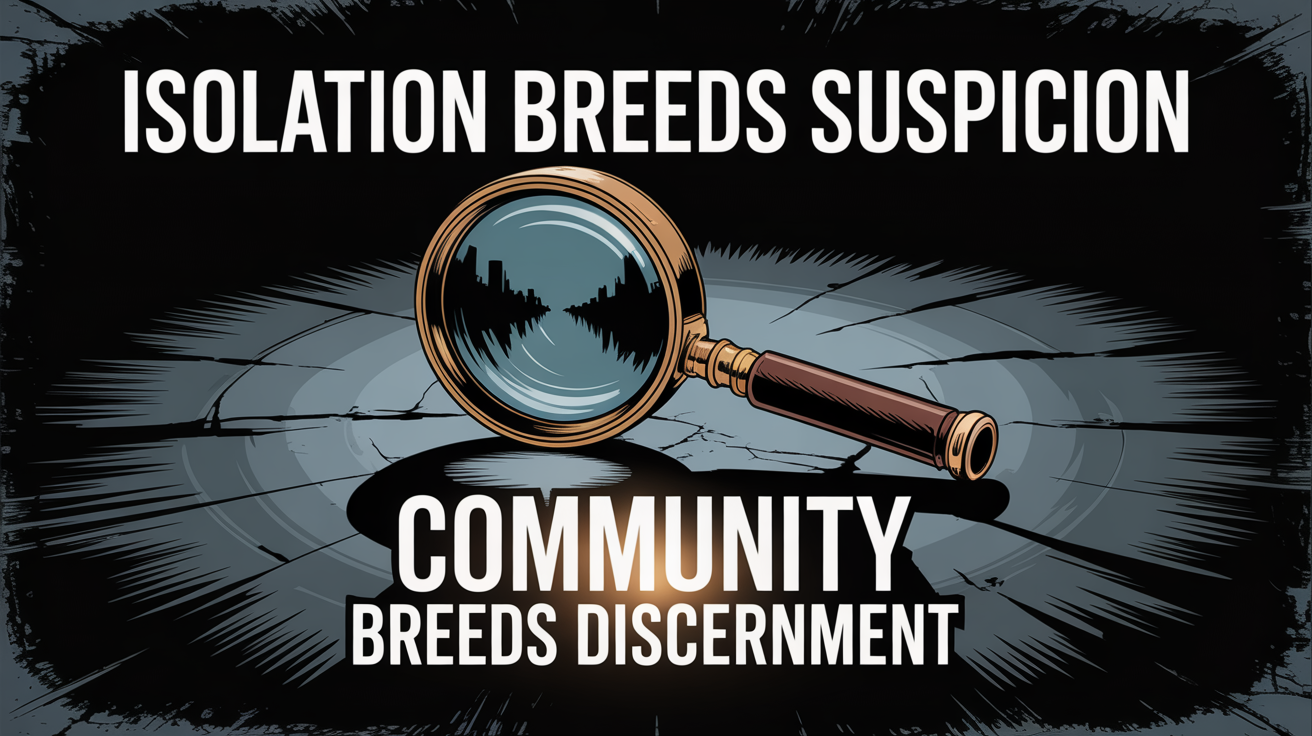
Isolation Breeds Suspicion
Suspicion grows best in the dark.
When we’re hurt, when trust is fractured, when trauma has left its fingerprint on our souls, the temptation is to retreat. To circle the wagons. To pull back from people because people were the problem.
Isolation doesn’t just keep us “safe.” It breeds suspicion.
Suspicion whispers, “You can’t trust them. They’re out to get you. Better watch your back.” And soon, suspicion metastasizes into paranoia. Paranoia convinces us we’re discerning when, in fact, we’re simply afraid.
But the Bible tells a different story.
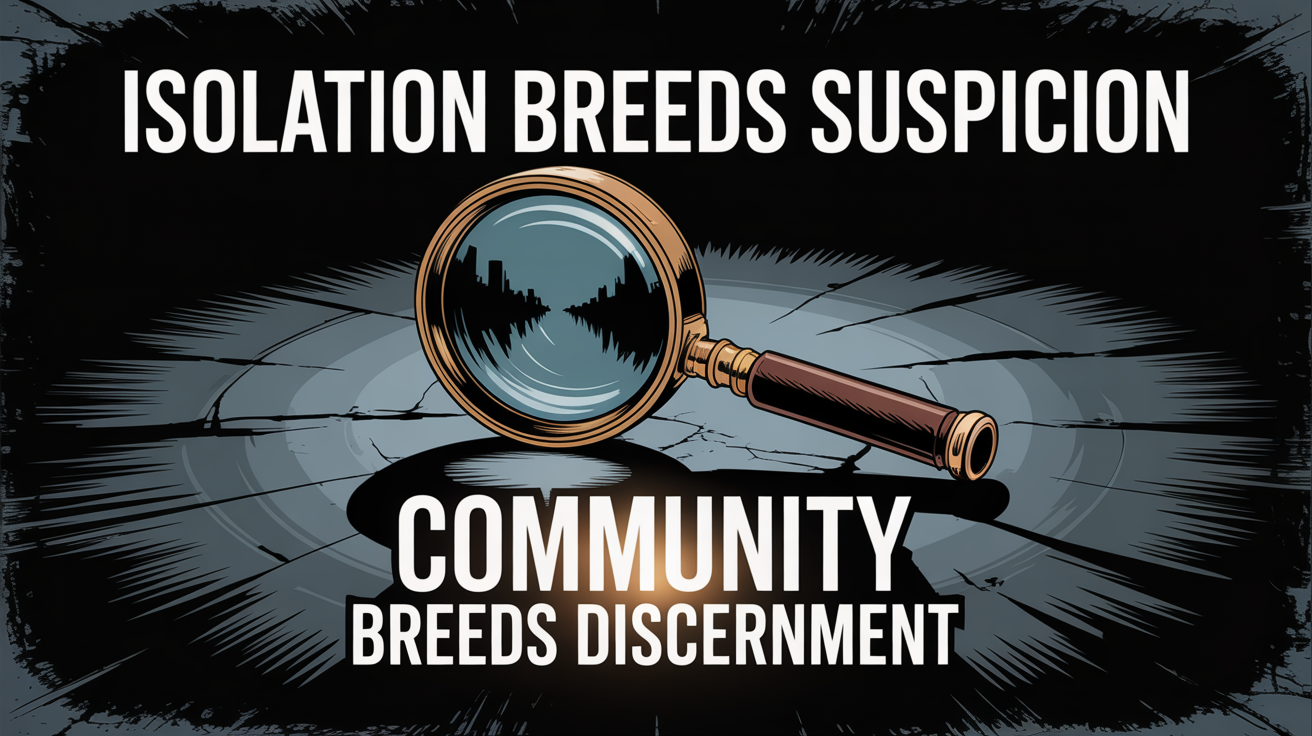
Suspicion grows best in the dark.
When we’re hurt, when trust is fractured, when trauma has left its fingerprint on our souls, the temptation is to retreat. To circle the wagons. To pull back from people because people were the problem.
Isolation doesn’t just keep us “safe.” It breeds suspicion.
Suspicion whispers, “You can’t trust them. They’re out to get you. Better watch your back.” And soon, suspicion metastasizes into paranoia. Paranoia convinces us we’re discerning when, in fact, we’re simply afraid.
But the Bible tells a different story:
“For God gave us not a spirit of fear, but of power, love, and self-control.”
—2 Timothy 1:7
Fear isolates. Love draws near.
Discernment is not suspicion. Discernment is Spirit-led clarity. And clarity grows best in community.
When we’re in community, we borrow each other’s eyes. We borrow each other’s faith. We lend courage, perspective, and hope.
“Two are better than one, because they have a good reward for their toil. For if they fall, one will lift up his fellow.”
—Ecclesiastes 4:9–10
Suspicion makes us look sideways. Community teaches us to look upward.
When suspicion creeps in, don’t sit in the dark with it. Don’t let the whisper become your worldview. Bring it into the light. Call a trusted friend. Pray with your small group. Share the thought that’s been eating at you—and watch how quickly the power drains from it.
Discernment is a team sport.
And the only way to trade paranoia for peace… is to stop standing alone.

Exposing 7 Lies Facing America
Our country has just walked through a major national tragedy.
The murder of Charlie Kirk was not only heard about—it was seen. Millions watched the footage, a demonic spectacle replayed on screens that seared itself into our collective memory.
Moments like this mark a generation. They don’t just change what we see—they change how we think. If we’re not careful, these moments embed lies into the background code of our soul’s operating system. They hum quietly, but they redirect our choices, limit our identity, and even reroute our destiny.
The work isn’t just to grieve. The work is to debug.
Here are seven lies that surface after tragedy—and the truths that expose them:

Our country has just walked through a major national tragedy.
The murder of Charlie Kirk was not only heard about—it was seen. Millions watched the footage, a demonic spectacle replayed on screens that seared itself into our collective memory.
Moments like this mark a generation. They don’t just change what we see—they change how we think. If we’re not careful, these moments embed lies into the background code of our soul’s operating system. They hum quietly, but they redirect our choices, limit our identity, and even reroute our destiny.
The work isn’t just to grieve. The work is to debug.
Here are seven lies that surface after tragedy—and the truths that expose them:
Lie 1: “If this could happen to Charlie Kirk, no one is safe.”
Fear masquerades as wisdom. But the early church understood something we often forget: safety was never the goal.
After every wave of persecution, they gathered—not to pray for protection, but for boldness. In the first century, safety wasn’t even an option. And it still isn’t today.
Truth: Our calling has never been contingent on guarantees of safety. What we need is supernatural boldness to fulfill our assignments despite the threats. Death doesn’t get the last word—Jesus does.
“The Lord is my light and my salvation; whom shall I fear?” (Psalm 27:1)
Lie 2: “The enemy is winning.”
Every headline seems to agree. But history doesn’t. The cross looked like defeat—until it wasn’t. Martyrdom has never stopped the Church; it has only fueled revival.
Truth: The enemy has already lost. On the cross, Christ “disarmed the rulers and authorities and put them to open shame, by triumphing over them” (Colossians 2:15). We know the end of the story—Jesus wins.
King Jesus is on the throne, and “God raised us up with Christ and seated us with him in the heavenly realms in Christ Jesus” (Ephesians 2:6). Don’t believe the lie. We are not fighting for victory; we are fighting from victory.
Lie 3: “I need to fight fire with fire.”
Revenge feels like justice. But when we’re given to reaction, we can unwittingly partner with the very demons we think we’re defeating. Retaliation only multiplies the darkness.
Truth: We are not called to reaction, but to revelation. Obedience, Spirit-led boldness, and God’s Word are our weapons. We overcome evil not by mirroring it, but by manifesting the Kingdom.
“Do not be overcome by evil, but overcome evil with good.” (Romans 12:21)
Lie 4: “Suspicion will protect me.”
Suspicion is the fruit of isolation. It feels like safety, but it’s really counterfeit discernment. It turns flesh and blood into the enemy, while the real enemy hides in the shadows. Paranoia promises protection but delivers only chains.
Truth: Discernment doesn’t prematurely judge people—it equips us with prophetic ammunition to confront the mind-blinding spirits controlling them. Suspicion is about survival. Discernment is about victory.
“And the peace of God, which surpasses all understanding, will guard your hearts and your minds in Christ Jesus.” (Philippians 4:7)
Lie 5: “We are powerless.”
When the news cycle overwhelms, apathy whispers: You can’t change this.
Truth: The Church is not powerless. We carry resurrection power, Kingdom authority, and the Spirit of the Living God. “But you will receive power when the Holy Spirit has come upon you; and you will be my witnesses” (Acts 1:8). We fight on our knees, we fight together, and we fight with the boldness of Christ.
Lie 6: “It’s safer to stay silent.”
Silence sounds prudent. But it’s actually agreement. Fear and intimidation always aim for the same target: your voice.
Truth: Your voice is your power. Everything that exists—the heavens, the earth, even the Scriptures themselves—was spoken into being. If the voice of the Lord is silenced, creation unravels. But love will never let you go silent. Love liberates you. It compels you to speak, to pray, to declare.
Salt and light only work when exposed. Boldness is what shakes nations. Refuse to be silenced.
“You are the salt of the earth… You are the light of the world.” (Matthew 5:13–16)
Lie 7: “This is the end of something.”
The enemy always whispers: This is the end. Give up. Lose hope. And tragically, many Christians echo him—clinging to “defeater beliefs” about the end times that sound more like despair than hope.
Truth: The Bible never ends with the end. It ends with restoration—the renewal of all things, Eden 2.0, Heaven on Earth. Yes, things come to an end. But this Kingdom? “Of the increase of His government and peace there will be no end” (Isaiah 9:7).
Every ending in God’s hands is a planting, not a burial. The seed goes into the ground so resurrection life can spring forth. This Kingdom has no expiration date.
The challenge:
Lies don’t leave on their own. They must be exposed, confronted, and replaced with truth.
Debugging the soul isn’t optional after tragedy—it’s survival.
And when we choose truth, the background noise changes.
The operating system updates.
And destiny stays intact.

The Compatibility Code
Most of us think of the fruit of the Spirit as a private list.
Love. Joy. Peace. Patience. Kindness. Goodness. Faithfulness. Gentleness. Self-control.
Nine nice words to hang on a wall.
But what if Paul wasn’t handing us a personal development checklist?
What if he was describing a compatibility code?

Most of us think of the fruit of the Spirit as a private list.
Love. Joy. Peace. Patience. Kindness. Goodness. Faithfulness. Gentleness. Self-control.
Nine nice words to hang on a wall.
But what if Paul wasn’t handing us a personal development checklist?
What if he was describing a compatibility code?
The Spirit cuts us into shape.
Left to ourselves, we’re jagged. Sharp corners. Edges that slice instead of join.
Ever tried to jam two puzzle pieces together that don’t fit? You can push, you can bend, you can force… but it doesn’t make a picture. It makes a mess.
The fruit of the Spirit isn’t just about what grows inside of you—it’s about how you’re reshaped for someone else. Each virtue sands down the edges:
Love makes space.
Joy makes you buoyant.
Peace makes you steady.
Patience gives you margin.
Kindness softens the impact.
Goodness makes you trustworthy.
Faithfulness makes you reliable.
Gentleness makes you safe.
Self-control keeps you from snapping.
Together, they make you fit.
The bond of peace is the glue.
Paul calls it “the bond of peace” in Ephesians. That’s not an accident.
Peace isn’t passive. It’s adhesive. It’s the Spirit’s way of locking us together, piece by piece, until a bigger picture emerges.
Alone, you’re just a strange shape. With others, you become part of a masterpiece.
Division breaks the picture.
The enemy knows this. That’s why gossip, suspicion, and bitterness always feel so corrosive—they’re solvents, dissolving the bond of peace.
The culture of hell is division. The culture of heaven is unity.
And unity isn’t sentimental. It’s supernatural.
The challenge.
Don’t just ask, “Am I bearing fruit?”
Ask, “Am I becoming more compatible with others?”
Because heaven shows up not in perfect individuals, but in imperfect people cut to fit, bonded together by peace.

Watch the Mission or Join It
And God is still looking.
Not for tourists.
Not for spiritual nomads, camera in hand, chasing the next holy Instagram post.
Not for ministries trying to pose in front of Antifa graffiti.
Not for spectators.
He’s looking for people.
People who build.
People who move in.
People who stay.

We rebuilt the walls.
We restored the temple.
We wept.
We worshipped.
But the city is still empty.
And God is still looking.
Not for tourists.
Not for spiritual nomads, camera in hand, chasing the next holy Instagram post.
Not for ministries trying to pose in front of Antifa graffiti.
Not for spectators.
He’s looking for people.
People who build.
People who move in.
People who stay.
People who don’t need a perfect picture before they pick up a shovel.
Nehemiah 11 is a peculiar chapter. It doesn’t preach well.
It reads like a census. A roll call.
But it’s the sound of people choosing.
Choosing to dwell in the ruins.
To live in a place everyone else had written off.
This wasn’t glamour. This wasn’t glory.
This was calling.
God’s looking for those who say:
“Here I am. Plant me in the ruins. I will not leave until it looks like Eden again.”
This isn’t judgment.
This is invitation.
There’s a difference between watching revival and becoming it.
Between visiting a city and becoming its root system.
Too many believers are spiritual renters.
They move where the presence is “popping.”
They hop from Sunday to Sunday, live stream to live stream, city to city.
God’s not asking for your attendance.
He’s asking for your residency.
Three Prophetic Movements for Builders
1. Stop Chasing Beauty. Occupy the Ashes.
The Instagram algorithm rewards the beautiful.
So we chase blessing. We move toward ease.
We wait for the open door in the obvious place.
But what if beauty isn’t found—it’s formed?
Isaiah 61:3 doesn’t say God gives beauty to the beautiful.
It says He gives beauty for ashes.
Which means someone has to move into the ashes.
You’ve been praying for an open door.
God’s been pointing at the rubble.
He’s not sending you where the fruit is.
He’s sending you where the roots are missing.
Not to steal someone else’s harvest.
But to dig. Plant. Bleed. Pray.
You’re not chasing Eden.
You’re restoring it.
Question:
Where have you been chasing beauty instead of stewarding brokenness?
2. Stop Spectating. Start Stewarding.
We love good worship.
We crave great messages.
We binge revival content the way others binge Netflix.
But the Kingdom isn’t built by critics or consumers.
It’s built by planted people.
We don’t need more charisma.
We need more commitment.
You are not outside of God’s move.
You are the vessel He wants to move through.
You are not a spectator of the sacred.
You are His sanctuary.
The Lord isn’t hyped by hype.
He’s drawn to homes—people who say, “Come abide in me.”
Hard places are holy ground when we stop asking for comfort and start asking for a commission.
Jesus didn’t livestream heaven.
He moved in to Nazareth.
He didn’t just comment.
He committed.
Question:
Where are you watching what God is doing instead of partnering with Him?
3. Commit Before You Comment.
Social media taught us to react.
Heaven is teaching us to root.
You don’t bring the Kingdom by pointing at problems.
You bring the Kingdom by planting your feet.
God’s not calling you to post about broken places.
He’s calling you to live there.
To stay when it’s awkward.
To dig when it’s dry.
To speak life when no one claps back.
This is the era of refiners.
The age of the occupiers.
The movement of those who remain.
God is saying: “I’m in the dust. I’m in the ruins. I’m in the unimpressive place.”
Stay.
Speak.
Steward.
Watch beauty rise from below your feet.
Question:
Where are you being called to stay, even though it still looks unimpressive?
Final Declaration: Eden, Again.
God is rebuilding cities.
But not through superstars.
Through servants.
Through stayers.
Through people who don’t need to see it all today because they trust the tomorrow He’s building.
“I am looking for a people,” says the Lord.
Not to escape the world.
But to rebuild it.
Not to spectate, but to partner.
Not to run from cursed ground,
but to speak beauty into ashes.
That’s you.
You are not the crowd.
You are the core.
You are not the fan.
You are the family.
You are not waiting for permission.
You already carry the presence.
So dwell.
Build.
Stay.
Restore.
Because Eden isn’t lost.
It’s just waiting for someone to say:
“Here I am. Plant me in the ruins.”
And God is saying:
“I’m doing it through you.”