
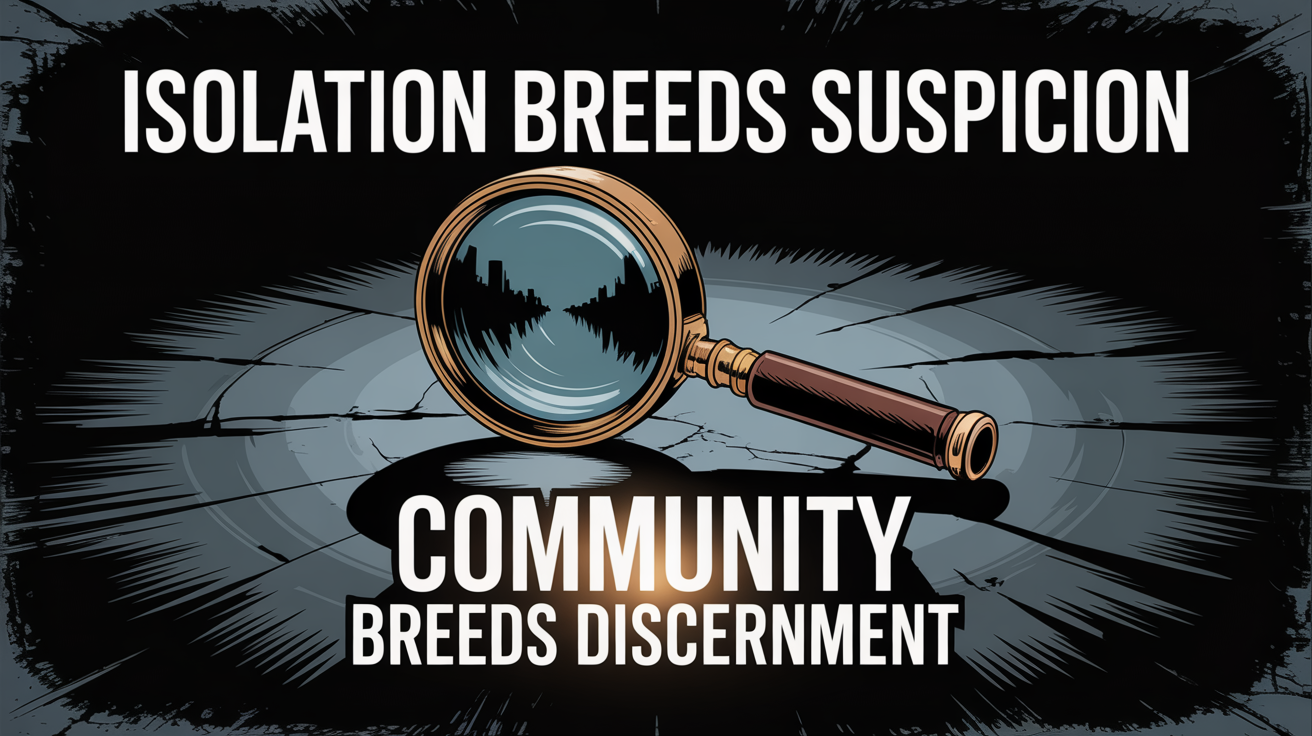
Isolation Breeds Suspicion
Suspicion grows best in the dark.
When we’re hurt, when trust is fractured, when trauma has left its fingerprint on our souls, the temptation is to retreat. To circle the wagons. To pull back from people because people were the problem.
Isolation doesn’t just keep us “safe.” It breeds suspicion.
Suspicion whispers, “You can’t trust them. They’re out to get you. Better watch your back.” And soon, suspicion metastasizes into paranoia. Paranoia convinces us we’re discerning when, in fact, we’re simply afraid.
But the Bible tells a different story.
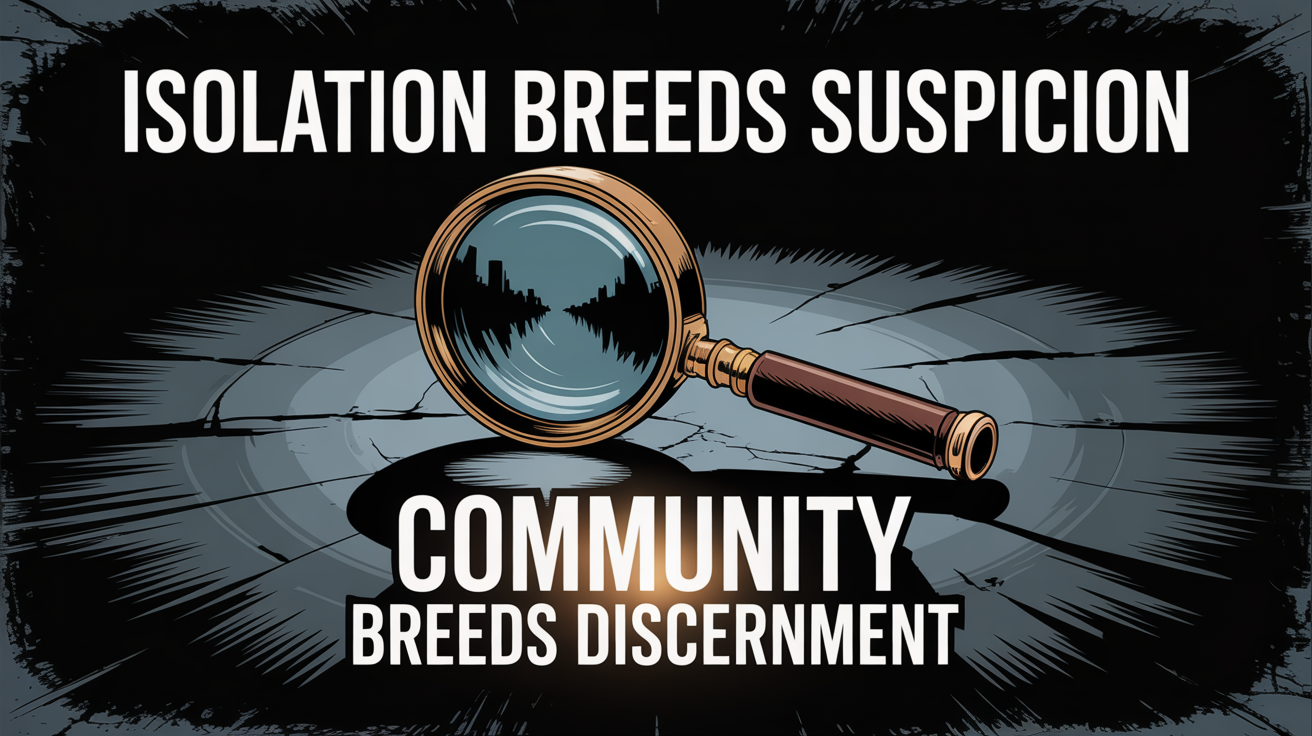
Suspicion grows best in the dark.
When we’re hurt, when trust is fractured, when trauma has left its fingerprint on our souls, the temptation is to retreat. To circle the wagons. To pull back from people because people were the problem.
Isolation doesn’t just keep us “safe.” It breeds suspicion.
Suspicion whispers, “You can’t trust them. They’re out to get you. Better watch your back.” And soon, suspicion metastasizes into paranoia. Paranoia convinces us we’re discerning when, in fact, we’re simply afraid.
But the Bible tells a different story:
“For God gave us not a spirit of fear, but of power, love, and self-control.”
—2 Timothy 1:7
Fear isolates. Love draws near.
Discernment is not suspicion. Discernment is Spirit-led clarity. And clarity grows best in community.
When we’re in community, we borrow each other’s eyes. We borrow each other’s faith. We lend courage, perspective, and hope.
“Two are better than one, because they have a good reward for their toil. For if they fall, one will lift up his fellow.”
—Ecclesiastes 4:9–10
Suspicion makes us look sideways. Community teaches us to look upward.
When suspicion creeps in, don’t sit in the dark with it. Don’t let the whisper become your worldview. Bring it into the light. Call a trusted friend. Pray with your small group. Share the thought that’s been eating at you—and watch how quickly the power drains from it.
Discernment is a team sport.
And the only way to trade paranoia for peace… is to stop standing alone.

The Compatibility Code
Most of us think of the fruit of the Spirit as a private list.
Love. Joy. Peace. Patience. Kindness. Goodness. Faithfulness. Gentleness. Self-control.
Nine nice words to hang on a wall.
But what if Paul wasn’t handing us a personal development checklist?
What if he was describing a compatibility code?

Most of us think of the fruit of the Spirit as a private list.
Love. Joy. Peace. Patience. Kindness. Goodness. Faithfulness. Gentleness. Self-control.
Nine nice words to hang on a wall.
But what if Paul wasn’t handing us a personal development checklist?
What if he was describing a compatibility code?
The Spirit cuts us into shape.
Left to ourselves, we’re jagged. Sharp corners. Edges that slice instead of join.
Ever tried to jam two puzzle pieces together that don’t fit? You can push, you can bend, you can force… but it doesn’t make a picture. It makes a mess.
The fruit of the Spirit isn’t just about what grows inside of you—it’s about how you’re reshaped for someone else. Each virtue sands down the edges:
Love makes space.
Joy makes you buoyant.
Peace makes you steady.
Patience gives you margin.
Kindness softens the impact.
Goodness makes you trustworthy.
Faithfulness makes you reliable.
Gentleness makes you safe.
Self-control keeps you from snapping.
Together, they make you fit.
The bond of peace is the glue.
Paul calls it “the bond of peace” in Ephesians. That’s not an accident.
Peace isn’t passive. It’s adhesive. It’s the Spirit’s way of locking us together, piece by piece, until a bigger picture emerges.
Alone, you’re just a strange shape. With others, you become part of a masterpiece.
Division breaks the picture.
The enemy knows this. That’s why gossip, suspicion, and bitterness always feel so corrosive—they’re solvents, dissolving the bond of peace.
The culture of hell is division. The culture of heaven is unity.
And unity isn’t sentimental. It’s supernatural.
The challenge.
Don’t just ask, “Am I bearing fruit?”
Ask, “Am I becoming more compatible with others?”
Because heaven shows up not in perfect individuals, but in imperfect people cut to fit, bonded together by peace.

Watch the Mission or Join It
And God is still looking.
Not for tourists.
Not for spiritual nomads, camera in hand, chasing the next holy Instagram post.
Not for ministries trying to pose in front of Antifa graffiti.
Not for spectators.
He’s looking for people.
People who build.
People who move in.
People who stay.

We rebuilt the walls.
We restored the temple.
We wept.
We worshipped.
But the city is still empty.
And God is still looking.
Not for tourists.
Not for spiritual nomads, camera in hand, chasing the next holy Instagram post.
Not for ministries trying to pose in front of Antifa graffiti.
Not for spectators.
He’s looking for people.
People who build.
People who move in.
People who stay.
People who don’t need a perfect picture before they pick up a shovel.
Nehemiah 11 is a peculiar chapter. It doesn’t preach well.
It reads like a census. A roll call.
But it’s the sound of people choosing.
Choosing to dwell in the ruins.
To live in a place everyone else had written off.
This wasn’t glamour. This wasn’t glory.
This was calling.
God’s looking for those who say:
“Here I am. Plant me in the ruins. I will not leave until it looks like Eden again.”
This isn’t judgment.
This is invitation.
There’s a difference between watching revival and becoming it.
Between visiting a city and becoming its root system.
Too many believers are spiritual renters.
They move where the presence is “popping.”
They hop from Sunday to Sunday, live stream to live stream, city to city.
God’s not asking for your attendance.
He’s asking for your residency.
Three Prophetic Movements for Builders
1. Stop Chasing Beauty. Occupy the Ashes.
The Instagram algorithm rewards the beautiful.
So we chase blessing. We move toward ease.
We wait for the open door in the obvious place.
But what if beauty isn’t found—it’s formed?
Isaiah 61:3 doesn’t say God gives beauty to the beautiful.
It says He gives beauty for ashes.
Which means someone has to move into the ashes.
You’ve been praying for an open door.
God’s been pointing at the rubble.
He’s not sending you where the fruit is.
He’s sending you where the roots are missing.
Not to steal someone else’s harvest.
But to dig. Plant. Bleed. Pray.
You’re not chasing Eden.
You’re restoring it.
Question:
Where have you been chasing beauty instead of stewarding brokenness?
2. Stop Spectating. Start Stewarding.
We love good worship.
We crave great messages.
We binge revival content the way others binge Netflix.
But the Kingdom isn’t built by critics or consumers.
It’s built by planted people.
We don’t need more charisma.
We need more commitment.
You are not outside of God’s move.
You are the vessel He wants to move through.
You are not a spectator of the sacred.
You are His sanctuary.
The Lord isn’t hyped by hype.
He’s drawn to homes—people who say, “Come abide in me.”
Hard places are holy ground when we stop asking for comfort and start asking for a commission.
Jesus didn’t livestream heaven.
He moved in to Nazareth.
He didn’t just comment.
He committed.
Question:
Where are you watching what God is doing instead of partnering with Him?
3. Commit Before You Comment.
Social media taught us to react.
Heaven is teaching us to root.
You don’t bring the Kingdom by pointing at problems.
You bring the Kingdom by planting your feet.
God’s not calling you to post about broken places.
He’s calling you to live there.
To stay when it’s awkward.
To dig when it’s dry.
To speak life when no one claps back.
This is the era of refiners.
The age of the occupiers.
The movement of those who remain.
God is saying: “I’m in the dust. I’m in the ruins. I’m in the unimpressive place.”
Stay.
Speak.
Steward.
Watch beauty rise from below your feet.
Question:
Where are you being called to stay, even though it still looks unimpressive?
Final Declaration: Eden, Again.
God is rebuilding cities.
But not through superstars.
Through servants.
Through stayers.
Through people who don’t need to see it all today because they trust the tomorrow He’s building.
“I am looking for a people,” says the Lord.
Not to escape the world.
But to rebuild it.
Not to spectate, but to partner.
Not to run from cursed ground,
but to speak beauty into ashes.
That’s you.
You are not the crowd.
You are the core.
You are not the fan.
You are the family.
You are not waiting for permission.
You already carry the presence.
So dwell.
Build.
Stay.
Restore.
Because Eden isn’t lost.
It’s just waiting for someone to say:
“Here I am. Plant me in the ruins.”
And God is saying:
“I’m doing it through you.”

When the People Cry Out
There’s a moment—
A shift.
A sound too raw, too human, too urgent to ignore.
It doesn’t come from enemies.
It comes from within the walls.
From the people we thought were safe.
From the voices we trained ourselves not to hear.
They weren’t strangers.
They were family.
The very people of God.

Nehemiah 5:1–13
There’s a moment—
A shift.
A sound too raw, too human, too urgent to ignore.
It doesn’t come from enemies.
It comes from within the walls.
From the people we thought were safe.
From the voices we trained ourselves not to hear.
They weren’t strangers.
They were family.
The very people of God.
And they were being crushed.
The text says,
“There arose a great outcry...”
It wasn’t noise.
It was signal.
The kind that slices through distraction.
The kind that makes a true leader pause—
Not to analyze, but to act.
Nehemiah didn’t manage the crisis.
He embodied it.
He got angry.
But not the kind of anger that burns bridges—
The kind that builds new ones.
Because he knew:
What’s the point of rebuilding walls if the people behind them are enslaved?
What good is a move of God if it doesn’t move us toward justice?
What’s the value of leadership that only asks, “What’s in it for me?”
Leadership isn’t about being in charge.
It’s about being in between.
Between the pain and the promise.
Between the silence and the sound.
1. Hear the Cry. Prophesy the Future.
Don’t dismiss what disturbs you.
Leadership begins with listening—not with the ears, but with the soul.
You can’t solve what you refuse to feel.
“There arose a great outcry of the people…” (Nehemiah 5:1)
Real leaders hear what others ignore.
And when they hear it—they speak.
They name what God is saying.
They create the future by declaring it.
2. Name the Wrong. Don’t Cover It.
Call it. Don’t coat it.
Injustice thrives in ambiguity.
Religious language has a way of making rot look holy.
But Nehemiah didn’t spiritualize sin—he exposed it.
“I was very angry… I brought charges against the nobles and the officials.” (Nehemiah 5:6–7)
Confrontation is compassion in motion.
When you name the wrong, healing can finally begin.
3. Expect Repentance. Build for Breakthrough.
Bold leadership breaks strongholds.
We’ve grown too used to managing dysfunction.
Nehemiah demanded change—and got it.
Not because he was loud, but because he was clear.
“We will restore… we will do as you say.” (Nehemiah 5:12–13)
When leaders speak with integrity, people respond.
Not just with applause—but with action.
You’ve heard something
A whisper. A rumble. A cry.
Maybe it’s not public.
But in your spirit, it’s loud.
This is your cue.
Not to wait.
Not to delegate.
Not to play it safe.
Because Kingdom leadership doesn’t wait for permission.
It answers the cry.
So—will you?
Will you rise?
Will you risk?
Will you lead?
Because heaven is listening.
And the people are crying.
Let it be you.
Let it be now.
Let it be loud.

Build And Defend
We love the idea of building.
The thrill of starting something new. The excitement of vision, calling, purpose. The sense that we’re participating in something bigger than ourselves.
But what happens when opposition shows up?
What happens when the enemy sees what you're building and decides it’s worth tearing down?
Most people hesitate. They assume that if an idea is truly from God, it shouldn’t require a fight.
Nehemiah knew better.

We love the idea of building
The thrill of starting something new. The excitement of vision, calling, purpose. The sense that we’re participating in something bigger than ourselves.
But what happens when opposition shows up?
What happens when the enemy sees what you're building and decides it’s worth tearing down?
Most people hesitate. They assume that if an idea is truly from God, it shouldn’t require a fight.
Nehemiah knew better. His people weren’t just building. They were battling while they built.
They worked with one hand and held a weapon in the other. They didn’t take off their armor. They never let their guard down.
Because if it’s worth building, it’s worth protecting.
We Build, but We Don’t Guard
It happens all the time.
A business launches, but no one builds the systems to sustain it.
A marriage begins, but no effort is made to protect it.
A dream is birthed, but distractions steal it away.
We ask for blessing but don’t build boundaries.
We cry out for breakthrough but don’t establish safeguards.
We get frustrated by attacks but never take steps to prevent them.
Nehemiah’s people understood that anything worth building will be challenged. So, they stayed ready.
If You Don’t Guard It, You’ll Lose It
"Those who carried burdens were loaded in such a way that each labored on the work with one hand and held his weapon with the other." (Nehemiah 4:17)
Imagine building a house with one hand while holding a sword in the other.
It’s not convenient. But it’s necessary.
Because if you aren’t holding a sword, the enemy assumes you’re easy to take down.
Want to protect your marriage? Guard your words, your time, your priorities.
Want to keep your calling alive? Guard your focus.
Want to build a lasting legacy? Guard your habits.
Loose grips sink ships.
The solution is simple.
Guard it and grip it!
Stay Ready So You Don’t Have to Get Ready
"None of us took off our clothes; each kept his weapon at his right hand." (Nehemiah 4:23)
Most people think they’ll get battle-ready when the fight comes.
They assume they’ll develop discipline when life demands it.
They hope they’ll build resilience when hardship shows up.
It doesn’t work that way.
Nehemiah’s men slept in their armor. They were always ready.
You don’t wait until the attack to pray.
You don’t wait until the crisis to strengthen your marriage.
You don’t wait until the enemy starts taking ground to fight back.
Prepare now, so when the moment comes, you don’t have to scramble.
Find Your People and Fight Together
"In the place where you hear the sound of the trumpet, rally to us there. Our God will fight for us!" (Nehemiah 4:20)
You can’t win this fight alone.
You need people who will rally when you’re under attack.
You need voices that will remind you of the vision when you’re ready to quit.
You need a team that doesn’t scatter when the enemy shows up.
Nehemiah’s men didn’t run from the fight. They ran toward it.
When your marriage is struggling, don’t isolate—get help.
When your business is under attack, don’t retreat—find support.
When you feel spiritually drained, don’t disengage—press into your community.
The enemy wants you alone. The wise know better.
What Are You Building and Are You Protecting It?
Most people don’t fail because they lacked vision.
They fail because they weren’t ready for resistance.
The difference between those who finish and those who quit isn’t calling, talent, or gifting.
It’s vigilance.
Are you guarding what God gave you?
Are you staying battle-ready?
Are you surrounding yourself with people who will fight with you?
Building is only half the job.
Protecting is the other half.
Revival Begins at Home
In Nehemiah 3, as the walls of Jerusalem were being rebuilt, the workers weren’t assigned random sections of the city. They built opposite their own homes.
Their own neighborhoods.
Their own streets.
Their own front doors.
Why?
Because before you build anything significant, before you restore what’s broken in the world, you have to secure what’s happening in your own home.
Nehemiah’s people understood something we often forget: a city isn’t strong if its families are weak.

In Nehemiah 3, as the walls of Jerusalem were being rebuilt, the workers weren’t assigned random sections of the city. They built opposite their own homes.
Their own neighborhoods.
Their own streets.
Their own front doors.
Why?
Because before you build anything significant, before you restore what’s broken in the world, you have to secure what’s happening in your own home.
Nehemiah’s people understood something we often forget: a city isn’t strong if its families are weak.
Your Home Is Your First Ministry
It’s easy to want big change.
To focus on the world’s problems.
To look out at what’s broken and think, "Somebody needs to fix that."
But you can’t build a strong city with broken households.
Too many people try to be heroes in the streets while being strangers at home.
They’re fixing their communities but neglecting their families.
They’re trying to rebuild the world but ignoring the brokenness under their own roof.
But real revival starts at home.
Before you fix the world, build your home.
Before you lead others, lead your own family.
Before you defend the city, make sure your walls are strong.
The Hidden Gaps Where the Enemy Gets In
A wall without a gate keeps everything out.
But a home without walls lets everything in.
Nehemiah’s people understood something fundamental: without walls, their homes were vulnerable. They weren’t just rebuilding houses—they were reinforcing their lives against intrusion, compromise, and invasion.
Today, those walls don’t look like stone and mortar. But they’re just as critical.
Walls are practical boundaries that protect what matters most.
🛑 A wall is deciding that husband and wife go to bed at the same time—so there’s no room for distance, distraction, or temptation to creep in.
🛑 A wall is unplugging the WiFi at bedtime—so kids aren’t mindlessly scrolling YouTube or wandering into dangerous content when no one is watching.
🛑 A wall is keeping work emails out of family dinner—so your children know they come before your job.
🛑 A wall is intentional family prayer—so your household isn’t just coexisting under one roof but thriving under God’s covering.
🛑 A wall is teaching discernment—so your home isn’t infiltrated by influences that erode your values.
What are the practical things your family can do to prevent snakes from getting into your garden?
The enemy doesn’t always come through the front door—sometimes, he sneaks in through compromise. Through screens left unchecked. Through relationships left unguarded. Through exhaustion that leaves you too tired to fight for what matters.
A home without boundaries is like a city without walls—completely exposed.
Nehemiah’s people didn’t just build homes—they fortified them. They made sure their families were protected, covered, and aligned.
So before you focus on building big things out there, take a moment to secure what’s happening inside your home.
Where are the gaps?
What needs to be reinforced?
What practical walls need to be built to protect what God has entrusted to you?
Because if the enemy can infiltrate your home, it doesn’t matter how strong your city looks.
🔥 Build the wall.
🔥 Rebuild where you live.
🔥 Then—and only then—change the world.

How Poor Counseling Can Hurt Your Marriage
Today, we’re focusing on one of the most critical—and sometimes misunderstood—aspects of marital healing: seeking outside help.
Whether you’re facing communication breakdowns, toxic control patterns, or even navigating the complex terrain of a narcissistic spouse, involving the right third party can make all the difference. But how do you know where to start? And how do you find someone who can genuinely help? Let’s explore this in detail.
Welcome to the final article in our series, What to Do When Your Marriage is in Trouble. If you’ve just joined us, I encourage you to start from the beginning of the series. Each installment builds on the last, helping you create a roadmap for addressing challenges in your marriage one step at a time.
Today, we’re focusing on one of the most critical—and sometimes misunderstood—aspects of marital healing: seeking outside help.
Whether you’re facing communication breakdowns, toxic control patterns, or even navigating the complex terrain of a narcissistic spouse, involving the right third party can make all the difference. But how do you know where to start? And how do you find someone who can genuinely help? Let’s explore this in detail.
The Role of a Neutral Third Party: Pastor, Counselor, or Both?
When you realize you can’t fix things on your own, the next logical step is to involve a neutral third party. This could be a pastor, a professional counselor, or, in many cases, both. Each has a unique role to play, and understanding their strengths and limitations will help you make the most of their involvement.
Is a Pastor a Professional Counselor?
The short answer? No.
While pastors often have years of experience offering spiritual guidance, most are not trained as professional counselors. Their role is to provide biblical wisdom, pray with you, and help you explore God’s design for marriage. However, when it comes to complex dynamics like trauma, abuse, or mental health disorders, they usually lack the specialized training to dive deep into these issues.
Think of a pastor as your first responder. They’re an excellent resource for one to three visits, during which they can listen, pray, and offer biblical perspective. But after those initial sessions, it’s often best to ask for a referral. Most pastors have a network of trusted, spirit-filled, biblically-centered counselors they can recommend. This referral can bridge the gap between spiritual guidance and clinical expertise.
When Should You Transition to a Professional Counselor?
Here are some clear indicators it’s time to involve a professional counselor:
Complex or Recurring Issues: Patterns of conflict that persist despite your best efforts.
Trauma or Abuse: Emotional, physical, or psychological harm that requires deep healing.
Mental Health Concerns: Anxiety, depression, addiction, or other conditions impacting one or both spouses.
Narcissism: If one spouse exhibits manipulative or controlling behaviors, a specialized counselor is often necessary.
While pastors provide invaluable spiritual support, professional counselors offer tools, strategies, and clinical insights that are vital for addressing these deeper challenges.
Special Considerations for Narcissistic Marriages
If you’re married to a narcissist, counseling isn’t just challenging—it’s an advanced-level game of emotional chess. Narcissists are master manipulators, capable of twisting the narrative and charming even the most well-meaning counselors or pastors. Without the right guidance, the counseling process can leave you feeling more frustrated and confused than when you started.
Here’s the reality: narcissists thrive on control. They can present themselves as the victim, the hero, or the misunderstood genius, all while subtly gaslighting and deflecting blame. They may even use counseling as another stage to assert dominance. That’s why finding the right counselor—one who specializes in narcissistic abuse and high-conflict relationships—isn’t optional; it’s critical. Here’s how to make that happen:
1. Seek Referrals from Trusted Sources
Start with your pastor or church leadership. Many pastors maintain connections with Christian counselors who specialize in high-conflict marriages and abusive dynamics. But here’s the catch: not every pastor or counselor is equipped to handle narcissistic behavior. Be clear about your situation when asking for recommendations.
2. Look for Specific Expertise
Not all counselors are created equal, and in narcissistic marriages, you need someone who’s fluent in the language of manipulation. Look for counselors who explicitly list experience in narcissistic abuse, gaslighting, and high-conflict relationships. A generalist counselor might be great for communication issues, but they’re not prepared to untangle the web of control and charm a narcissist spins.
3. Ask the Right Questions
A little interview with your potential counselor can go a long way in determining if they’re the right fit. Ask them directly:
How do you address narcissistic behaviors in a counseling session?
What strategies do you use to ensure both spouses are heard without enabling manipulation?
How do you integrate biblical principles with clinical practices when working with high-conflict marriages?
If they fumble these questions or give vague answers, keep looking. You need someone who isn’t intimidated by a narcissist’s bravado or tactics.
4. Protect Yourself During the Process
Narcissists are skilled at using counseling as another tool to maintain control. They may try to manipulate the sessions, twist your words, or even charm the counselor into taking their side. This is why it’s crucial to have a counselor who’s seen these tactics before and knows how to navigate them. If you feel unheard or invalidated, speak up—or consider switching counselors.
Vetting Your Pastor: Are They Equipped to Help?
If you decide to begin with your pastor, here are a few things to consider:
Experience with Marital Issues: Ask if they’ve worked with couples facing similar challenges.
Approach to Confidentiality: Confirm that your discussions will remain private.
Willingness to Refer: A good pastor will know their limits and recommend professional help when necessary.
If your pastor is willing but lacks experience or training, be gracious. Thank them for their time and ask for a referral to someone with the expertise your situation requires.
How to Find a Spirit-Filled, Christian Counselor
Finding a counselor who is both clinically skilled and biblically grounded takes effort, but it’s worth it. Here’s how to start:
Use Trusted Resources
Check with your church, pastor, or organizations like the American Association of Christian Counselors for recommendations.Research Their Credentials
Look for licensed professionals (LMFT, LPC, or similar) who specialize in marriage counseling. Verify their training in trauma, abuse, or high-conflict relationships if needed.Pray for Discernment
Ask God to guide you to the right person. He knows your situation better than anyone and can open doors you hadn’t considered.
Interviewing a Counselor: Making Sure It’s the Right Fit
Interviewing a Counselor: Making Sure It’s the Right Fit
When you meet a potential counselor, treat the first session like a job interview. They’re not just here to hear your feelings and nod; they’re here to guide you through some of the most complicated, emotionally charged terrain you’ll ever encounter. You’re putting your marriage on the table, and not everyone’s equipped to handle that responsibility. Let’s break down how you figure out if they’re the real deal or just a well-meaning amateur with a clipboard.
What’s Your Experience with Marital Challenges?
The first question you need to ask is: “Have you actually worked with couples like us before?” This isn’t a time for vague philosophical musings about love or humanity. You want specifics. If they’ve spent the last 20 years helping people overcome fear of public speaking, that’s great, but it won’t help you figure out why your marriage feels like a Cold War standoff.
A solid counselor should be able to explain their experience clearly. “Yes, I’ve worked with couples dealing with trust issues, communication breakdowns, and power imbalances. Here’s how I approach it.” That’s the kind of answer you’re looking for. If they start saying things like, “Well, all relationships are unique,” that’s counselor-speak for, “I have no idea what I’m doing.”
Marriage counseling is a specialized field. If you’re dealing with complex dynamics like narcissism or manipulation, you need someone who’s not just good but very good. Think of it like going to a mechanic. You wouldn’t bring your Tesla to a guy who’s only ever worked on lawnmowers.
Finding the Right Christian Counselor: Spirit-Filled, Biblically Sound, and Grounded
When looking for a counselor as a Christian, it’s essential to find someone who shares your Biblical values, and is equipped to balance spiritual truths with practical strategies.
Ask them directly: “How do you integrate biblical principles into your counseling?”
This isn’t just about knowing Bible verses—it’s about how they weave those principles into the real-world tools you need for healing and growth.
A solid Christian counselor might say, “I view marriage as a covenant before God, not just a contract. I incorporate biblical principles alongside evidence-based practices to help couples address challenges and grow closer.” This reflects a healthy balance between faith and practical application.
However, avoid extremes. Some counselors may lean too heavily into the "woo-woo" zone, where everything is left up to supernatural intervention without addressing the practical work required for change. While it’s amazing to have a Spirit-filled counselor, remember that neither the Holy Spirit nor the counselor can “supernaturally fix” the deeper patterns or “software issues” of your soul. Healing takes effort, responsibility, and intentionality from both you and your spouse.
At the same time, avoid counselors who dismiss faith entirely with comments like, “We don’t deal with religion here.” Your counselor should see your relationship as more than just a partnership—it’s a spiritual journey as well.
Ultimately, the Holy Spirit will be faithful to do what only He can do, but rebuilding your marriage requires you to step into the hard work of change.
A Christian counselor who is biblically literate, Spirit-filled, and grounded can guide you, but transformation begins when you’re ready to take responsibility and actively participate in the process.
What’s Your Strategy for Addressing Manipulative or Controlling Behaviors?
If your marriage involves manipulation or control—and let’s be honest, most relationships have a little of that—this question is critical.
Ask: “How do you address manipulative or controlling behaviors in counseling?”
This is where a counselor proves whether they’re playing checkers or chess. A good one will tell you they focus on creating a safe space, balancing power dynamics, and identifying unhealthy patterns without immediately vilifying one spouse.
A bad one might say, “We let the couple work it out together.” Well, that’s great if you’re arguing over where to eat, but if one person is gaslighting the other, “working it out” isn’t going to cut it.
A great counselor knows that manipulation thrives in ambiguity. They’ll bring clarity to the situation by calling out toxic behaviors, setting boundaries, and ensuring both partners are heard. You need someone who’s not afraid to say, “Hey, that’s not okay,” even if it ruffles some feathers.
What’s Your Approach to Confidentiality?
Confidentiality is the glue that holds counseling together. Without it, you’re just venting to a stranger who might as well livestream your sessions. So ask: “What’s your approach to confidentiality?”
A competent counselor will explain their rules upfront. Generally, everything you say stays in the room—unless there’s abuse, threats of harm, or something legally mandated.
They’ll also clarify how they handle joint sessions versus individual sessions. If one of you spills a secret during a solo session, will they keep it private or bring it up later in front of your spouse? These are things you need to know.
If their answer is vague or they seem dismissive about confidentiality, it’s a no-go. You’re here to build trust, not create more reasons to distrust the process.
What to Look For in Their Answers
When you ask these questions, pay attention to more than just the words. A good counselor’s responses should make you feel safe, understood, and hopeful. Here’s what to look for:
Clarity: They should explain their approach without sounding like they just Googled “marriage counseling 101.”
Confidence: They know what they’re doing and aren’t afraid to lay out their strategy.
Balance: They’re empathetic but firm, addressing issues without taking sides prematurely.
If you walk away from the session thinking, “I trust this person to help us unpack our mess without making it worse,” you’ve probably found a keeper.
Red Flags to Watch Out For in a Counselor
Finding the right counselor is like picking a mechanic for your soul. You wouldn’t trust your car to someone who says, “Let’s just pray over the engine and see what happens,” and you shouldn’t trust your marriage to someone who dodges your questions or pushes their own agenda. So, let’s dive into what to avoid:
1. Avoidance
If you ask, “How do you integrate faith into your counseling?” and they respond with, “Well, we kind of just go with the flow,” run. Fast. Vague answers are the counseling equivalent of bringing a spoon to a knife fight—they’re just not equipped for the complexity of your situation. You need someone who knows how to dive deep, not someone who’s skimming the surface.
2. Over-Siding
If your counselor immediately takes one spouse’s side—congratulations, you just paid for a referee, not a counselor. A good counselor stays neutral to help both of you uncover the truth. If they’re already picking favorites, they’re not ready to handle the dynamics of your relationship. You don’t need a cheerleader for one side; you need a coach for the whole team.
3. Dismissiveness
Picture this: You open up about a major issue, and they say, “Oh yeah, I’ve seen this a thousand times. It’s no big deal.”
Translation? They’ve either lost their passion for helping or they’re too jaded to care. If your problems feel small to them, how can they help you tackle the big stuff? You want a counselor who listens like your problems matter—because they do.
4. Too Woo-Woo
Look, it’s great to have a Spirit-filled counselor, but if their solution to every problem is “Let’s just pray about it and let God do the rest,” they’re overselling the supernatural. The Holy Spirit is powerful, no doubt, but He’s not your marriage mechanic here to fix everything while you binge Netflix. You and your spouse have to do the work. It’s not magic; it’s effort.
5. Faithless Faith
On the flip side, if they dismiss faith altogether with something like, “Oh, we don’t really get into religion here,” that’s a hard pass. You’re not looking for a lecture on cognitive behavioral therapy devoid of God; you’re looking for someone who gets that your faith is part of the solution.
Trust Your Gut
At the end of the day, you’ve got to trust your instincts. A counselor might check all the professional boxes but still not feel like the right fit for you and your spouse. And that’s okay. This is one of the most important decisions you’ll make for your marriage, so don’t settle.
If you feel safe, respected, and understood, you’re on the right track. If not, keep looking. There’s a counselor out there who’s ready to help you navigate this journey with wisdom, compassion, and a healthy dose of practicality. Don’t stop until you find them.
After all, this isn’t just about fixing what’s broken—it’s about building something better. And that’s worth the effort.
Maximizing the Counseling Process
Counseling isn’t like ordering a pizza—you can’t just show up, pay the fee, and expect all your problems to be neatly delivered with extra cheese. It’s a process that takes time, effort, and a big ol’ dose of honesty. Here’s how to make sure you’re squeezing every drop of value out of those sessions.
1. Be Transparent
This isn’t the time for polite smiles or holding back because you’re afraid of judgment. If your marriage is falling apart over toothpaste cap placement or silent treatment stand-offs, say so. A counselor can’t help with what they don’t know.
Pretending everything is fine is like taking a broken car to the mechanic and saying, “Oh, it’s just a little noise.”
Share the real struggles, your fears, and your goals—ugly parts and all. Transparency opens the door for real healing.
2. Do the Work
Counselors don’t just hand out magical advice that instantly transforms your relationship. They give you tools—assignments, exercises, and insights—that require your participation.
It’s like going to the gym: you don’t get stronger by sitting on the bench scrolling Instagram. If your counselor suggests communication exercises or journaling, don’t roll your eyes and skip it. Those little assignments are where the rubber meets the road.
3. Stay Prayerful
God’s not just a backup plan for when counseling gets hard—He’s the foundation. Pray before and after each session. Ask God to open your heart, bring clarity to the mess, and heal what’s broken.
Counseling isn’t about inviting God into just one part of the process; it’s about making Him part of the entire journey. And here’s the beauty: as you invite God in, you might find Him working not only through the counselor but in your heart, too.
4. Manage Your Expectations
This isn’t a TV drama where breakthroughs happen by the end of the episode.
Counseling takes time, and change is often slow and unglamorous. Some weeks will feel like you’re making huge strides; others, like you’re stuck in neutral. Trust the process. Healing isn’t about perfection—it’s about progress.
5. Take Responsibility
Sure, your counselor has wisdom and tools, but they aren’t your personal problem-fixer. The Holy Spirit isn’t going to swoop in and fix what you refuse to acknowledge or work on. Both you and your spouse have to take responsibility for your part in the mess. This means owning up to mistakes, apologizing, forgiving, and making changes. The counselor is your guide, not your savior.
6. Keep Showing Up
There will be days when you don’t feel like going, when it seems easier to avoid the hard conversations or just throw in the towel.
Go anyway.
Sometimes, just showing up and staying engaged is the breakthrough you didn’t know you needed.
A Final Word
Seeking outside help isn’t a sign of failure; it’s a courageous step toward healing. Whether you start with your pastor, a professional counselor, or both, the key is to find someone equipped to guide you through the unique challenges of your situation.
If you’re married to a narcissist or navigating patterns of control and manipulation, healing can feel overwhelming. But with the right support—and a firm commitment to truth—you can find freedom and restoration. God designed marriage to be a reflection of His love, not a prison of control or fear. Taking action to restore your relationship honors that design.
About Darren Stott
Darren Stott is a pastor, speaker, and senior leader of Eden Church, a movement focused on freedom, healing, and restoration. With campuses in Arlington and Newcastle, Washington, Darren is passionate about helping individuals and couples find hope and healing through biblical truth and practical wisdom.
For more resources, insights, and invitations to special events, join our email list at darrenstott.com. Let’s navigate this journey together, one step at a time.

OMG, I MARRIED DARTH VADE!!!
Today, we’re diving into something serious: what to do when you realize you’re married to someone who… let’s just say it… has a bit too much in common with Darth Vader.

We’re continuing our blog series on What to Do When Your Marriage is in Trouble. If you haven’t caught the previous entries yet, do yourself a favor and go back to the beginning. Trust me—it’s worth it for the full picture, because all of these ideas build on each other.
But today, we’re diving into something serious: what to do when you realize you’re married to someone who… let’s just say it… has a bit too much in common with Darth Vader.
Surviving Darth Vader: The Straight Talk on Abuse and Control in Relationships
When it comes to relationships, there’s a lot of murky water to wade through.
A lot.
You’ve got roses, chocolates, and date nights on one side, and then on the other, you’ve got all those hard conversations, the resentments, and—let’s be honest—the outright toxicity that sometimes sneaks in the back door like a raccoon that just discovered your trash can.
Abuse in relationships? Now that’s more like a rabid raccoon that got real cozy in your kitchen. It’s there, it’s not supposed to be, and it can be pretty dangerous. So let’s talk about that raccoon.
Recognizing Narcissism and Abuse
These days, narcissism is one of the most misunderstood and overused labels in our culture. People throw the term around lightly—like calling anyone who pauses to snap a selfie 'narcissistic.' But true narcissism is far more complex and deeply rooted than this surface-level misconception.
Real narcissism isn’t just about the person who loves themselves a bit too much; it’s more like someone who loves themselves to the point they can’t stand the idea that you might also be a whole person.
If you’re in a relationship where someone’s convinced they’re the only full, complex human being in the room, while you’re basically just an accessory—well, that’s one big red flag right there.
Abuse and control in relationships are like moldy bread; once you spot it, it’s usually spread further than you think. Abuse isn’t always about black eyes and broken bones, either.
There are subtler ways it creeps in—manipulation, controlling your time and friendships, the constant belittling or gaslighting to make you feel about as substantial as a rice cake.
One day, you’re just minding your business, and the next, you’re questioning if you even have the right to choose your own friends.
Narcissists tend to be good at hiding this at first. Think of a narcissist like one of those haunted house guides who takes you by the hand and says, “Trust me, nothing to worry about!” And then BAM! You’re in a maze of emotional horror. You end up doubting your own thoughts, feeling isolated, and walking on eggshells.
It’s Not Just “Rough Times”
A big misconception, and I mean big, is that abuse can be worked through if you just try hard enough.
Like it’s just another relationship hiccup. Look, if someone’s treating you like a punching bag—whether that’s emotionally, mentally, or physically—it’s not a “tough phase.” It’s not going to just clear up like acne in your 20s. Abuse isn’t something you “get through.” It’s a violation of your safety and your dignity.
Even the Bible, the very foundation some people try to twist to defend staying in unhealthy situations, speaks against abuse.
Proverbs 10:6 says, “Blessings crown the head of the righteous, but violence overwhelms the mouth of the wicked.”
Let me be real clear here: “violence” isn’t just fists. It’s also manipulation, controlling behavior, and words that make you feel less than human.
In other words, that nagging feeling you get when someone’s treating you poorly isn’t just in your head. The Holy Spirit is sending you red alerts, and ignoring those can land you in a pretty dangerous place.
Abuse isn’t something you handle alone; it’s something that needs a reckoning, ideally from the outside.
Breaking the Cycle
Now, we’ve all heard that classic line, “Everyone deserves a second chance,” right? But when we’re talking about abuse, that second chance should come with a whole load of responsibility and transparency, not blind forgiveness.
If you’re dealing with someone who’s crossing boundaries repeatedly, forgiveness without consequence is just giving them a pass to do it all over again.
Breaking the cycle of abuse requires immediate action—and with backup.
If you’re facing physical abuse, your number one move is always to secure your safety. This is the point where you pull in the big dogs: 911, a pastor, home group leader, a counselor, a shelter, even that neighbor who lifts weights in his garage and seems to know everybody’s business.
It’s time to prioritize your well-being, remembering that caring for yourself is not selfish but a reflection of God's desire for us to steward our lives wisely. After all, we are called to love others as we love ourselves—and that begins with honoring the life God has entrusted to us.
Finding a Jedi for the Relationship Battle
Once you’re safe (or if the abuse is less physical but still harmful), the next step is seeking help with someone neutral. This isn’t a job for your best friend, who will give you biased pep talks about how your partner’s the worst person alive. What you need is someone like a pastor, a counselor, or even a mediator who can handle the situation without getting emotionally tangled. If they have experience in handling relationship abuse, even better.
Getting an unbiased third party is critical, because here’s the kicker: narcissistic or controlling partners are experts at twisting words and creating confusion. It’s hard to call out toxic behavior when you’re the only one seeing it. Bringing in a neutral party not only shines a light on the problem, but it helps cut through the manipulation and control tactics that can make you feel isolated or trapped.
Narcissists and Control Freaks Don’t Get to Call the Shots
Now, sometimes an abusive partner will tell you outright that you “better not” seek outside help. And if you’re thinking, “Well, that’s a bit suspicious,” you’re onto something.
When someone actively resists letting you speak with others, it’s usually because they know that their behavior doesn’t stand up to any kind of outside scrutiny.
If your partner’s response to your attempts at healthy intervention is to shut it down, there’s no clearer sign that something’s wrong.
Relationships don’t survive by keeping one person in the dark; they thrive on transparency, respect, and equal footing.
If your partner has a hard time with that, it’s worth considering that they may not have your best interest at heart.
Remember: they have no legal right to dictate who you can or cannot speak to about your well-being.
Whether it’s a counselor, a pastor, or a trusted professional, if you feel compelled to reach out, that’s your choice. Not theirs.
The Truth Will Set You Free
When it comes down to it, truth-telling is your ticket to freedom. Abuse and control thrive in the shadows, under layers of manipulation and guilt-tripping that keep you guessing and second-guessing.
The Bible says, “Then you will know the truth, and the truth will set you free” (John 8:32).
If you’re stuck in a loop of feeling “not enough” or “too much” all at once, that’s not your identity—that’s abuse talking. And here’s the good news: it doesn’t have to stay that way.
Practical Steps to Start Walking in Freedom
So, what do you do next? Here’s the actionable rundown:
1. Recognize the Signs of Abuse and Control
Abuse comes in many forms, and recognizing it is the first step to breaking free. Be aware of these signs:
Gaslighting: Constantly being told, “You’re overreacting,” “That never happened,” or “You’re imagining things,” when you know the truth.
Isolation: Being discouraged or outright prevented from seeing friends, family, or anyone who could support you.
Physical Harm: Any form of physical aggression, intimidation, or violence, no matter how minor it may seem at first.
Sexual Abuse: Being forced into sexual activity without your full consent or being pressured to perform acts you’re uncomfortable with, even within a marriage or relationship.
Economic Abuse: Controlling your access to money or resources, such as withholding your paycheck, giving you an allowance, or sabotaging your ability to work or manage finances.
Emotional Abuse: Constant criticism, belittling, name-calling, or manipulation designed to make you feel unworthy or incapable.
Spiritual Abuse: Using your faith or beliefs to manipulate or control you, such as twisting scripture to justify their behavior or to make you feel guilty.
2. Set Clear Boundaries
Decide what behaviors you will and won’t accept, and clearly communicate them. For example:
“I won’t engage in conversations where I’m being yelled at or demeaned.”
“I will not cancel plans with my friends or family because you demand it.”
If your boundaries are consistently ignored or disrespected, consider it a major red flag that the relationship may be unhealthy.
3. Seek Support from Professionals
Reach out to people equipped to help you process and take next steps. This could include:
A licensed counselor or therapist trained in dealing with abuse.
A trusted pastor who can provide spiritual guidance and accountability.
A mediator if you’re trying to safely navigate changes in a relationship.
Avoid solely leaning on friends or family, as their bias or lack of expertise could hinder your progress.
4. Refrain from Gossiping About Your Relationship
Instead of venting to everyone in your social circle, focus on sharing your concerns with people who can help. For example:
Schedule a session with a counselor to work through your feelings.
If you need prayer support, ask a pastor or trusted prayer group, rather than broadcasting your struggles to everyone.
This will prevent unnecessary drama and keep the focus on productive solutions.
5. Prioritize Your Safety—Physically and Emotionally
If you feel physically unsafe, leave immediately and call 911 or a domestic violence hotline. For example, the National Domestic Violence Hotline in the U.S. is 800-799-SAFE (7233).
If emotional safety is a concern, create space for yourself by minimizing contact or arranging for time apart while seeking help.
Have a safety plan in place, like identifying trusted people who can help you leave or shelter you if necessary.
A Final Word
Abuse isn’t just “tough times.” It’s not what God intends for you, and it’s not something you were created to endure. You are not called to live under the weight of fear, shame, or control. Abuse is a violation of the worth and dignity God has given you, and it demands action, courage, and the support of His truth and love.
Breaking free from cycles of abuse, stepping away from toxic control, and reclaiming the abundant life God promises is a journey of faith and transformation. It won’t always be easy, but every boundary set, every prayer lifted, and every step forward is a testimony of God’s strength working in you. His grace will sustain you, and His love will restore you.
You are a beloved child of God, created in His image and redeemed through Christ. You are worth fighting for because God has already fought for you. He sees your pain, hears your cries, and walks beside you, offering the courage and wisdom to take the next step toward healing.
The truth will set you free, and that truth is found in God’s love. Trust in Him, lean on His promises, and allow His light to guide you out of the darkness. Your freedom is waiting, and God’s arms are open wide to welcome you into the peace and joy you deserve.