

Understanding Soul Spirit Hurts & Demonic Oppression
We are the most trauma-aware generation in history — and somehow the most spiritually tormented.
We have language for everything now. Trauma, triggers, attachment wounds, emotional dysregulation, nervous system dysrhythmia, trauma-bonding, shadow work. We’ve created an emotional dictionary that would impress Freud and bewilder Moses.
The Church is not well.
We are the most trauma-aware generation in history — and somehow the most spiritually tormented.
Isn’t that strange?
We have language for everything now. Trauma, triggers, attachment wounds, emotional dysregulation, nervous system dysrhythmia, trauma-bonding, shadow work. We’ve created an emotional dictionary that would impress Freud and bewilder Moses.
And yet — anxiety is up. Depression is rising. Trust is collapsing. Loneliness is epidemic. Self-harm among teens is skyrocketing. Marriages are dissolving. Friendships are thinning. Faith is fading behind a fog of exhaustion.
We are not well.
And the Christians aren’t doing much better. In fact, many believers feel like they’re drowning silently.
They love God.
They worship sincerely.
They pray earnestly.
But spiritually?
Emotionally?
They’re numb.
They’re tired.
They’re stuck in cycles they can’t explain or escape.
If emotional vocabulary could save the soul, we’d be the healthiest saints who ever lived. Instead, we are medicated, exhausted, overwhelmed, and spiritually compromised.
Why?
Because trauma isn’t just overwhelming pain from the past.
Trauma — when unhealed — becomes architecture.
It builds something.
A structure.
A legal opening.
A spiritual doorway.
And the enemy loves doorways.
We Don’t Have a Mental Health Crisis. We Have a Soul Crisis.
People say:
“I’m hurting emotionally.”
But look beneath that surface and you find:
Spiritual numbness
Suspicion toward God
Prayer fatigue
Trust collapse
Hope erosion
A constant sense of threat or abandonment
This isn’t just psychology.
This is spiritual biology.
Yes, humans have emotions — but the Bible says we also have souls.
And the soul can be:
Broken (Psalm 34:18)
“The LORD is near to the brokenhearted and saves those who are crushed in spirit.”
Crushed (Psalm 51:17)
“A broken and contrite heart, O God, You will not despise.”
Wounded (Psalm 147:3)
“He heals the brokenhearted and binds up their wounds.”
Cast down (Psalm 42:5)
“Why are you cast down, O my soul, and why are you in turmoil within me?”
Fragmented (Ezekiel 34:16)
“I will seek the lost, bring back the strayed, bind up the injured, and strengthen the weak…”
(speaks of God restoring the scattered, shattered, and broken parts of His people)
Tormented (Lamentations 3:17–19)
“My soul is bereft of peace… my soul continually remembers it and is bowed down within me.”
Scripture isn’t polite about this. It stares trauma in the face and names it.
Meanwhile, culture glamorizes trauma as identity, and the church often treats trauma like a bad mood.
So believers limp along, inwardly bleeding, outwardly smiling, doing their best to worship through internal shrapnel.
But here’s the truth most people never hear:
You can't worship your way out of a lie that lives in your soul.
You can be saved and still be stuck.
Not because you don't love God — but because you're injured.
How Trauma Becomes a Door
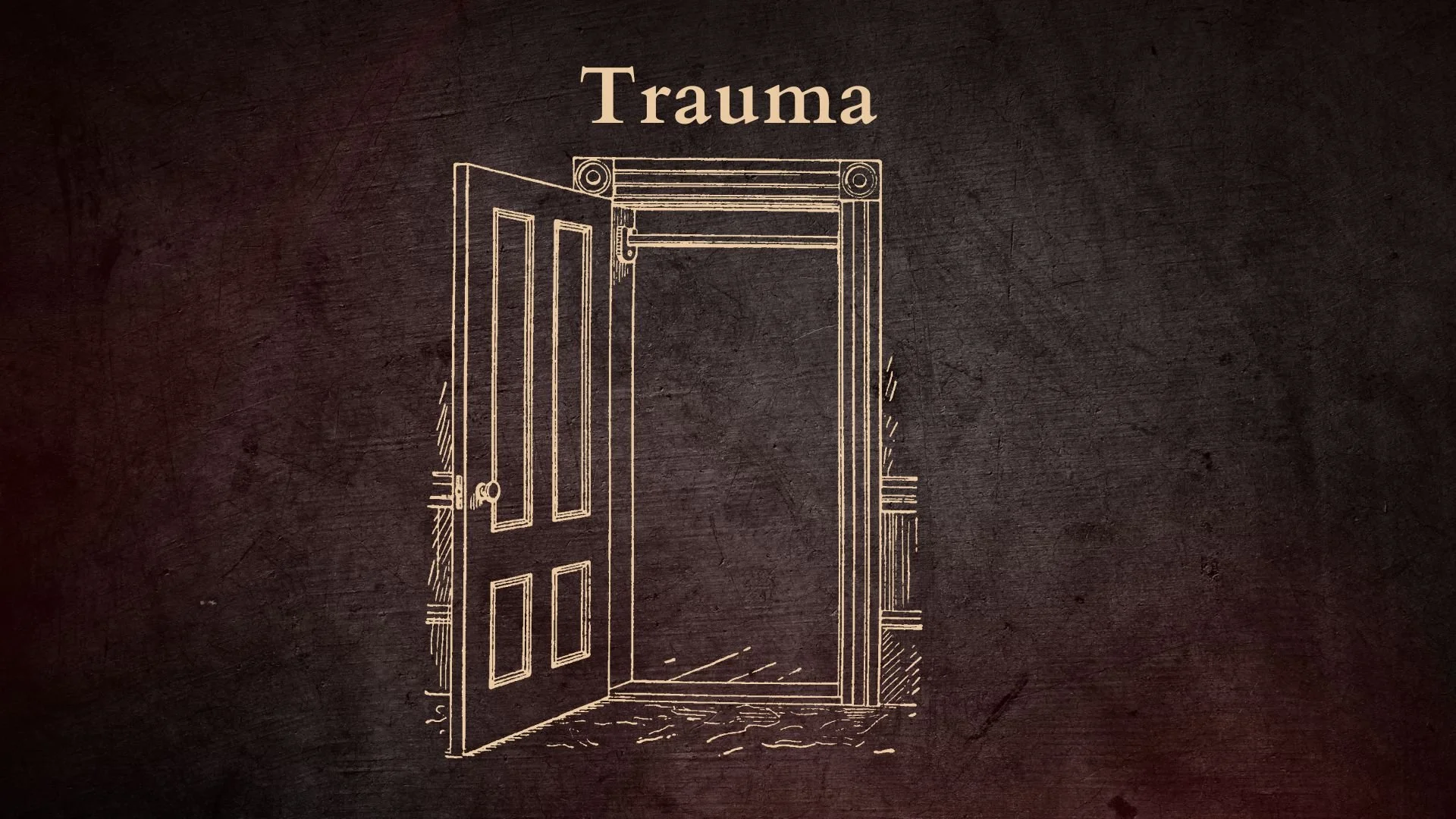
Trauma happens.
And for a moment, everything freezes.
But here’s the part no one talks about:
The doorway isn't built during the trauma.
It's built afterward. Quietly. Piece by piece.
Like a spiritual IKEA project, assembled without instructions but with devastating precision.
It starts with the trauma — the moment something broke. That becomes the top beam of the frame. Then comes the unhealed wound — the lingering ache we never really processed or resolved. That takes its place as the left post, holding the structure steady. Now comes the crucial moment: a lie enters — whispered at the point of maximum vulnerability…
“You’re alone.”
“You’re not safe.”
“You don’t matter.”
“God didn’t show up for you.”
“You’re unlovable.”
That lie becomes the right post — the supporting beam. And once you believe it, agreement forms — like a hinge. That hinge swings open the moment you emotionally nod along. Then coping mechanisms arrive — the doorknob — the habits we think are protecting us but that actually become re-entry points for bondage. And then, quietly, like a thief slipping through the night, the intruder steps in: fear, shame, despair, rejection, torment, heaviness — not invited, but legally permitted.
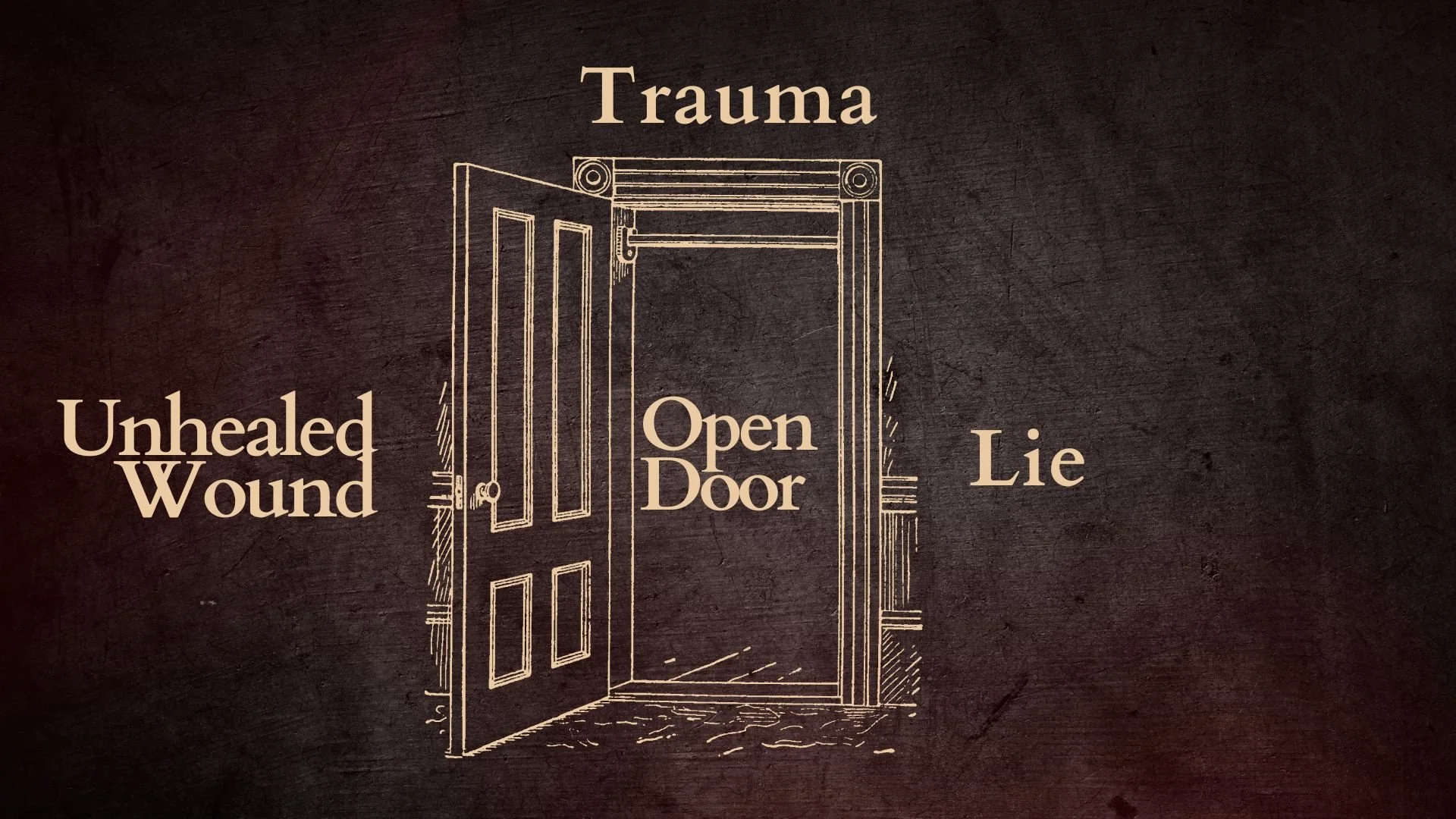
No one intends to build a spiritual doorway.
But unresolved pain, embraced lies, and survival habits become the raw materials.
Time passes. Life moves on.
And suddenly, there it is — a door you never meant to construct, opened to something God never invited in.
Why So Many Believers Feel Spiritually “Blocked”
Modern Christian advice often sounds like:
“Just pray about it.”
“Praise through it.”
“Try harder.”
“Trust God.”
And those things matter — deeply.
But here's the catch:
You can’t cast out what has legal right,
and you can’t praise away what has permission to stay.
You don’t have a faith problem.
You have a wound problem.
And wounds don’t heal through striving — they heal through truth.
How The Devil Uses Pain To Train
Satan doesn’t simply wound you.
He teaches you through the wound.
Trauma becomes his classroom.
And pain becomes a megaphone.
Right after the impact, while your soul is raw, he feeds you doctrine:
“You’re abandoned.”
“You’re unsafe.”
“You’re unseen.”
“You’re worthless.”
“Love hurts.”
“God protects everyone else.”
“You’re damaged.”
And you don’t say it out loud, but a part of your soul whispers,
“…maybe that’s true.”
That is the agreement.
That is the hinge.
That is the moment the door creaks open.
The enemy does not need rebellion —
just cooperation with a lie.
Five Real Doorway Blueprints
1. Abandonment
Trauma: A parent leaves, emotionally or physically.
Wound: Rejection.
Lie: “No one will ever stay.”
Agreement: “I must protect myself.”
Doorway: Self-isolation, mistrust.
Spirit: Rejection, fear, loneliness.
They don’t fear commitment —
they fear devastation.
2. Betrayal
Trauma: Someone you trusted violated you.
Wound: Shattered trust.
Lie: “I can only rely on myself.”
Agreement: “Never trust fully again.”
Doorway: Control, emotional shutdown.
Spirit: Suspicion, fear, jealousy.
They call it discernment —
but it’s actually fear with Bible verses.
3. Humiliation / Shame
Trauma: Mocked, belittled, bullied.
Wound: Identity rupture.
Lie: “I’m not enough.”
Agreement: “I must hide my real self.”
Doorway: People-pleasing, self-rejection.
Spirit: Shame, insecurity, self-loathing.
They don’t lack confidence —
they lack safety.
4. Sudden Loss
Trauma: Unexpected grief or abandonment by circumstance.
Wound: Despair, heartbreak.
Lie: “God didn’t show up.”
Agreement: “I can’t trust God with my heart again.”
Doorway: Withdrawing from faith.
Spirit: Heaviness, hopelessness.
They don’t doubt God exists —
they doubt His care.
5. Sexual Violation
Trauma: Abuse, betrayal of innocence, unwanted exposure.
Wound: Soul defilement.
Lie: “I am dirty.”
Agreement: “I have no worth.”
Doorway: Self-hate, secret shame, compulsion.
Spirit: Lust, torment, confusion.
They don’t struggle with purity —
they struggle with violation.
Why the Church Often Misses It
Because we preach forgiveness without inner healing.
Deliverance without soul repair.
Holiness without emotional restoration.
But Jesus didn’t come just to save you.
He came to heal your soul and then set you free.
Heal the brokenhearted → proclaim liberty
(Luke 4:18)
Not the other way around.
You don’t free captives by yelling at chains —
you heal the heart that forged them.
Healing Doesn’t Mean Pretending It Didn’t Hurt
Healing means:
You remember without bleeding
You feel without drowning
You trust without terror
You love without bracing for abandonment
You rest without fear
You worship with an open heart again
Healing isn’t forgetting.
It's removing the power, authority, and influence of the wound.
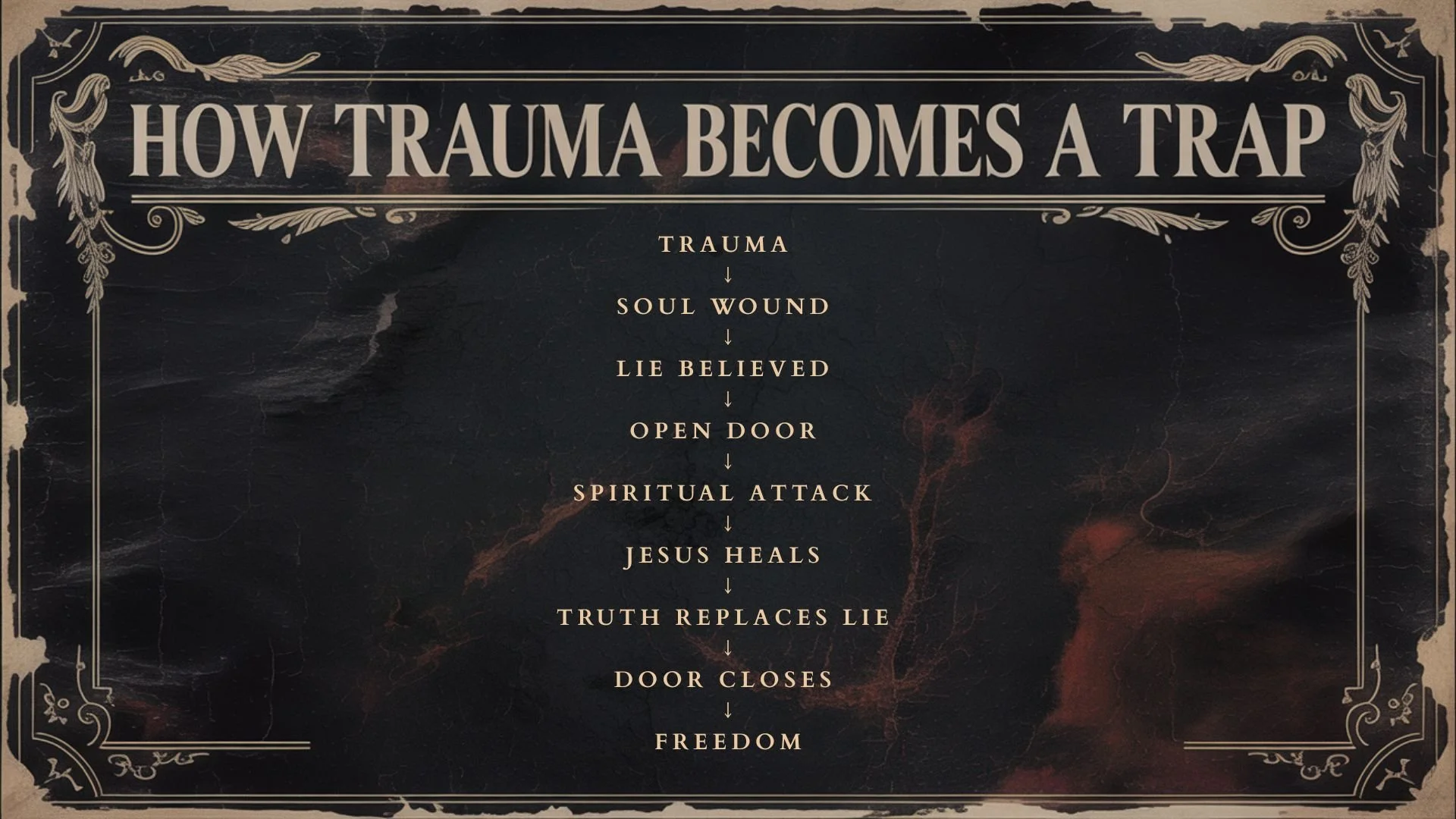
The Door-Closing Prayer
(Intentionally unchanged — this is the legal language that shuts doors.)
Lord Jesus, I come before You…
(full inner-healing prayer as provided)
Pray it slowly.
Name the wound. ___________________________
Break agreement with the lie.
Close the door.
Invite the Spirit of Truth to fill the now-vacated space.
Mercy rebuilds.
Truth seals.
Freedom enters.
This is how you heal a soul.
You're Not Weak — You're Wounded
You don’t need shame.
You don't need to “try harder.”
You don’t need to fake being fine.
You need healing — and Jesus heals deeply.
The enemy hoped your trauma would become a tomb.
Instead, it’s becoming your testimony.
You are not broken beyond repair.
You are being rebuilt by the One who restores souls.
Trauma doesn’t get the last word —
Jesus does.
And He calls you whole.

Debugging the Soul: Understanding Generational Curses
We all inherit things we didn’t choose.
A way of reacting. A fear that doesn’t make sense. A story that seems to replay itself in every generation.
You can feel it sometimes — in the way your temper mirrors your father’s, or how your mother’s anxiety hums quietly in your own chest.
We call it personality.
But what if it’s code?
We all inherit things we didn’t choose.
A way of reacting. A fear that doesn’t make sense. A story that seems to replay itself in every generation.
You can feel it sometimes — in the way your temper mirrors your father’s, or how your mother’s anxiety hums quietly in your own chest.
We call it personality.
But what if it’s code?
What if every human carries an operating system written by generations before us — lines of belief, fear, and desire that keep running in the background until someone decides to rewrite them?
That’s what Scripture calls a curse. Not a superstition, but a system bug — an inherited malfunction that keeps repeating itself until grace steps in to debug the soul.
You can see it in cultures too—repeating loops of greed, division, and decay. Nothing new under the sun, just old code running again on new hardware.
Creation runs on divine architecture—a spiritual operating system—then generational curses are what happen when the system gets breached. Not because of superstition or fate, but because of code that was written wrong and never corrected.
A generational curse isn’t a ghost haunting your family tree. It’s legacy software—a repeating script that keeps running because no one ever went in to comment it out.
Think of it like this: a curse is a malicious process authorized to run in a family’s operating system because someone—an ancestor, a parent, even you—clicked “agree” on the wrong terms of service. It gains access through sin, through the violation of divine law, and continues executing across generations until the original permission is revoked.
A curse is a bug in the code, and bugs never fix themselves.
To understand this, we have to start with the code itself. The Bible calls it “the law,” but that word—torah—means instruction, design, blueprint.
The law of God isn’t a rulebook; it’s the architecture of existence. It’s the source code that governs both Heaven and Earth. “Forever, O Lord, your word is settled in heaven.” Translation: the code is stable. The system works.
Creation itself runs on binary: light and darkness, life and death, blessing and curse, obedience and rebellion. The logic gates of existence. One and zero. When the code aligns with its Designer, everything hums. When it doesn’t, corruption spreads. This is what Deuteronomy 28 describes—not random punishments, but the built-in consequences of disobedience. When you honor the design, you prosper. When you don’t, the system collapses.
The first recorded system breach happened in Eden. We often describe the Fall as a relational failure—Adam and Eve disobeyed, and intimacy was lost. But beneath the heartbreak was something more technical: a legal rupture. God entrusted Adam with dominion—a kind of administrative authority over creation. He wasn’t just tending a garden; he was managing a network. He didn’t have a written law, but he had divine instruction embedded in him. Dominion was sustained through alignment.
When Adam disobeyed, he didn’t merely offend God’s heart; he triggered a breach. The firewall went down. The system was exposed. Humanity’s moral and spiritual DNA—our source code—became open to corruption.
And where there’s vulnerability, there’s exploitation. Lucifer didn’t seize creation by brute force; he logged in with Adam’s stolen credentials. He didn’t own the earth, but he gained control of its systems. He became, as Jesus called him, “the prince of this world,” not because he was enthroned, but because the true administrator abandoned his post.
From that point forward, two systems began running in parallel: the Kingdom of Light, still stable, still secure; and a counterfeit network built on stolen authority—the System of Darkness. Paul called it “the mystery of lawlessness.” Not chaos, but an elegant counterfeit, a rival legal order running corrupted code.
Lucifer The Hacker
Lucifer has always been a hacker, not a creator. He can’t write original code; he can only copy and corrupt what already exists. His strategy is accusation, not creation. He’s not just the tempter; he’s the prosecutor. The “accuser of the brethren” isn’t shouting insults—he’s submitting legal claims based on unpatched vulnerabilities in the human code.
Every unconfessed sin, every unhealed wound, every unresolved agreement with darkness becomes a data point he uses to sustain his access. The real battle isn’t fought with swords or slogans—it’s fought in the court of law and the lines of code.
Humanity’s original role was priestly—to bridge Heaven and Earth, to keep the systems synchronized. We were designed as the API between divine and created realms. But when the priesthood fell, the sync broke. Earth’s operating system desynchronized from Heaven’s. That’s why disease, decay, and death exist—they’re not part of the original design; they’re evidence of desync.
Redemption, then, isn’t escape—it’s restoration. Christ came not as a revolutionary, but as a programmer. The Second Adam logged back in sinless, authorized, and fully aligned. He fulfilled every legal requirement of the code and reestablished human access. He didn’t bypass the law; He fulfilled it from within. Because you can’t hack your way into holiness. You have to satisfy the system.
The Cross was more than a spiritual symbol—it was a system-wide update. When Jesus said, “It is finished,” it wasn’t a cry of exhaustion. It was a deployment notice. The patch was complete. The corrupted build was terminated. A new version of humanity went live.
Colossians says He “canceled the record of debt that stood against us, nailing it to the cross.” That wasn’t metaphor—it was a legal announcement. Every recursive loop of sin, shame, and death was closed. Every access point sealed. Every generational exploit patched.
Communion was never meant to just be a religious ritual. It is the symbolic installation of the new system. “This is my body, broken for you. This is my blood, shed for you.” The old covenantal code—bound by sin and death—was deprecated. A new covenant—powered by grace—was uploaded!
Grace isn’t the absence of law; it’s law fulfilled and rewritten inside us. Romans 8 calls it “the law of the Spirit of life in Christ Jesus,” meaning a higher algorithm now supersedes the corrupted one. The same code, but rewritten in love.
Generational Curses
So where does that leave the idea of generational curses? Think of them as legacy code—scripts that were written generations ago, still running quietly in the background. You didn’t write them, but you’re still executing them. The insecurity, the addiction, the self-sabotage—they’re not random; they’re echoes of inherited code.
It may or may not be your fault. But it is your responsibility to debug it.
Confession is the act of opening the console and viewing the errors. Repentance is deleting the malicious lines. Faith is installing the patch. And the blood of Jesus is the security certificate that authorizes the change.
You don’t need to throw out the whole system; you just need to rewrite the corrupted parts.
Most people try to fix their lives by adding features—new habits, new apps, new affirmations. But that’s surface-level. The real bugs hide in the kernel—in the way you process shame, fear, power, or belonging. The only way to fix a system that’s broken at the root is to reinstall it.
This is what Jesus did. He didn’t just save souls; He restored the source. He didn’t erase the law; He encoded it into the human spirit. The Holy Spirit is now the compiler—translating the code of Christ into human syntax.
Grace runs natively now.
The New Creation Operation System
When Paul said we are “a new creation,” he wasn’t speaking in metaphor. He meant it literally: a new kind of human software now exists. The old operating system has been replaced.
The difference between a person living under a curse and one living under blessing isn’t moral superiority—it’s code alignment. One runs on fear and self-reliance. The other runs on love and obedience. One constantly crashes; the other hums in harmony.
And if you’ve ever wondered why certain patterns keep showing up in your life—why you keep reliving the same conflict, falling into the same relational script, repeating the same fears—it might not be about willpower. It might be about programming.
You’re not broken. You’re running old code.
But here’s the beauty: Jesus paid for your update.
The system doesn’t need to be replaced—it’s already been redeemed. You just have to download what’s already been written for you.
Every time you forgive, you’re rewriting code.
Every time you worship, you’re syncing to the Source.
Every time you love your enemies, you’re running Heaven’s software in real time.
Faith is not superstition—it’s alignment. It’s trusting that the Architect knew what He was doing when He wrote the system. It’s agreeing that His logic still works.
And once you begin to live from that perspective, sin stops feeling like failure. It starts looking like malfunction. Repentance stops feeling like punishment. It starts looking like optimization. Holiness stops feeling like control. It starts looking like stability.
That’s what the gospel really is: not a moral code, but a system update. Not a demand for perfection, but an invitation to restoration.
When Jesus rose from the dead, He didn’t just defeat death—He deployed resurrection life. Paul called Him “the firstfruits,” the prototype of a restored human system—bug-free, death-proof, fully synchronized with Heaven. And now that same Spirit runs in us.
Every believer is a participant in the restoration project of creation. We’re not waiting for Heaven to download; we’re the servers through which it’s being streamed into the world.
Every healed heart is a patch. Every act of forgiveness, a bug fix. Every miracle, a system restore.
Adam opened the loop. Christ closed it. And now, the system is stable again.
If you find yourself repeating the same old patterns, maybe it’s time to ask: is this really me, or is it legacy code still running in the background?
Maybe what your soul needs isn’t another app, another plan, or another promise.
Maybe it just needs a reboot.
Because the patch has already been written.
You just have to install it.

The Compatibility Code
Most of us think of the fruit of the Spirit as a private list.
Love. Joy. Peace. Patience. Kindness. Goodness. Faithfulness. Gentleness. Self-control.
Nine nice words to hang on a wall.
But what if Paul wasn’t handing us a personal development checklist?
What if he was describing a compatibility code?

Most of us think of the fruit of the Spirit as a private list.
Love. Joy. Peace. Patience. Kindness. Goodness. Faithfulness. Gentleness. Self-control.
Nine nice words to hang on a wall.
But what if Paul wasn’t handing us a personal development checklist?
What if he was describing a compatibility code?
The Spirit cuts us into shape.
Left to ourselves, we’re jagged. Sharp corners. Edges that slice instead of join.
Ever tried to jam two puzzle pieces together that don’t fit? You can push, you can bend, you can force… but it doesn’t make a picture. It makes a mess.
The fruit of the Spirit isn’t just about what grows inside of you—it’s about how you’re reshaped for someone else. Each virtue sands down the edges:
Love makes space.
Joy makes you buoyant.
Peace makes you steady.
Patience gives you margin.
Kindness softens the impact.
Goodness makes you trustworthy.
Faithfulness makes you reliable.
Gentleness makes you safe.
Self-control keeps you from snapping.
Together, they make you fit.
The bond of peace is the glue.
Paul calls it “the bond of peace” in Ephesians. That’s not an accident.
Peace isn’t passive. It’s adhesive. It’s the Spirit’s way of locking us together, piece by piece, until a bigger picture emerges.
Alone, you’re just a strange shape. With others, you become part of a masterpiece.
Division breaks the picture.
The enemy knows this. That’s why gossip, suspicion, and bitterness always feel so corrosive—they’re solvents, dissolving the bond of peace.
The culture of hell is division. The culture of heaven is unity.
And unity isn’t sentimental. It’s supernatural.
The challenge.
Don’t just ask, “Am I bearing fruit?”
Ask, “Am I becoming more compatible with others?”
Because heaven shows up not in perfect individuals, but in imperfect people cut to fit, bonded together by peace.

The Power of Covenant
Most of us are great at making commitments.
We commit to eating clean.
To going to the gym.
To being nicer to our spouse.
To getting serious about God.
And then… life happens.
You get tired.
You get offended.
You get distracted.
And just like that, your commitment is out the window.
You know why?
Because commitment isn’t the same as covenant.
Most of us are great at making commitments.
We commit to eating clean.
To going to the gym.
To being nicer to our spouse.
To getting serious about God.
And then… life happens.
You get tired.
You get offended.
You get distracted.
And just like that, your commitment is out the window.
You know why?
Because commitment isn’t the same as covenant.
Covenant isn’t sexy. But it’s powerful.
In the book of Nehemiah, something radical happens.
The people don’t just apologize for messing up.
They go all in.
They write it down.
They sign their names.
They say, “We’re done playing games. This time, we mean it.”
That’s not commitment.
That’s covenant.
Here’s the difference:
Commitment is emotional.
Covenant is intentional.
Commitment says, “As long as this feels right.”
Covenant says, “Even when it doesn’t.”
You’re not tired. You’re unaligned.
You’ve been praying for power, for breakthrough, for purpose.
And you keep wondering why you’re not seeing results.
I’ll tell you why:
Because power follows covenant, not feelings.
You can cry all you want.
You can mean well.
You can post inspirational Bible verses on Instagram all day long.
But if you’re not living in covenant, nothing sticks.
You want results? Make it real.
Here’s how:
1. Make it public.
Stop hiding.
Tell someone what God is doing in your life.
Say it out loud. Write it down. Own it.
You want change? Great. Put it out there.
2. Make it disciplined.
Want to walk in freedom?
It’s not about motivation. It’s about rhythm.
Set the schedule. Show up. No excuses.
Sunday church. Daily prayer. Real accountability.
That’s how grown-ups build a life that lasts.
3. Make it holy.
This isn’t self-help.
This isn’t about being a better person.
This is about surrender.
You don’t need another plan. You need a Savior.
You don’t need to try harder. You need to die to yourself.
Religion says “Do better.”
Covenant says “It’s already done.”
You’re not loved because you perform.
You’re loved because He bled.
You’re not saved because you “meant well.”
You’re saved because Jesus said, “It is finished.”
Listen to me.
You’re not broken beyond repair.
You’re not too far gone.
You’re not the exception.
You are loved.
Right now.
As you are.
And He’s waiting for your yes.
Not your perfect behavior.
Not your spotless record.
Just your yes.
That’s the beginning of covenant.
And that’s where the power is.
Now stop waiting for the feeling.
Stop waiting for the mood.
Step in.
Say yes.
And watch what happens.
You don’t need to be perfect. You just need to be all in.
Let’s go.

Influence Without Control
In this article, Darren explores the powerful difference between control and influence through the lens of Nehemiah’s leadership. He challenges the idea that leadership requires a title or authority, showing instead that true influence is built on moral authority, integrity, and consistency.
You can’t make anyone do anything.
Not really.
You can coerce.
You can manipulate.
You can force.
But that’s not leadership. That’s control.
Nehemiah didn’t control people.
He influenced them.
And that’s the invitation:
To lead without control. To influence without a title.
You want to change your world?
Start here.

Build And Defend
We love the idea of building.
The thrill of starting something new. The excitement of vision, calling, purpose. The sense that we’re participating in something bigger than ourselves.
But what happens when opposition shows up?
What happens when the enemy sees what you're building and decides it’s worth tearing down?
Most people hesitate. They assume that if an idea is truly from God, it shouldn’t require a fight.
Nehemiah knew better.

We love the idea of building
The thrill of starting something new. The excitement of vision, calling, purpose. The sense that we’re participating in something bigger than ourselves.
But what happens when opposition shows up?
What happens when the enemy sees what you're building and decides it’s worth tearing down?
Most people hesitate. They assume that if an idea is truly from God, it shouldn’t require a fight.
Nehemiah knew better. His people weren’t just building. They were battling while they built.
They worked with one hand and held a weapon in the other. They didn’t take off their armor. They never let their guard down.
Because if it’s worth building, it’s worth protecting.
We Build, but We Don’t Guard
It happens all the time.
A business launches, but no one builds the systems to sustain it.
A marriage begins, but no effort is made to protect it.
A dream is birthed, but distractions steal it away.
We ask for blessing but don’t build boundaries.
We cry out for breakthrough but don’t establish safeguards.
We get frustrated by attacks but never take steps to prevent them.
Nehemiah’s people understood that anything worth building will be challenged. So, they stayed ready.
If You Don’t Guard It, You’ll Lose It
"Those who carried burdens were loaded in such a way that each labored on the work with one hand and held his weapon with the other." (Nehemiah 4:17)
Imagine building a house with one hand while holding a sword in the other.
It’s not convenient. But it’s necessary.
Because if you aren’t holding a sword, the enemy assumes you’re easy to take down.
Want to protect your marriage? Guard your words, your time, your priorities.
Want to keep your calling alive? Guard your focus.
Want to build a lasting legacy? Guard your habits.
Loose grips sink ships.
The solution is simple.
Guard it and grip it!
Stay Ready So You Don’t Have to Get Ready
"None of us took off our clothes; each kept his weapon at his right hand." (Nehemiah 4:23)
Most people think they’ll get battle-ready when the fight comes.
They assume they’ll develop discipline when life demands it.
They hope they’ll build resilience when hardship shows up.
It doesn’t work that way.
Nehemiah’s men slept in their armor. They were always ready.
You don’t wait until the attack to pray.
You don’t wait until the crisis to strengthen your marriage.
You don’t wait until the enemy starts taking ground to fight back.
Prepare now, so when the moment comes, you don’t have to scramble.
Find Your People and Fight Together
"In the place where you hear the sound of the trumpet, rally to us there. Our God will fight for us!" (Nehemiah 4:20)
You can’t win this fight alone.
You need people who will rally when you’re under attack.
You need voices that will remind you of the vision when you’re ready to quit.
You need a team that doesn’t scatter when the enemy shows up.
Nehemiah’s men didn’t run from the fight. They ran toward it.
When your marriage is struggling, don’t isolate—get help.
When your business is under attack, don’t retreat—find support.
When you feel spiritually drained, don’t disengage—press into your community.
The enemy wants you alone. The wise know better.
What Are You Building and Are You Protecting It?
Most people don’t fail because they lacked vision.
They fail because they weren’t ready for resistance.
The difference between those who finish and those who quit isn’t calling, talent, or gifting.
It’s vigilance.
Are you guarding what God gave you?
Are you staying battle-ready?
Are you surrounding yourself with people who will fight with you?
Building is only half the job.
Protecting is the other half.

Fighting for What Matters
You are where you are because of the fights you were willing to have—or the ones you avoided. It’s that simple.
Somewhere along the way, we bought into the lie that keeping the peace is the goal. But Jesus didn’t call us to be peacekeepers. He called us to be peacemakers. And there’s a big difference. Peacekeepers avoid conflict. Peacemakers step into it, take ownership, and build something better in its place.

You are where you are because of the fights you were willing to have—or the ones you avoided. It’s that simple.
Somewhere along the way, we bought into the lie that keeping the peace is the goal. But Jesus didn’t call us to be peacekeepers. He called us to be peacemakers. And there’s a big difference. Peacekeepers avoid conflict. Peacemakers step into it, take ownership, and build something better in its place.
Why Christians Struggle with Conflict
Let’s be honest—Christians are notoriously bad at handling conflict. We avoid it. We fear it. And when we do engage, we often do it terribly. Why?
We confuse kindness with passivity. We think that being nice means never rocking the boat. That avoiding confrontation is a virtue. But in reality, avoiding necessary conflict isn’t kindness—it’s cowardice. I know how strong your fight life is by how strong your prayer life is. If you don’t know how to contend in the secret place, you’ll never know how to contend in the public space. We think that being nice means never rocking the boat. That avoiding confrontation is a virtue. But in reality, avoiding necessary conflict isn’t kindness—it’s cowardice.
We’ve been conditioned to keep the peace. Many of us were raised in church cultures that emphasized harmony over honesty. We were told to "forgive and forget" instead of addressing real issues. And so we became people-pleasers rather than truth-tellers.
We don’t like discomfort. Fighting for what matters is uncomfortable. Calling out sin is awkward. Confronting toxicity is painful. It’s easier to pretend everything’s fine than to do the hard work of real reconciliation and real leadership.
We’re afraid of losing relationships. The fear of rejection keeps us silent. We’d rather let a friendship or a marriage slowly deteriorate than risk a conversation that might change everything.
But avoiding conflict doesn’t make it go away—it makes it worse. And when we refuse to fight for what matters, we give the enemy free rein in our lives, our families, and our communities.
Fighting Isn’t the Problem. Avoiding the Fight Is.
Most people in the church don’t know how to fight. We’ve been taught to back down. To let it go. To let the enemy run rampant in our marriages, our families, our careers, and our calling because we think that avoiding conflict is a sign of maturity.
It’s not.
Nehemiah understood this. In Nehemiah 4, the opposition showed up as soon as the work started. Samballat and Tobiah mocked and ridiculed them, trying to get in their heads. That’s how the enemy works. The moment you move from talking about something to building something, the opposition shows up.
So what did Nehemiah do? He prayed—and then he acted. He set guards. He armed his people. He made sure they were ready to fight. And then he told them something crucial:
Do not be afraid of them. Remember the Lord, who is great and awesome, and fight for your brothers, your sons, your daughters, your wives, and your homes. (Nehemiah 4:14)
He didn’t tell them to run. He told them to remember.
Remember who God is. Remember what’s at stake. Remember what you’re building—and why it’s worth fighting for.
The Cost of Avoiding the Fight
Some of you are stuck. You’ve been circling the same mountain for years because, at some point, God called you to something, and you didn’t step in. Fear crept in. The enemy got in your head. And instead of fighting, you backed down.
Good news: You can get back in the fight. God restores the years the enemy has stolen.
The enemy wants to get in your head. He wants to discourage you, depress you, and convince you that you’ve lost your appointment. But here’s the truth:
You are anointed.
You are appointed.
And the enemy can’t take that from you.
So What Do You Do?
Pray like a warrior. Stop praying passive prayers. Stop asking God to do what He’s given you the authority to do. Pray boldly. Pray militantly. I know how strong your fight life is by how strong your prayer life is. If you don’t know how to contend in the secret place, you’ll never know how to contend in the public space. Stop praying passive prayers. Stop asking God to do what He’s given you the authority to do. Pray boldly. Pray militantly. Pray publicly.
Fight for your faith. If your faith is weak, everything else will be. Get filled with the Holy Spirit. Pray in tongues. Build yourself up in the most holy faith.
Fight for your family. Revival begins at home. Love your spouse. Date your spouse. Fight for your kids.
Fight for your future. God has a plan for you, but you have to fight for it. Declare His promises. Take action. Stop waiting for the perfect moment—it doesn’t exist.
The Bottom Line
The enemy has a strategy to take you out. To keep you stuck. To keep you scared. But you weren’t called to be passive. You weren’t called to sit on the sidelines.
You were called to fight.
And fight we will.
Because we serve a warrior King.

The 4 Questions Builders Ask
Most people prefer a comfortable lie over an inconvenient truth.
They sugarcoat reality. They downplay their problems. They avoid the hard questions because hard questions demand hard answers.
But Nehemiah? He wasn’t afraid to look at the ruins.
He wasn’t a pessimist—he didn’t drown in despair. He wasn’t a naïve optimist—he didn’t pretend things were fine. He was a realist.
And reality is the foundation of every successful rebuilding effort.
Most people prefer a comfortable lie over an inconvenient truth.
They sugarcoat reality. They downplay their problems. They avoid the hard questions because hard questions demand hard answers.
But Nehemiah? He wasn’t afraid to look at the ruins.
He wasn’t a pessimist—he didn’t drown in despair. He wasn’t a naïve optimist—he didn’t pretend things were fine. He was a realist.
And reality is the foundation of every successful rebuilding effort.
The Brutal Honesty of Rebuilding
Before you can rebuild anything—a business, a marriage, a church, a reputation—you have to start by seeing things clearly. That means asking four hard questions.
1. What’s broken? Stop sugarcoating it.
If your marriage is in trouble, say it. If your business is failing, admit it. If your faith feels dead, acknowledge it. Pretending things are fine doesn’t make them fine. Clarity is the first step toward change.
2. What’s possible? Stop making excuses.
Yes, things are bad. But are they unfixable? Is there a way forward? A path to restoration? Nehemiah didn’t just see the ruins—he saw what could be rebuilt. He saw the future inside the destruction. That’s what leaders do. They don’t just see the problem; they see the potential.
3. Who’s with you? Not everyone near you is for you.
Some people will help. Others will watch. Some will believe in the vision. Others will quietly hope you fail. Nehemiah didn’t assume everyone was on his side. He identified his allies and strengthened his inner circle. Rebuilding is not a solo mission. Choose your team wisely.
4. Who’s against you? The enemy is watching you assess the ruins.
Not everyone wants you to succeed. Some people profit from brokenness. Some are threatened by your restoration. Nehemiah didn’t just inspect the walls; he was aware of the opposition. The moment you decide to rebuild, there will be resistance. Prepare for it.
The Hardest Step is the First One
The biggest barrier to change isn’t lack of resources. It isn’t opposition. It isn’t even failure.
It’s refusing to acknowledge reality.
You can’t fix a marriage if you won’t admit it’s broken. You can’t rebuild a business if you ignore the financial cracks. You can’t step into your calling if you refuse to assess where you actually are.
Nehemiah knew that seeing is the first battle. And so do you.
Before You Build, Face the Brutal Facts
This is where most people quit before they even start. It’s easier to talk about rebuilding than actually do it. It’s easier to hope things change than take responsibility for them. It’s easier to delay the hard conversations than face the truth.
But if you want to move forward, you have to see clearly. See the damage. See the possibilities. See the threats.
And most importantly—see it before your enemies see it.
Because the people who rebuild aren’t the ones who wait for things to magically improve. They’re the ones who face reality and move forward anyway.
You cannot fix what you refuse to face.