

The Power of Covenant
Most of us are great at making commitments.
We commit to eating clean.
To going to the gym.
To being nicer to our spouse.
To getting serious about God.
And then… life happens.
You get tired.
You get offended.
You get distracted.
And just like that, your commitment is out the window.
You know why?
Because commitment isn’t the same as covenant.
Most of us are great at making commitments.
We commit to eating clean.
To going to the gym.
To being nicer to our spouse.
To getting serious about God.
And then… life happens.
You get tired.
You get offended.
You get distracted.
And just like that, your commitment is out the window.
You know why?
Because commitment isn’t the same as covenant.
Covenant isn’t sexy. But it’s powerful.
In the book of Nehemiah, something radical happens.
The people don’t just apologize for messing up.
They go all in.
They write it down.
They sign their names.
They say, “We’re done playing games. This time, we mean it.”
That’s not commitment.
That’s covenant.
Here’s the difference:
Commitment is emotional.
Covenant is intentional.
Commitment says, “As long as this feels right.”
Covenant says, “Even when it doesn’t.”
You’re not tired. You’re unaligned.
You’ve been praying for power, for breakthrough, for purpose.
And you keep wondering why you’re not seeing results.
I’ll tell you why:
Because power follows covenant, not feelings.
You can cry all you want.
You can mean well.
You can post inspirational Bible verses on Instagram all day long.
But if you’re not living in covenant, nothing sticks.
You want results? Make it real.
Here’s how:
1. Make it public.
Stop hiding.
Tell someone what God is doing in your life.
Say it out loud. Write it down. Own it.
You want change? Great. Put it out there.
2. Make it disciplined.
Want to walk in freedom?
It’s not about motivation. It’s about rhythm.
Set the schedule. Show up. No excuses.
Sunday church. Daily prayer. Real accountability.
That’s how grown-ups build a life that lasts.
3. Make it holy.
This isn’t self-help.
This isn’t about being a better person.
This is about surrender.
You don’t need another plan. You need a Savior.
You don’t need to try harder. You need to die to yourself.
Religion says “Do better.”
Covenant says “It’s already done.”
You’re not loved because you perform.
You’re loved because He bled.
You’re not saved because you “meant well.”
You’re saved because Jesus said, “It is finished.”
Listen to me.
You’re not broken beyond repair.
You’re not too far gone.
You’re not the exception.
You are loved.
Right now.
As you are.
And He’s waiting for your yes.
Not your perfect behavior.
Not your spotless record.
Just your yes.
That’s the beginning of covenant.
And that’s where the power is.
Now stop waiting for the feeling.
Stop waiting for the mood.
Step in.
Say yes.
And watch what happens.
You don’t need to be perfect. You just need to be all in.
Let’s go.

The Playground Strategy Isn’t Working
There’s a difference between fighting a war and picking a fight.
Too often, what gets labeled “spiritual warfare” is nothing more than a jolt of caffeine, a hit of dopamine, and a random burst of emotion disguised as strategy. We call it warfare, but it’s not. It’s noise. It’s lashing out. It’s babbling in battle gear.
It’s the kid who kicks the bully in the shin and sprints away—because there’s no plan to stand, no commitment to see it through, no positioning to actually win.
The problem with this approach? It may feel bold, but it’s mostly reaction. It doesn’t build. It doesn’t reclaim. It doesn’t last.
There’s a difference between fighting a war and picking a fight.
Too often, what gets labeled “spiritual warfare” is nothing more than a jolt of caffeine, a hit of dopamine, and a random burst of emotion disguised as strategy. We call it warfare, but it’s not. It’s noise. It’s lashing out. It’s babbling in battle gear.
It’s the kid who kicks the bully in the shin and sprints away—because there’s no plan to stand, no commitment to see it through, no positioning to actually win.
The problem with this approach? It may feel bold, but it’s mostly reaction. It doesn’t build. It doesn’t reclaim. It doesn’t last.
War—real war—requires endurance. It demands a different posture: quiet resolve, long-term investment, and the willingness to hold your ground even when the headlines fade.
You don’t win a war with a single tweet. You don’t take ground by storming the gates once a year at a conference. You win when you stop reacting and start building.
The Kingdom isn’t dropped in like a flash mob. It comes through farmers, not fighters. Through architects, not anarchists. Through people who wake up every morning and sow into something that will outlast them.
Yes, the enemy is real. But so is strategy. And timing. And wisdom. And alignment. And the kind of obedience that doesn’t need a microphone to feel powerful.
It’s time to stop running at giants with slingshots we only dust off when we feel “led.” It’s time to become a people of precision and persistence.
We don’t need more noise. We need a network. A grid of commitment. A culture of faithful resistance.
So let’s ditch the playground tantrums.
And let’s start building something the gates of hell can’t shake.
Because that’s how Kingdoms come.

Affirmation Is Not the Doorway to Joy
This article challenges the cultural obsession with affirmation as the path to healing, arguing instead that true joy begins with truth—not comfort. It explores how grace-fueled transformation starts with conviction, confession, and repentance, not denial or flattery. Rooted in the gospel, it reminds us that while tears may come first, they are the seeds of a deeper joy only Christ can bring. Transformation isn’t achieved—it’s received. And joy, in the end, is not manufactured but harvested through surrender.

Affirmation of a lie only leads to further deception—and deeper bondage.
It might numb the shame.
It might offer a quick hit of soul relief.
But hours later, truth comes knocking… and the hangover begins.
Simply trying to verbally rescue people from shame or suffering isn’t the role of a Christian.
Our job isn’t to edit reality for comfort.
It’s to tell the truth—with love, with grace, and with an eye toward real freedom.
Because real transformation doesn’t begin with affirmation.
It begins with truth.
But not cold, detached truth—truth carried by grace.
Salvation by grace through faith in Christ alone opens the door.
It’s the Spirit who convicts.
It’s grace that leads to confession.
And it’s the kindness of God that empowers repentance.
We don’t climb our way into joy.
We’re led into it.
This is how joy is born.
Before there is real, lasting joy, there are tears.
Tears are the seeds.
Not because sadness is spiritual, but because honesty is.
Remorse.
Shame.
Conviction.
These aren’t enemies to avoid.
They’re signals—pointing us back to the One who carries our burden and rewrites our story.
They bring us fully and honestly to the end of ourselves—
To the revelation of our dependency.
To the reality of our union with Christ.
Transformation doesn’t happen when we hide from the truth.
It happens when we step into it—
Fully exposed, completely known, and deeply loved.
So sow your sorrow.
Water it with grace.
Let the Spirit do what only He can do.
Because in Christ, even your tears have purpose.
And joy is not just possible—it’s inevitable.

The One Mountain Mandate
Jesus didn’t teach us to pray so we’d sound holy.
He taught us to pray so we’d build something.
“Your kingdom come, your will be done, on earth as it is in heaven.”
—Matthew 6:10
Not just a poem.
Not just a lyric.
A blueprint.

Jesus didn’t teach us to pray so we’d sound holy.
He taught us to pray so we’d build something.
“Your kingdom come, your will be done, on earth as it is in heaven.”
—Matthew 6:10
Not just a poem.
Not just a lyric.
A blueprint.
Heaven is the top of the mountain.
Earth is the base.
And the call?
Bring the top down.
Before Moses ever led people, he climbed.
Before he gave commands, he received them.
Before he changed the world, he was changed.
“Then the Lord said to Moses, ‘Come up to Me on the mountain and be there; and I will give you tablets of stone, and the law and commandments which I have written, that you may teach them.’”
—Exodus 24:12 (NKJV)
Not do there.
Be there.
Because if you don’t learn to be with Him,
you’ll have nothing to give from Him.
Isaiah echoes the same rhythm.
“Come, let us go up to the mountain of the Lord. There He will teach us His ways, and we will walk in His paths.”
—Isaiah 2:3 (NLT)
This is practical.
This is mystical.
This is a command.
Jesus basically says, “Ministry is to look this way.”
The Temptation
The temptation, when we haven’t gone up the mountain to be with the Lord,
is to replace the mountain with a man-made model.
A successful-looking substitute.
Something someone else built—
that once worked.
So we replicate.
Again and again.
But replication is not revelation.
The crowd size at an event?
Doesn’t frame success.
The offering total?
Doesn’t frame success.
The YouTube views?
Not it.
Even a viral moment?
Still not it.
Heaven On Earth
Heaven on earth—that’s the measure.
Catalytic moments that bend gravity.
Moments that shift culture.
Moments that pull history in the direction of glory.
That’s the only model that matters.
So here’s how the pattern plays out.
You go in to go up.
Not to escape the world, but to receive something for it.
You create space. You fight for minutes. Because minutes create moments.
The kitchen table becomes Sinai.
The car ride becomes sacred.
But it’s always uphill.
It costs time.
It costs silence.
It costs honesty.
The mountain will always cost you something.
You’ll want to skip it.
You’ll want to serve before you’ve sat.
You’ll want to talk before you’ve listened.
You’ll want to react before you’ve abided.
That’s what makes the mountain hard.
But that’s what makes the mountain holy.
And when you go up, go to receive.
This isn’t a retreat.
This isn’t a quiet time with curated vibes.
This is covenant.
You don’t go up to feel something.
You go up to receive someone.
Moses didn’t walk out of the cloud with a feeling.
He walked out with a greater relationship, and tablets.
Truth you can carry.
Words that still set captives free.
“And He gave to Moses… two tablets of the testimony, tablets of stone, written with the finger of God.”
—Exodus 31:18
Moments with God aren’t just for memory.
They’re for mandates.
And then—
you come down.
Because the mountain isn’t the mission.
The mission is what you bring down from the mountain.
Newton said what goes up must come down.
But heaven says what goes up must come down with glory.
You weren’t filled to stay full.
You were filled to be poured out.
So your job? It’s your ministry.
Your home? It’s your mission field.
Your street? It’s your sermon.
The evidence of the encounter isn’t how you felt in the cloud—
It’s how you live in the crowd.
The fire wasn’t meant for storage.
It was meant for cities.
And Eden—this is the pattern.
Go in. Go up.
Receive. Come out.
Bring it down.
Not once.
Not someday.
Every day.
Because the world isn’t transformed by people who had a moment at the mountain.
It’s transformed by people who came down glowing, commissioned, and generous.
“Now it was so, when Moses came down from Mount Sinai… the skin of his face shone while he talked with Him.”
—Exodus 34:29
IN is UP.
OUT is DOWN.
That’s the rhythm of revival.
Let’s go.

Don’t Just Build the Fire Pit (And Forget the Flame)
Stop obsessing over perfect structures and start tending to people. Using the metaphor of a fire pit and flame, this article draws from Nehemiah’s example to show that real leadership requires both systems and souls—framework and fire. You don’t just build for the sake of building; you build to host something alive. Leaders are accountable not just for what they construct, but for who gathers because of it.

Anyone can dig a hole and call it a fire pit.
Stack some stones. Make it symmetrical.
Post a photo. Feel accomplished.
But a fire pit without flame is just landscaping.
And a flame without fuel burns out fast.
Movements are the same.
Structure without people is cold.
People without structure scatter.
Nehemiah knew this.
He built the wall. But he didn’t stop there.
He looked around and asked: Where are the people?
He didn’t celebrate a finished framework.
He asked a deeper question: Who are we building this for?
Then he counted them. Appointed them.
Named roles before the city was full.
Because real leaders don’t wait for crowds.
They steward sparks.
The fire came because he prepared a place for it.
And the people stayed because there was warmth and direction.
Too many leaders today are obsessed with building fire pits.
The polished structure. The perfect model.
But no one wants to light the match.
Or worse—they expect a fire with no wood, no air, no effort.
If you build the pit but forget the flame, all you’ve done is decorate the ground.
If you chase the flame but refuse to build, all you’ve got is a wildfire.
Leadership is both.
Build the place.
Fuel the fire.
Tend the people.
And never forget:
You’re not building for the sake of building.
You’re building for the sake of those who will gather around the flame.

Success is a Magnet
Most people think finishing is the finish line—they believe success secures itself. But success is actually a magnet, attracting both opportunity and opposition. Nehemiah shows a different way: finishing isn’t enough—you must also fortify. This blog challenges the common mindset of "celebrate and coast" and invites you into a wiser way of thinking—protect what you build, or risk losing it.
Success is a magnet.
It pulls opportunity.
It pulls momentum.
It also pulls enemies.
Nehemiah finished Jerusalem’s wall in 52 days.
Miraculous. Historic.
But Nehemiah knew the truth most people forget:
Finishing isn’t the finish line.
When you succeed, you attract everything — the good and the bad.
Supporters. Imitators. Critics. Saboteurs.
Your success becomes a signal. A spotlight.
That’s why Nehemiah didn’t celebrate when the wall went up.
He fortified it.
He posted guards.
He tightened the perimeter.
He finished and fortified.
Because a blessing unguarded is a blessing abandoned.
How to Protect Your Reputation
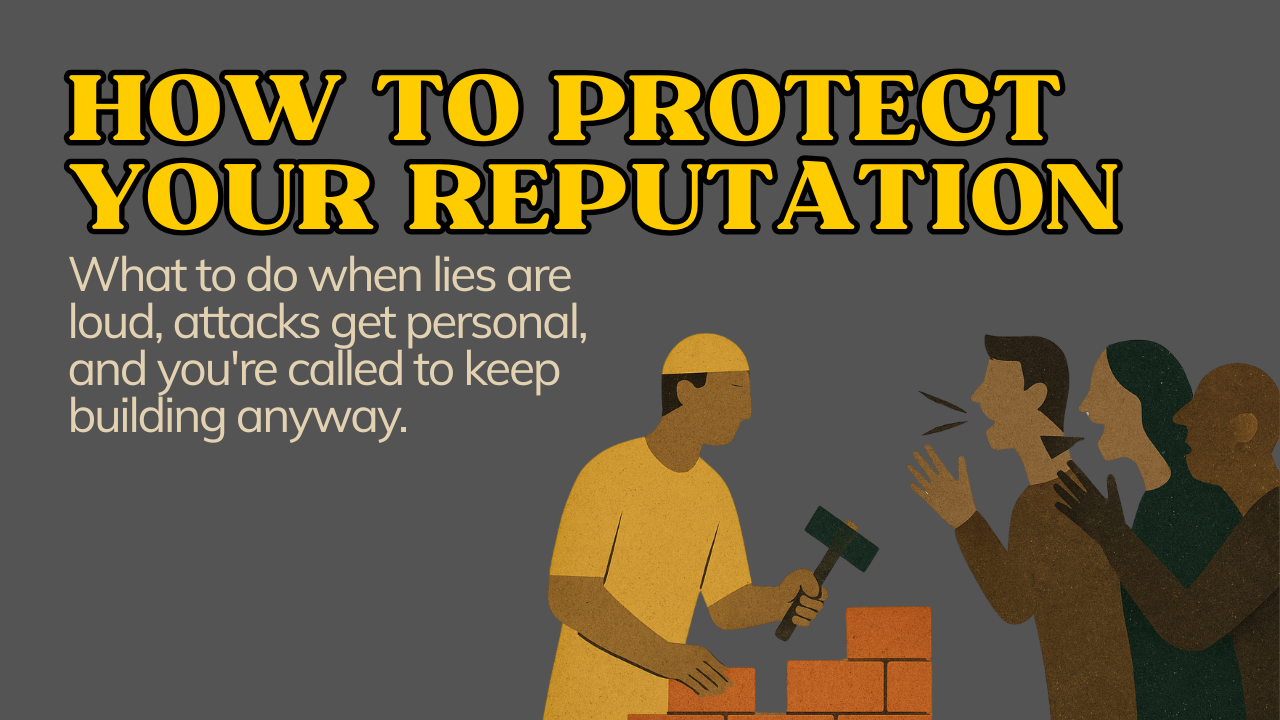
How to protect your reputation when you're under spiritual, personal, or public attack—drawing wisdom from Nehemiah 6. When you're building something meaningful, resistance is inevitable. Rather than reacting to gossip, slander, or false accusations, the biblical approach is to stay grounded in integrity, avoid petty arguments, trust God for vindication, and keep your hands on the work. With a bold, minimalist tone inspired by Seth Godin, this piece challenges readers to remain faithful to their calling in the face of character assassination and distraction. The higher you build, the louder it gets—but your persistence is your protection.

Nehemiah was almost done. The wall was nearly finished. The noise got louder.
That’s the pattern.
Build something that matters, and opposition will follow. Not just criticism — assassination. Of your purpose. Your character. Your authority.
But you don’t have to play their game.
In the Kingdom, the win isn’t applause — it’s obedience.
Staying faithful to your assignment is the victory.
When resistance comes — and it will — don’t panic. Don’t retaliate.
Keep building.
1. Guard Your Private Life Like It’s Sacred (Because It Is)
The enemy doesn’t need much — just a crack in the door. A scrap of gossip. A late-night message that never should’ve been sent.
And if he can’t find anything real? He’ll make it up.
So don’t give him anything.
No fuel. No crumbs. No open windows.
Your integrity is the firewall. Your character is your cloak.
Your private life is the scaffolding of your public influence. Protect it like your calling depends on it — because it does.
2. Don’t Argue with Fools
There’s a difference between being wise and being loud.
Proverbs says, “Do not answer a fool according to his folly.” Translation? Stop arguing with trolls.
The moment you start defending yourself to the wrong crowd, you’ve already lost. Because their goal isn’t truth — it’s distraction.
And the minute you stop to engage, the wall stops rising.
Let them tweet. Let them spin. Let them make YouTube videos about you.
You don’t owe everyone an answer. You owe God your obedience.
3. Let God Be Your PR Team
Psalm 37:6 — “He will make your righteousness shine like the dawn.”
God is better at vindicating you than you are. Way better.
When you walk in obedience, your life becomes undeniable.
And when that fruit starts falling off your tree? Even your enemies will have to admit it’s real.
Time and truth are a team — and they always win in the end.
4. Keep Your Hands on the Bricks
This is where it gets gritty.
Nehemiah didn’t stop. Not for threats. Not for gossip. Not for false accusations.
He stayed on the wall.
He knew what we often forget: the goal of slander is not just to hurt you — it’s to stop you.
But every brick you lay is a middle finger to hell. Every prayer, every step, every act of faithfulness is a declaration: I will not come down.
Because Heaven is watching. And Hell is trembling.
The Higher You Build, the Louder It Gets
This isn’t just about damage control. It’s about destiny.
If they’re trying to pull you down, it’s probably because you’re finally standing up.
So let them talk.
You? Keep your hands dirty with the work.
Don’t let a liar’s words stop a holy assignment.
Don’t trade your hammer for a microphone.
Don’t come down from that wall.
What you’re building is bigger than the backlash.
And what God is doing in you is louder than anything they can say about you.

Influence Without Control
In this article, Darren explores the powerful difference between control and influence through the lens of Nehemiah’s leadership. He challenges the idea that leadership requires a title or authority, showing instead that true influence is built on moral authority, integrity, and consistency.
You can’t make anyone do anything.
Not really.
You can coerce.
You can manipulate.
You can force.
But that’s not leadership. That’s control.
Nehemiah didn’t control people.
He influenced them.
And that’s the invitation:
To lead without control. To influence without a title.
You want to change your world?
Start here.