
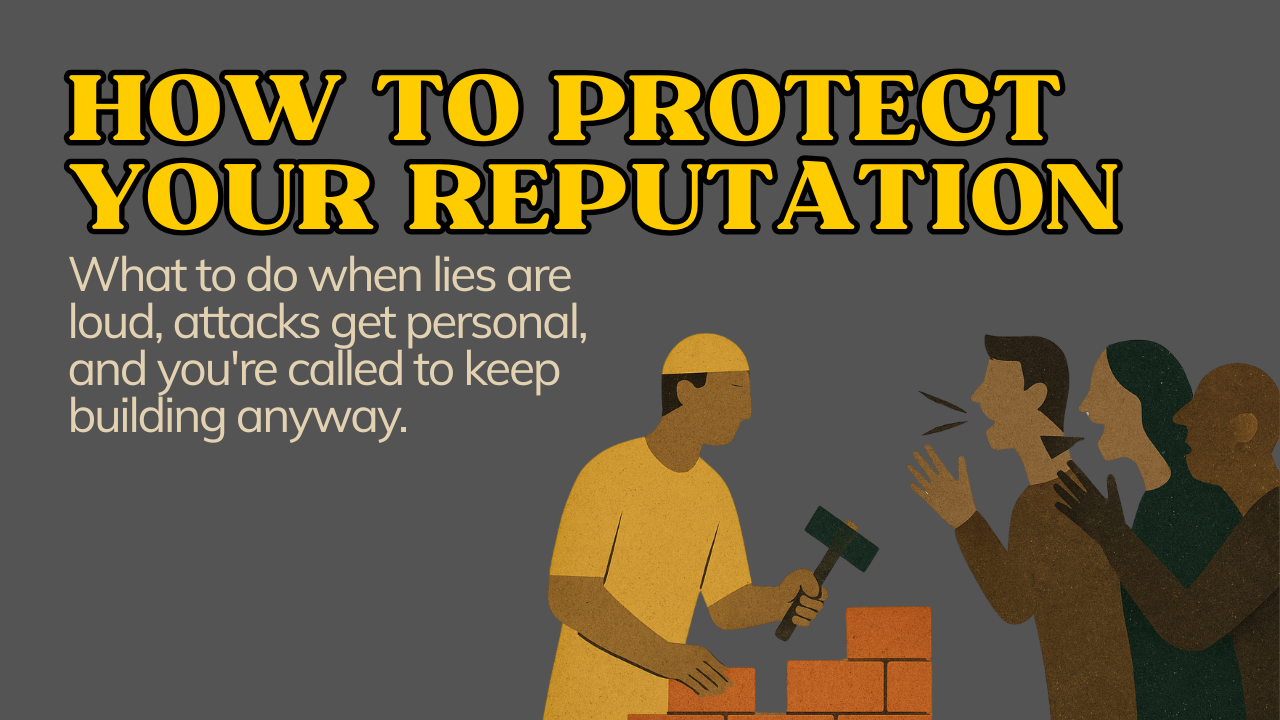
How to Protect Your Reputation
How to protect your reputation when you're under spiritual, personal, or public attack—drawing wisdom from Nehemiah 6. When you're building something meaningful, resistance is inevitable. Rather than reacting to gossip, slander, or false accusations, the biblical approach is to stay grounded in integrity, avoid petty arguments, trust God for vindication, and keep your hands on the work. With a bold, minimalist tone inspired by Seth Godin, this piece challenges readers to remain faithful to their calling in the face of character assassination and distraction. The higher you build, the louder it gets—but your persistence is your protection.

Nehemiah was almost done. The wall was nearly finished. The noise got louder.
That’s the pattern.
Build something that matters, and opposition will follow. Not just criticism — assassination. Of your purpose. Your character. Your authority.
But you don’t have to play their game.
In the Kingdom, the win isn’t applause — it’s obedience.
Staying faithful to your assignment is the victory.
When resistance comes — and it will — don’t panic. Don’t retaliate.
Keep building.
1. Guard Your Private Life Like It’s Sacred (Because It Is)
The enemy doesn’t need much — just a crack in the door. A scrap of gossip. A late-night message that never should’ve been sent.
And if he can’t find anything real? He’ll make it up.
So don’t give him anything.
No fuel. No crumbs. No open windows.
Your integrity is the firewall. Your character is your cloak.
Your private life is the scaffolding of your public influence. Protect it like your calling depends on it — because it does.
2. Don’t Argue with Fools
There’s a difference between being wise and being loud.
Proverbs says, “Do not answer a fool according to his folly.” Translation? Stop arguing with trolls.
The moment you start defending yourself to the wrong crowd, you’ve already lost. Because their goal isn’t truth — it’s distraction.
And the minute you stop to engage, the wall stops rising.
Let them tweet. Let them spin. Let them make YouTube videos about you.
You don’t owe everyone an answer. You owe God your obedience.
3. Let God Be Your PR Team
Psalm 37:6 — “He will make your righteousness shine like the dawn.”
God is better at vindicating you than you are. Way better.
When you walk in obedience, your life becomes undeniable.
And when that fruit starts falling off your tree? Even your enemies will have to admit it’s real.
Time and truth are a team — and they always win in the end.
4. Keep Your Hands on the Bricks
This is where it gets gritty.
Nehemiah didn’t stop. Not for threats. Not for gossip. Not for false accusations.
He stayed on the wall.
He knew what we often forget: the goal of slander is not just to hurt you — it’s to stop you.
But every brick you lay is a middle finger to hell. Every prayer, every step, every act of faithfulness is a declaration: I will not come down.
Because Heaven is watching. And Hell is trembling.
The Higher You Build, the Louder It Gets
This isn’t just about damage control. It’s about destiny.
If they’re trying to pull you down, it’s probably because you’re finally standing up.
So let them talk.
You? Keep your hands dirty with the work.
Don’t let a liar’s words stop a holy assignment.
Don’t trade your hammer for a microphone.
Don’t come down from that wall.
What you’re building is bigger than the backlash.
And what God is doing in you is louder than anything they can say about you.

Influence Without Control
In this article, Darren explores the powerful difference between control and influence through the lens of Nehemiah’s leadership. He challenges the idea that leadership requires a title or authority, showing instead that true influence is built on moral authority, integrity, and consistency.
You can’t make anyone do anything.
Not really.
You can coerce.
You can manipulate.
You can force.
But that’s not leadership. That’s control.
Nehemiah didn’t control people.
He influenced them.
And that’s the invitation:
To lead without control. To influence without a title.
You want to change your world?
Start here.

When the People Cry Out
There’s a moment—
A shift.
A sound too raw, too human, too urgent to ignore.
It doesn’t come from enemies.
It comes from within the walls.
From the people we thought were safe.
From the voices we trained ourselves not to hear.
They weren’t strangers.
They were family.
The very people of God.
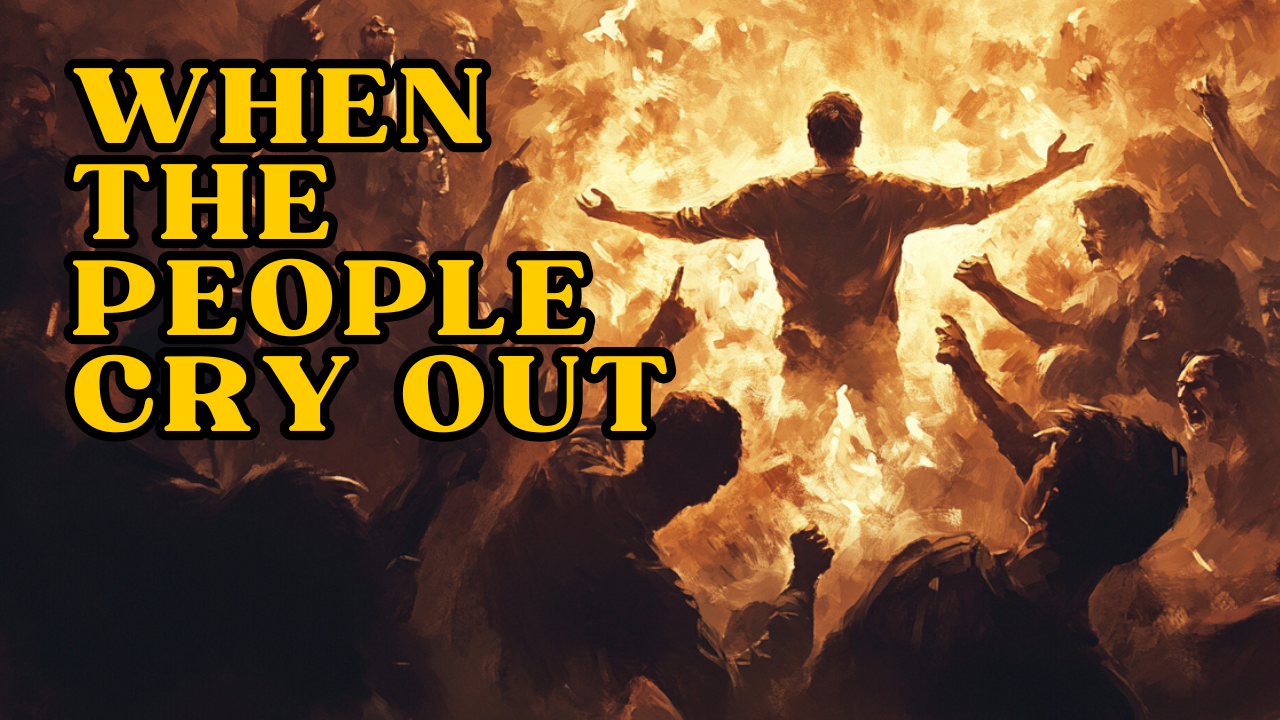
Nehemiah 5:1–13
There’s a moment—
A shift.
A sound too raw, too human, too urgent to ignore.
It doesn’t come from enemies.
It comes from within the walls.
From the people we thought were safe.
From the voices we trained ourselves not to hear.
They weren’t strangers.
They were family.
The very people of God.
And they were being crushed.
The text says,
“There arose a great outcry...”
It wasn’t noise.
It was signal.
The kind that slices through distraction.
The kind that makes a true leader pause—
Not to analyze, but to act.
Nehemiah didn’t manage the crisis.
He embodied it.
He got angry.
But not the kind of anger that burns bridges—
The kind that builds new ones.
Because he knew:
What’s the point of rebuilding walls if the people behind them are enslaved?
What good is a move of God if it doesn’t move us toward justice?
What’s the value of leadership that only asks, “What’s in it for me?”
Leadership isn’t about being in charge.
It’s about being in between.
Between the pain and the promise.
Between the silence and the sound.
1. Hear the Cry. Prophesy the Future.
Don’t dismiss what disturbs you.
Leadership begins with listening—not with the ears, but with the soul.
You can’t solve what you refuse to feel.
“There arose a great outcry of the people…” (Nehemiah 5:1)
Real leaders hear what others ignore.
And when they hear it—they speak.
They name what God is saying.
They create the future by declaring it.
2. Name the Wrong. Don’t Cover It.
Call it. Don’t coat it.
Injustice thrives in ambiguity.
Religious language has a way of making rot look holy.
But Nehemiah didn’t spiritualize sin—he exposed it.
“I was very angry… I brought charges against the nobles and the officials.” (Nehemiah 5:6–7)
Confrontation is compassion in motion.
When you name the wrong, healing can finally begin.
3. Expect Repentance. Build for Breakthrough.
Bold leadership breaks strongholds.
We’ve grown too used to managing dysfunction.
Nehemiah demanded change—and got it.
Not because he was loud, but because he was clear.
“We will restore… we will do as you say.” (Nehemiah 5:12–13)
When leaders speak with integrity, people respond.
Not just with applause—but with action.
You’ve heard something
A whisper. A rumble. A cry.
Maybe it’s not public.
But in your spirit, it’s loud.
This is your cue.
Not to wait.
Not to delegate.
Not to play it safe.
Because Kingdom leadership doesn’t wait for permission.
It answers the cry.
So—will you?
Will you rise?
Will you risk?
Will you lead?
Because heaven is listening.
And the people are crying.
Let it be you.
Let it be now.
Let it be loud.

Build And Defend
We love the idea of building.
The thrill of starting something new. The excitement of vision, calling, purpose. The sense that we’re participating in something bigger than ourselves.
But what happens when opposition shows up?
What happens when the enemy sees what you're building and decides it’s worth tearing down?
Most people hesitate. They assume that if an idea is truly from God, it shouldn’t require a fight.
Nehemiah knew better.

We love the idea of building
The thrill of starting something new. The excitement of vision, calling, purpose. The sense that we’re participating in something bigger than ourselves.
But what happens when opposition shows up?
What happens when the enemy sees what you're building and decides it’s worth tearing down?
Most people hesitate. They assume that if an idea is truly from God, it shouldn’t require a fight.
Nehemiah knew better. His people weren’t just building. They were battling while they built.
They worked with one hand and held a weapon in the other. They didn’t take off their armor. They never let their guard down.
Because if it’s worth building, it’s worth protecting.
We Build, but We Don’t Guard
It happens all the time.
A business launches, but no one builds the systems to sustain it.
A marriage begins, but no effort is made to protect it.
A dream is birthed, but distractions steal it away.
We ask for blessing but don’t build boundaries.
We cry out for breakthrough but don’t establish safeguards.
We get frustrated by attacks but never take steps to prevent them.
Nehemiah’s people understood that anything worth building will be challenged. So, they stayed ready.
If You Don’t Guard It, You’ll Lose It
"Those who carried burdens were loaded in such a way that each labored on the work with one hand and held his weapon with the other." (Nehemiah 4:17)
Imagine building a house with one hand while holding a sword in the other.
It’s not convenient. But it’s necessary.
Because if you aren’t holding a sword, the enemy assumes you’re easy to take down.
Want to protect your marriage? Guard your words, your time, your priorities.
Want to keep your calling alive? Guard your focus.
Want to build a lasting legacy? Guard your habits.
Loose grips sink ships.
The solution is simple.
Guard it and grip it!
Stay Ready So You Don’t Have to Get Ready
"None of us took off our clothes; each kept his weapon at his right hand." (Nehemiah 4:23)
Most people think they’ll get battle-ready when the fight comes.
They assume they’ll develop discipline when life demands it.
They hope they’ll build resilience when hardship shows up.
It doesn’t work that way.
Nehemiah’s men slept in their armor. They were always ready.
You don’t wait until the attack to pray.
You don’t wait until the crisis to strengthen your marriage.
You don’t wait until the enemy starts taking ground to fight back.
Prepare now, so when the moment comes, you don’t have to scramble.
Find Your People and Fight Together
"In the place where you hear the sound of the trumpet, rally to us there. Our God will fight for us!" (Nehemiah 4:20)
You can’t win this fight alone.
You need people who will rally when you’re under attack.
You need voices that will remind you of the vision when you’re ready to quit.
You need a team that doesn’t scatter when the enemy shows up.
Nehemiah’s men didn’t run from the fight. They ran toward it.
When your marriage is struggling, don’t isolate—get help.
When your business is under attack, don’t retreat—find support.
When you feel spiritually drained, don’t disengage—press into your community.
The enemy wants you alone. The wise know better.
What Are You Building and Are You Protecting It?
Most people don’t fail because they lacked vision.
They fail because they weren’t ready for resistance.
The difference between those who finish and those who quit isn’t calling, talent, or gifting.
It’s vigilance.
Are you guarding what God gave you?
Are you staying battle-ready?
Are you surrounding yourself with people who will fight with you?
Building is only half the job.
Protecting is the other half.

Prophecy Is A Weapon Needed For Battle
The prophetic is not a mystical lottery; it is a sword. When you receive a word from God, you are not merely given information—you are handed ammunition. The Word of the Lord is meant to be wielded, spoken, and acted upon with courage and discipline. It is not something to be shelved like a trophy; it is a directive for war.

“This charge I commit to you, son Timothy, according to the prophecies previously made concerning you, that by them you may wage the good warfare,”
- 1 Timothy 1:18
In an era where skepticism and deconstruction are celebrated as intellectual virtues, the church faces a crisis of authority. The prophetic voice—the divine articulation of God's truth—has been undermined by manipulation, misapplication, and sheer neglect. We have treated prophecy as a trinket, a sentimental relic, rather than what it is meant to be: a weapon. And, if we are to stand firm in the face of cultural decay, we must recover its power.
The Nature of Prophecy
Many believers treat prophecy as a fortune cookie—pleasant, disposable, and optional. They want a word from God, but only if it aligns with their preconceived desires. They chase after prophets like oracles, dispensing divine dictation to those too timid to seek God themselves. But this is an abdication of responsibility.
The prophetic is not a mystical lottery; it is a sword. When you receive a word from God, you are not merely given information—you are handed ammunition. The Word of the Lord is meant to be wielded, spoken, and acted upon with courage and discipline. It is not something to be shelved like a trophy; it is a directive for war.
Warriors vs. Spectators
Consider this: If the prophetic is merely a comforting message, why does the Apostle Paul tell Timothy to recall the prophecies spoken over him to fight the battle well? (1 Tim. 1:18). The answer is straightforward—because prophecy, when properly stewarded, grants the soldier his battle orders. Without it, he is wandering, reactionary, and vulnerable.
It is no coincidence that Christ is depicted with a sword proceeding from his mouth in Revelation. His authority is not wielded through sheer force but through the spoken Word, through truth declared with precision. If that is the model set before us, how should we approach our prophetic words? Should they not be wielded with the same intentionality, sharpness, and holy ferocity?
The Crisis of Despising Prophecy
Today, many in the church, scandalized by false prophets and charlatans, have thrown the baby out with the bathwater. The moment a prophetic word fails to materialize according to their personal timeline, they cast off the entire concept of divine speech. This is intellectual laziness disguised as discernment. It is a failure to recognize that counterfeits only exist because something authentic is worth imitating.
Paul's admonition in 1 Thessalonians 5:20—"Do not despise prophecies"—was not an abstract encouragement. It was a direct command to a church tempted to reject the prophetic because of misuse and disorder. The same danger persists today. We are on the precipice of dismissing one of the most potent weapons in our arsenal simply because it has been mishandled by those unworthy of it.
The Shield and the Sword
The previous season—whether in your life or the life of the church—may have been one of defense. A year where the objective was simply to endure, to stand firm. That was the season of the shield, the year of holding the line against the relentless onslaught of doubt, despair, and demonic resistance.
But this season is different. This is the year of the sword, the year when the church must take ground rather than merely defend it. This is the year when believers must recognize that their prophetic words are not just nice ideas but weapons—sharpened for strategic engagement in the battle for culture, truth, and righteousness.
Activating the Prophetic Sword
So, how does one wield prophecy as a weapon?
Recall the Word – A forgotten prophecy is a useless prophecy. Write it down. Memorize it. Make it a living part of your spiritual arsenal.
Declare the Word – Speak it out. The sword is in the mouth. If you refuse to declare what God has spoken, you fight unarmed.
Align Your Life to the Word – A prophetic word is not an inevitability but an invitation. It requires action, discipline, and obedience. A soldier does not merely read his battle orders—he executes them.
Test the Word – Prophecy is not above scrutiny. Test it against scripture, confirm it with wise counsel, and ensure it aligns with the nature of God. But do not let the fear of deception lead to paralysis.
War with the Word – Use your prophetic word as a counterstrike when the enemy comes with discouragement, doubt, or distraction. "It is written!" should not just be the cry of Christ in the wilderness but the rallying cry of every believer armed with divine Revelation.
Time to Take Up Arms
There is a cultural, spiritual, and existential battle raging, and the church cannot afford to be unarmed. We must cease treating prophecy as mere sentimentality and begin wielding it with the weight it deserves. The enemy has no issue using words as weapons—he has been twisting and distorting truth since the beginning. The only question is whether we will do the same, not with distortion but divine clarity and courage.
The prophetic is not an accessory to the Christian life but a weapon. So take up your sword. Speak the word. Advance.

The Church, Scandals, and Righteous Anger
Recently, I came across a video of Dana White, the CEO of UFC, addressing one of his fighters, Bryce Mitchell, who had made some ignorant and outright ridiculous comments about Adolf Hitler. Dana White didn’t mince words. He didn’t sugarcoat or excuse it. He simply said, “Yeah, this is my guy. And what he said was stupid.”
Contrast that with what we see in the church when ministers fall into scandal. Where are the pastors, the leaders, standing up and saying, This is one of ours, and what they did was wrong? Instead, we see defensiveness, silence, and sometimes even enabling. And in that vacuum of accountability, the internet—specifically, independent YouTube creators and podcasters—has stepped in.

If we haven’t met yet, my name is Darren Stott. I pastor a church called Eden in the greater Seattle area. I want to address something heavy today—not to create more harm, speculation, or stir up pessimism against the church, but to help people navigate ministry scandals honestly, deeply, and righteously. Because if we’re not careful, disillusionment can lead to disengagement, and disengagement from the body of Christ can be dangerous.
Recently, I came across a video of Dana White, the CEO of UFC, addressing one of his fighters, Bryce Mitchell, who had made some ignorant and outright ridiculous comments about Adolf Hitler. Dana White didn’t mince words. He didn’t sugarcoat or excuse it. He simply said, “Yeah, this is my guy. And what he said was stupid.”
Contrast that with what we see in the church when ministers fall into scandal. Where are the pastors, the leaders, standing up and saying, This is one of ours, and what they did was wrong?
Instead, we see defensiveness, silence, and sometimes even enabling. And in that vacuum of accountability, the internet—specifically, independent YouTube creators and podcasters—has stepped in.
The Rise of New Media and the Church's Response
We live in a new media era. The traditional gatekeepers of information—major news networks, denominational structures, and official church statements—no longer control the narrative. Instead, independent content creators, some of whom have never stepped foot inside a seminary, are exposing issues within the church with a level of depth and detail that institutional bodies have either ignored or suppressed.
And while some see this as a negative development—an untrained army of young YouTubers monetizing scandal—the truth is more complex. Many of these people have been deeply wounded by the church. Their anger is not baseless. It is a response to real pain, real betrayal, real hypocrisy. And for those of us within the church, the question isn’t, How do we shut them down? The question is, How do we respond righteously?
The IHOP Scandal and the Pain of Betrayal
The recent investigative report on IHOP (International House of Prayer) and its founder, Mike Bickle, has brought to light a staggering number of allegations—over 200 testimonies of abuse, grooming, and manipulation. If you have a heart, even a fraction of these allegations should break it. If you have any sense of righteousness, it should stir a deep, holy anger.
The church is meant to be a place of refuge, a sanctuary of safety. Yet, when institutions that claim to center on Christ instead become places of secrecy, coercion, and harm, the world takes note. And rightly so.
We saw this with the Catholic Church decades ago. Now, the microscope is on our own charismatic, apostolic, and revivalist circles. And while the enemy seeks to weaponize these exposures to discredit the faith entirely, we cannot allow that to deter us from seeking truth.
Because here’s the reality: Jesus himself got angry. He flipped tables in the temple because the sacred was being exploited. That was righteous anger. And what we see today—the exposure of deep-seated corruption—is something that should stir a similar reaction in us.
Processing the Truth Without Losing Faith
Many people right now are walking through a crisis of faith. Some are turning away from the church entirely. Others are throwing out anything supernatural, prophetic, or charismatic, as though spiritual gifts themselves are the problem rather than the individuals who abused them.
I get it. I’ve been there. I was hurt in the church, and I let my brokenness turn into bitterness. I swore I would never go back. But let me tell you what I learned: Forgiveness is not about feeling ready. It is an act of faith. It is choosing to release judgment, even when you don’t feel like it. And when you do, it breaks the power of bitterness over your life.
So if you’ve been hurt by the church, by a pastor, by a leader—say it out loud: I forgive you. Not because they deserve it, but because you deserve freedom. Say it in faith, and trust that the feelings will follow.
God is Revealing to Heal
There’s a lot of talk right now about “exposure.” But I don’t believe God is merely exposing to shame. I believe He is revealing to heal. The devil accuses to destroy. God reveals to restore. And while some leaders will fall and never return to ministry, others will repent, be refined, and be entrusted again—not because of their power, but because of their humility.
A new breed of leaders is rising. And you will know them not by their charisma, but by their character. Not by their authority, but by the way they steward it. They will be those who walk with a limp—because they have wrestled with God, and they have come out different.
The Lord showed me that these will be leaders who do not build platforms for their own names but create altars for His presence. They will not chase influence, but they will steward intimacy with God. These are not men and women who will be blinded by their own ambition, but those who have been broken in secret places and have learned what it means to be fully dependent on the Lord. They have walked through betrayal, failure, loss, and hardship—not as a badge of honor, but as a refining fire that has burned away pride and left behind only what is pure.
They will not manipulate, coerce, or deceive to gain a following. Instead, their authority will be evident in their integrity. You will know them not because they declare themselves as apostles and prophets, but because their lives bear the weight of true apostolic and prophetic responsibility. Their leadership will be marked by service, their power will be tempered by humility, and their influence will not come from the stage but from the depths of their prayer closets.
These are the ones who walk with a limp, not because they are weak, but because they have contended with God and have surrendered. They do not lean on their own strength but on the One who has carried them through the fire. They are leaders who have been crushed but not destroyed, who have been humbled but not silenced, and who have found their greatest joy in obedience rather than in recognition.
The Church is Not Finished
The enemy would love for us to believe that the church is beyond redemption. That it is not a safe place. That we cannot trust anyone. But let me tell you: The church is not done.
Yes, it is being refined. Yes, there is judgment in the house of God. But don’t let cynicism win. Don’t let bitterness steal what is holy. This is not the time to disengage. It is the time to lean in, to intercede, to be a priesthood that stands in the gap for the broken.
So guard your faith. Don’t throw out Jesus because of Judas. Don’t abandon the gospel because of grifters. Stay engaged. Process righteously. Fight for truth. And above all, walk in love—even when that love is fierce, unyielding, and unwilling to tolerate evil in the house of God.
Grace and peace be unto you, in the name of our Lord Jesus Christ.
Harvard University’s new chief chaplain is … an atheist

Greg Epstein was recently unanimously elected by his fellow university “chaplains” to be the chief chaplain at Harvard University.
The only problem is, Greg Epstein doesn’t believe in the existence of God.
This all makes PERFECT sense right?!!
Let’s rewind.
Harvard University was founded in 1636, making it the oldest institution in higher learning in the United States. The school was started by John Harvard, a Congregational minister, who gave half his estate and books to the school. It was pastor John Harvard’s dream to educate clergymen unto the glory of God for the excellence and expansion of the Christian faith.

Now, the new lead pastor of the school does not believe in the expansion of the Christian faith nor the promotion of any religion whatsoever. Greg Epstein’s religion is non-religion. His practical savior is self, and he believes that the absence of a higher power points to the significance of humanity being its own practical and functional savior.
Ridiculous or wildly unreasonable is the definition of absurdity.
Enter the age of pseudo modernism, the erratic cultural response to logic.
This is like making an Amish dude the CEO of Google or a Desert-Dwelling Lizard the captain of the swim team.
Here are some questions for you:
Can a nation be saved in a day?
Your answer: ___________________________.
How long will it take for Jesus to save the institution of higher learning in America?
Your answer: ___________________________.
Do you believe it is redeemable?
Your answer: ___________________________.
Is there a remnant at Harvard University?
Please comment below.

CELEBRITY CULTURE VERSES A CULTURE OF CELEBRATION
Jesus did not target the world's influencers to influence the world. He had eyes to see invisible people, and he invested his time, revelation, and authority to see them transform from self-seeking outsiders to Christ-commissioned deputies.

My daughter Abigail is writing a tall tale for school, and she has created a character named Chloe, a niblet that's the size of a pinecone and lives in the walls of a television studio. Chloe feels insignificant because she's small, and nobody knows that she exists, and so she strategizes a plan to go "on-the-air" in the middle of the night, with her family and friends, to put on a talent show. Finally, the world will know that niblets exist and that they are amazing.
Abigail's story deals with an ingredient that exists within the human disposition; the desire to be noticed, to feel significant, and to make a difference.
This past week my family and the Sween’s (our close friends) journeyed from Seattle to Redding and then on to Hollywood to capture conversations, not with niblets, but with real-life cultural influencers. It went incredibly well, and I know people are going to enjoy them. However, these conversations began to create new discussions within my heart, regarding the incredible, talented, and influential niblets that live in my walls. What about all the incredible stories, potential, and power that exist but haven't been revealed yet?
The very first thing that Jesus did is he discovered his twelve niblets. These were twelve men that before Jesus was not known or celebrated, and today, in some traditions, they are worshiped. These guys went from being niblets to world changers, not because they were talented, but because they were willing to drop everything and follow Jesus. They were no longer niblets, they were now sons!!
In the Kingdom, there are no niblets. Jesus eradicated the human caste system of importance, and this creates a significant philosophical conversation that is past due within the Church. It also requires us to ask some big questions; questions like, "How has the world's celebrity culture penetrated the Church's philosophy for how we celebrate people?"
Jesus did not target the world's influencers to influence the world. He had eyes to see invisible people, and he invested his time, revelation, and authority to see them transform from self-seeking outsiders to Christ-commissioned deputies.
If we are in Christ, then our aim cannot be to "get discovered." Being in Christ is the evidence that you already are discovered. Our ambition cannot be to achieve celebration by our works because we already are celebrated by Heaven, because of the finished work of Christ Jesus. If we are in Christ, but our programming is no different than that of the world, we will invest all of our time, energy, and resources into self-celebration schemes.
Jesus didn't use his cell phone to take selfies; he used his phone to take pictures of others. He so loved the world that he devoted the majority of his bandwidth to reveal the character and nature of His father to those who had no clue.
How can we create cultures where people who feel like outsiders get to receive the celebration of their adoption as an insider? How can we create cultures where those who feel like orphans get to receive the celebration of a son? How can we create cultures where we do not idolize the idols that the culture worships? How can we walk in greatness while not allowing others to worship us?
What do you think?
Hit me up in the comments below.
Blessings!!
Darren