

THE MIRACLE DRUG IN THE OVAL OFFICE
The Oval Office has a way of shrinking conversations down to their essence. It is not just the weight of history or the symbolism of power, but the pace. Ideas do not linger there—they accelerate. What begins as discussion often ends as direction.
On this particular day, the conversation was not about war, trade, or elections. It was about a plant. A compound derived from the bark of a tree native to Central Africa. Something ancient, obscure, and until recently, largely confined to underground clinics and ceremonial settings. And yet, here it was—being discussed at the highest level of American influence.
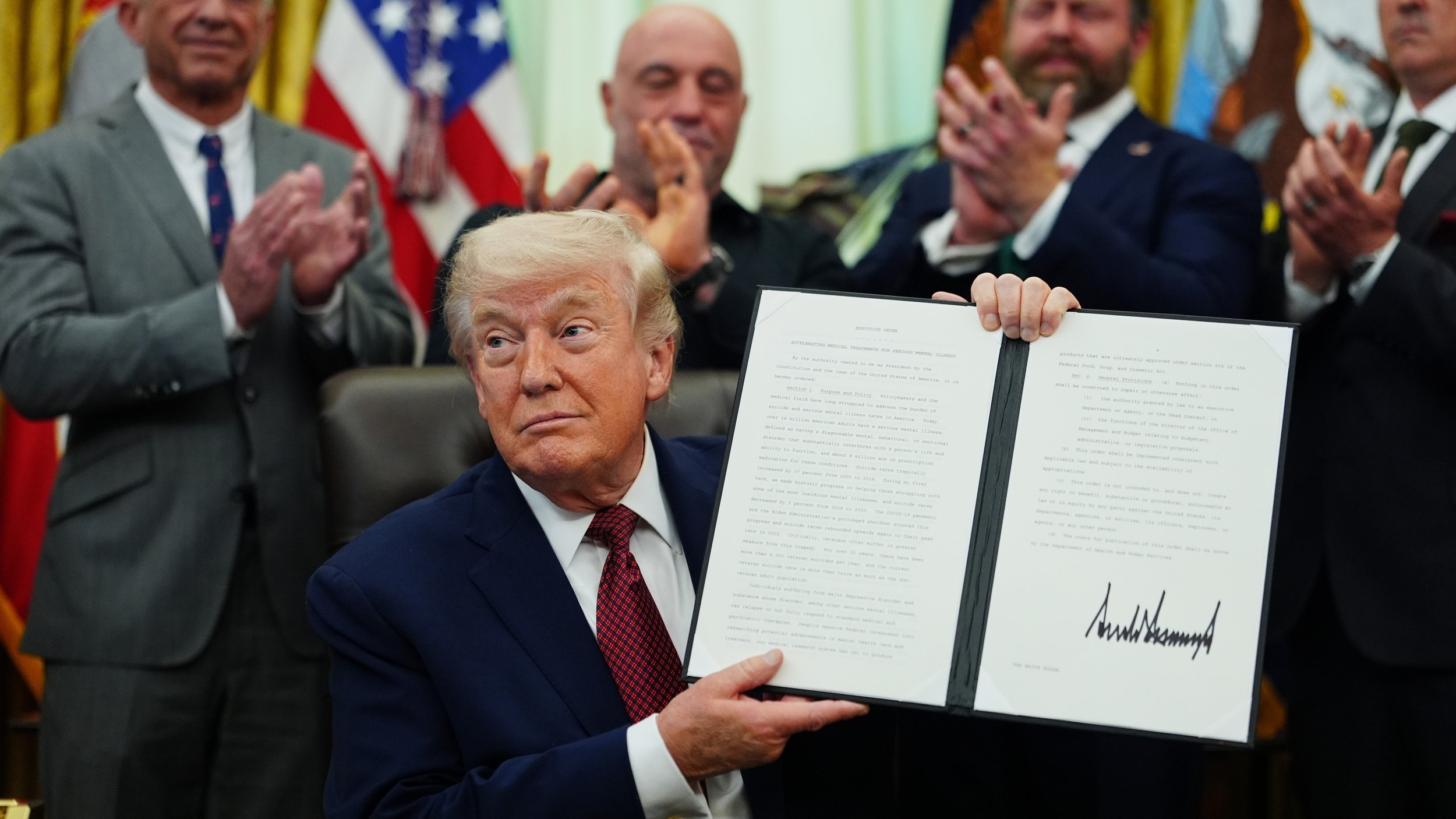
Joe Rogan leaned forward and described it plainly. He called it a “miracle drug,” pointing to claims that it could help people break opioid addiction at astonishing rates. Sitting nearby, Robert F. Kennedy Jr. listened with interest, recognizing both the urgency of the addiction crisis and the potential implications of such a treatment. Then, in a moment that reflects the speed at which modern decisions can be made, Donald Trump responded with characteristic directness: “Sounds great. Do you want FDA approval? Let’s do it.”
With that exchange, something that had long existed on the margins suddenly felt close to entering the mainstream. Ibogaine—once a fringe, controversial substance—was now part of a national conversation.
From Ceremony to Conversation
Outside of Washington, however, the reality of Ibogaine looks very different from the language of policy and approval. Traditionally, it is administered in a setting that feels less clinical and more ceremonial. The substance itself is often prepared as a thick, bitter mixture derived from the iboga plant, and in some traditions, its use is preceded by rituals in which practitioners seek permission from what they believe to be the spirit associated with the plant.
The experience is not casual. It is intense, prolonged, and deeply immersive. Those who undergo it often describe a process that unfolds over the course of one to three days. It begins with physical discomfort—nausea, heaviness, and a sense that the body is resisting what is about to happen. From there, the experience shifts into something far more complex.
Participants frequently report entering a state that resembles a waking dream. Memories emerge not as distant recollections but as vivid, fully formed scenes. Individuals revisit moments from their past, sometimes beginning with early childhood, and in some cases, even earlier experiences that they interpret as pre-birth or womb-related memories. The progression can feel chronological, as if one is walking through an entire life story with unusual clarity and detail.
What distinguishes this experience from ordinary memory is the sense of detachment. Rather than being overwhelmed by emotion, individuals often describe observing their past from a third-person perspective. This distance appears to allow them to process events that previously felt too painful or complex to confront. In this state, many report a sense of acceptance and reconciliation with their past, as well as a release of emotional burdens that had persisted for years.
Why It Feels Like Healing
This is one reason Ibogaine has gained attention as a potential treatment for addiction and trauma. From a neurological perspective, addiction—particularly to opioids—can fundamentally alter the brain’s reward system. Substances like heroin or oxycodone flood the brain with dopamine at levels far beyond what natural experiences can produce. Over time, the brain adapts by reducing its own ability to generate pleasure, creating a cycle in which the substance becomes necessary simply to feel normal.
Ibogaine appears to interact with the same regions of the brain involved in memory, emotion, and identity. By allowing individuals to revisit traumatic experiences from a detached perspective, it may help disrupt the patterns that sustain addiction and psychological distress. This capacity to interrupt deeply embedded loops is often cited as a reason for its reported effectiveness.
At a human level, this can feel like something more than treatment. When someone who has been trapped in addiction suddenly experiences clarity, distance from their pain, and the ability to process it without being overwhelmed, the result is often described in transformational terms. Words like “freedom,” “rebirth,” and “new life” are common—not because they are metaphorical, but because they feel literal to the person experiencing them.
The Experiences That Raise Questions

However, the experience is not limited to memory and emotional processing. Many participants also describe encounters that are more difficult to categorize within a purely neurological framework. These include interactions with what are perceived as guiding presences or entities. Some describe geometric or fractal-like beings that communicate through images, movement, or an intuitive transfer of understanding. Others report encountering figures that feel nurturing or instructive, sometimes described in terms such as “guides” or “teachers.”
What is particularly notable is the consistency of these reports. Across different individuals and settings, similar types of encounters are described. Moreover, comparable experiences have been reported in other altered states of consciousness, including those induced by different substances, intensive breathwork, and certain forms of meditation. This overlap raises questions that extend beyond chemistry and into the nature of perception and consciousness itself.
For many, these encounters are interpreted as meaningful and even beneficial. They can provide a sense of direction, understanding, or resolution. At the same time, they introduce a dimension to the experience that is not easily explained or measured, and that can shape how individuals interpret what has happened to them.
A Conversation Focused on Outcomes
As interest in Ibogaine grows, the public conversation has largely focused on its potential benefits. This is understandable. The opioid crisis continues to affect millions of people, and existing treatments are often limited in their effectiveness. Any substance that offers even the possibility of significant improvement is likely to generate attention and support.
In environments like the Oval Office, this conversation naturally centers on outcomes. Does it reduce addiction? Can it be studied? Should it be approved? These are practical and necessary questions, particularly when public health is at stake.
However, they do not fully capture the nature of the experience being discussed. If a treatment not only alters brain function but also introduces individuals to vivid, structured experiences that feel deeply personal or even spiritual, then its impact extends beyond biology. It begins to shape interpretation, belief, and meaning.
Looking Beneath the Surface
The structure of the Ibogaine experience itself is also worth examining. Many descriptions follow a similar pattern: a confrontation with one’s past, a sense of symbolic death or dissolution, a guided process of reflection or transformation, and a return with a renewed sense of life and identity. This sequence is powerful, and it resonates with broader human themes of change and renewal.
As Ibogaine moves closer to mainstream acceptance, the conversation surrounding it is likely to become more focused on measurable data—success rates, clinical trials, and regulatory pathways. These are essential components of responsible evaluation. At the same time, they do not fully address the experiential dimension that many participants report.
Ultimately, the emergence of Ibogaine into public awareness reflects a broader moment in which scientific inquiry, personal experience, and cultural narratives are intersecting. It highlights both the urgency of addressing addiction and the complexity of doing so through methods that extend beyond conventional frameworks.
The Question That Remains
The question, then, is not simply whether Ibogaine works, but how it works—and what accompanies that process. As with many developments that move rapidly from the margins to the center of attention, there is value in examining not only the outcomes but also the underlying experiences involved.
In the Oval Office, conversations tend to resolve quickly. Decisions are made, and momentum builds. Outside of it, the reality is more layered. And as this substance continues to move into the mainstream, those layers may prove just as important as the results themselves.